Barlow’s thirst for water justice rewarding

Advertisement

Advertise with us

It’s difficult to fathom that a water crisis exists in Canada. As a hyper-privileged person on this planet, the lack of this public good and basic necessity for life seems like a problem that other people have. Think Flint, Mich.; Cape Town, South Africa; Chile; Shoal Lake 40 First Nation. Many Canadians live under the illusion that clean drinking water is in abundance, that it is somehow protected from the greedy reach of corporations and that we have designed a system of governance to ensure that we all have access to this most basic need.

Read this article for free:


or

Already have an account? Log in here »

To continue reading, please subscribe:

Subscribe and receive a limited-edition Free Press branded hat or tote.

Digital Subscription

One year of digital access for only $205*

  • Enjoy unlimited reading on winnipegfreepress.com
  • Read the E-Edition, our digital replica newspaper
  • Access News Break, our award-winning app
  • Play interactive puzzles

*First annual payment billed as $205.00 + GST for one year. This annual subscription will automatically renew at $233.00 + GST every 52 weeks (10% off the regular annual price of $259.35). Offer available to new and qualified returning subscribers only. Cancel any time.

To continue reading, please subscribe:

Add Free Press access to your Brandon Sun subscription for only an additional

$1 for the first 4 weeks*

  • Enjoy unlimited reading on winnipegfreepress.com
  • Read the E-Edition, our digital replica newspaper
  • Access News Break, our award-winning app
  • Play interactive puzzles
Start now

*Your next Brandon Sun subscription payment will increase by $1.00 and you will be charged $17.95 plus GST for four weeks. After four weeks, your payment will increase to $24.95 plus GST every four weeks.

Hey there, time traveller!
This article was published 21/09/2019 (2559 days ago), so information in it may no longer be current.

It’s difficult to fathom that a water crisis exists in Canada. As a hyper-privileged person on this planet, the lack of this public good and basic necessity for life seems like a problem that other people have. Think Flint, Mich.; Cape Town, South Africa; Chile; Shoal Lake 40 First Nation. Many Canadians live under the illusion that clean drinking water is in abundance, that it is somehow protected from the greedy reach of corporations and that we have designed a system of governance to ensure that we all have access to this most basic need.

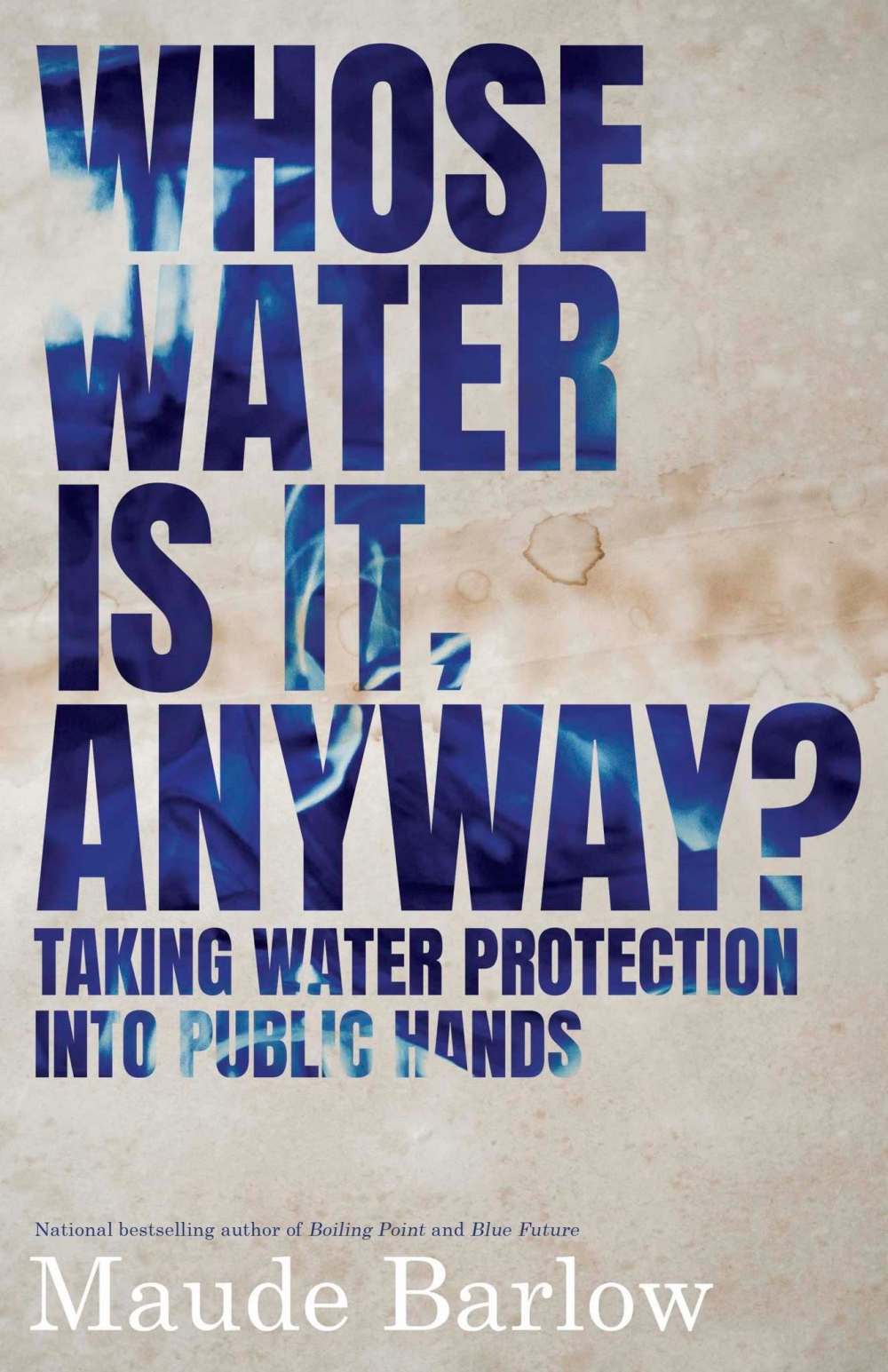
But we couldn’t be more wrong. And thanks to Maude Barlow, a hero in the Canadian and global progressive movement and a founding member of the Council of Canadians, the battle to ensure our global thirst is quenched is ratcheting up. In Whose Water Is It, Anyway?: Taking Water Protection Into Public Hands, Barlow passionately describes the history of how water, on a global scale, has been systematically transformed from a public good to an economic commodity — right under our noses.

Through the development of international trade deals and the neoliberal forces that brought in waves of privatization in the 1980s and ’90s, Barlow succinctly connects the dots as to how powerful global entities such as the World Bank and the World Water Forum began to push a global agenda that saw even the UN support the ideological position that water should be bought and sold like any other product. The old story that the free market will somehow manage to produce just and efficient pathways of distribution of resources pervaded and persists.
Barlow describes the global movement of resistance that took place during the ’90s and early 2000s that sought (and continues to seek) to ensure that water is protected and that it is viewed as a fundamental human right. Through the leadership and determination of humans across the planet, Barlow notes that the UN General Assembly finally, in 2015, “recognized water and sanitation as two distinct rights in yet another unanimously adopted resolution.”

But as we all know, talk is cheap, and UN resolutions often can be devalued and become inflationary. This is not lost on Barlow, who argues that “there will always be a need for the grassroots to bridge political debates into everyday reality.” This is the essence of democracy, global citizenship and cosmopolitanism.

And for Barlow, this democratic and grassroots engagement has manifested itself in the Blue Communities movement — a social justice movement designed to ensure that all humans have universal access to clean drinking water and that giant water corporations (like Nestlé, which pumps 4.7 million litres per day out of the aquifers surrounding Guelph for chump change) are denied access to our water. You only have to recall (or Google) the eerie interview with Nestlé CEO Peter Brabeck-Letmathe to understand what is at stake in terms of the sinister intentions of multinational corporations who salivate at the scarcity of water.

And it is through the grassroots Blue Communities movement that resistance to the privatization of water is achieved. Barlow describes the powerful examples throughout the world of how communities have stomped on the private control of water and taken back their right to clean drinking water and proper sanitation. Through positive activism, many community groups, schools, churches, youth, seniors and concerned citizens are engaged in this fight to ensure a sustainable and ethical source of drinking water for everyone on planet Earth.

Fortunately, Barlow provides a blueprint for the work and pathway for hope. She carves out a starting point for Manitobans and Canadians who care deeply about the fate of all our neighbours, our waterways and all species and systems on planet Earth. Time is of the essence, and the time for moral courage is nigh. As Bolivian activist and shoemaker Oscar Olivera asserts, “I would rather die of a bullet than thirst.”

Matt Henderson is assistant superintendent of Seven Oaks School Division.
Report Error Submit a Tip

More Stories

Barlow’s thirst for water justice rewarding

Reviewed by Matt Henderson 4 minute read Preview

Barlow’s thirst for water justice rewarding

Reviewed by Matt Henderson 4 minute read Saturday, Sep. 21, 2019

It’s difficult to fathom that a water crisis exists in Canada. As a hyper-privileged person on this planet, the lack of this public good and basic necessity for life seems like a problem that other people have. Think Flint, Mich.; Cape Town, South Africa; Chile; Shoal Lake 40 First Nation. Many Canadians live under the illusion that clean drinking water is in abundance, that it is somehow protected from the greedy reach of corporations and that we have designed a system of governance to ensure that we all have access to this most basic need.

But we couldn’t be more wrong. And thanks to Maude Barlow, a hero in the Canadian and global progressive movement and a founding member of the Council of Canadians, the battle to ensure our global thirst is quenched is ratcheting up. In Whose Water Is It, Anyway?: Taking Water Protection Into Public Hands, Barlow passionately describes the history of how water, on a global scale, has been systematically transformed from a public good to an economic commodity — right under our noses.

Through the development of international trade deals and the neoliberal forces that brought in waves of privatization in the 1980s and ’90s, Barlow succinctly connects the dots as to how powerful global entities such as the World Bank and the World Water Forum began to push a global agenda that saw even the UN support the ideological position that water should be bought and sold like any other product. The old story that the free market will somehow manage to produce just and efficient pathways of distribution of resources pervaded and persists.

Barlow describes the global movement of resistance that took place during the ’90s and early 2000s that sought (and continues to seek) to ensure that water is protected and that it is viewed as a fundamental human right. Through the leadership and determination of humans across the planet, Barlow notes that the UN General Assembly finally, in 2015, “recognized water and sanitation as two distinct rights in yet another unanimously adopted resolution.”

Read
Saturday, Sep. 21, 2019

Disgraced former law dean arrested, facing extradition to Canada

Morgan Modjeski 2 minute read Preview

Disgraced former law dean arrested, facing extradition to Canada

Morgan Modjeski 2 minute read Updated: 9:17 AM CDT

Jonathan Black-Branch, the disgraced former dean of law at the University of Manitoba, has been arrested in Europe and is awaiting extradition to Canada on fraud charges, Winnipeg police say.

Black-Branch, who failed to defend himself in a lawsuit filed by the U of M and his disbarment proceedings, was ordered in May 2025 to repay more than $682,000 in misspent expense funds.

Winnipeg police confirmed his arrest and pending extradition Wednesday morning. “The extradition process is ongoing,” police said.

Black-Branch left the university in 2020 amid allegations he had misspent public dollars and schemed to evade oversight while running Robson Hall from 2016 to 2020.

Read
Updated: 9:17 AM CDT

Health Canada suspends plasma collection at Grifols Taylor Avenue clinic

Chris Kitching 3 minute read Preview

Health Canada suspends plasma collection at Grifols Taylor Avenue clinic

Chris Kitching 3 minute read 1:59 PM CDT

Health Canada has suspended all plasma collection at Grifols’ Taylor Avenue facility while the private company continues to face scrutiny after two people died following donations at its Winnipeg clinics.

The suspension was issued Wednesday, although Grifols announced Aug. 13 it was pausing plasma collection in Canada a day after the federal department gave the Taylor Avenue site a non-compliant rating.

“Health Canada issued the suspension because Grifols had not effectively implemented some corrective and preventive actions and, overall, it failed to demonstrate that the Taylor Avenue site has implemented an effective quality management system,” the department said in a statement.

The Free Press has contacted Grifols for comment.

Read
1:59 PM CDT

Decorated business vet Spiring announced as NSL Winnipeg president

Grace Anne Paizen 5 minute read Preview

Decorated business vet Spiring announced as NSL Winnipeg president

Grace Anne Paizen 5 minute read Updated: Yesterday at 12:30 PM CDT

Manitoba’s own Dayna Spiring is no stranger to the sports world, but her latest venture into the world of football — this time of the kick-about variety — is a whole new ball game.

“I’m getting up to speed on that as quickly as I can,” Spiring told the Free Press Tuesday, shortly after the accomplished business leader was announced as Northern Super League Winnipeg’s president.

Spiring joins an already stacked roster on the first women’s professional sports team in the Keystone province alongside the likes of NSL Winnipeg’s decorated co-founders Desiree Scott and Rob Gale.

And her own stats sheet is just as historic. Spiring was one of the first women to serve on the CFL’s Board of Governors and was the first woman to serve as chair of the Winnipeg Football Club’s board of directors. She is also the first woman to have her name engraved on the Grey Cup when the Winnipeg Blue Bombers captured back-to-back titles in 2019 and 2021.

Read
Updated: Yesterday at 12:30 PM CDT

Manitoba budget reveals province underspent on crucial departments related to justice, public safety

Carol Sanders 5 minute read Preview

Manitoba budget reveals province underspent on crucial departments related to justice, public safety

Carol Sanders 5 minute read Updated: 8:09 AM CDT

While concerns about homelessness and public safety continue to make headlines in Manitoba, the two government departments mainly responsible for addressing them came in under budget last year.

The 2025-26 public accounts, released Monday, show Housing, Addictions and Homelessness underspent its budget of $869 million by $18 million. Manitoba Justice underspent its budget of $994 million by $34 million.

The 247-page public accounts report attributes the underspending in justice mainly to “reduced impacts of contingency liabilities,” such as a court ruling or legal settlement.

The report did not explain how and why Housing, Addictions and Homelessness underspent its budget last year as the province addresses those critical issues.

Read
Updated: 8:09 AM CDT

Ignoring AI warning could be the death of us all

Pam Frampton 5 minute read Preview

Ignoring AI warning could be the death of us all

Pam Frampton 5 minute read 2:00 AM CDT

In the 7th century BC, the formative years of Greek literature, the poet Hesiod told the story of Pandora’s Box.

Read
2:00 AM CDT