Beautiful Berlin

Lutes's sprawling, cinematic graphic novel explores glitz of interwar Germany

Advertisement

Advertise with us

The heady mix of politics, culture and sex of the Weimar-era Berlin — the time period between the two world wars — has long been a source of fascination for writers and filmmakers. Jason Lutes’s long-awaited omnibus edition of Berlin adds a masterwork to this oeuvre in the form of a graphic novel.

Read this article for free:


By clicking the button above, an account will be created and you will begin to receive some of our recommended newsletters. You may opt out of any newsletter by visiting your Email and Communication Preferences page or by clicking "unsubscribe" at the bottom of any email.

or

Already have an account? Log in here »

To continue reading, please subscribe:

Digital Subscription

One year of digital access for only $1.44 a week*

  • Enjoy unlimited reading on winnipegfreepress.com
  • Read the E-Edition, our digital replica newspaper
  • Access News Break, our award-winning app
  • Play interactive puzzles

*Billed as $5.77 plus GST every four weeks. After 52 weeks, price increases to the regular rate of $19.95 plus GST every four weeks. Offer available to new and qualified returning subscribers only. Cancel any time.

To continue reading, please subscribe:

Add Free Press access to your Brandon Sun subscription for only an additional

$1 for the first 4 weeks*

  • Enjoy unlimited reading on winnipegfreepress.com
  • Read the E-Edition, our digital replica newspaper
  • Access News Break, our award-winning app
  • Play interactive puzzles
Start now

*Your next Brandon Sun subscription payment will increase by $1.00 and you will be charged $17.95 plus GST for four weeks. After four weeks, your payment will increase to $24.95 plus GST every four weeks.

Hey there, time traveller!
This article was published 13/10/2018 (2933 days ago), so information in it may no longer be current.

The heady mix of politics, culture and sex of the Weimar-era Berlin — the time period between the two world wars — has long been a source of fascination for writers and filmmakers. Jason Lutes’s long-awaited omnibus edition of Berlin adds a masterwork to this oeuvre in the form of a graphic novel.

This edition combines the 22 serialized issues of Lutes’s Berlin comics, previously collected in two separate volumes published in 2000 and 2008. The final third volume was being released at the same time as this complete edition. Lutes has spent the past 20 years on this project, and this lengthy gestation pays off in a historically nuanced, visually stunning and narratively complex graphic novel with lasting power.

Lutes is an American cartoonist who graduated with a BFA from the Rhode Island School of Design and then spent 10 years working in the vibrant Seattle comics scene for publisher Fantagraphics and the alternative weekly the Stranger. Since 2008, he has been a faculty member at the Centre for Cartoon Studies in White River Junction, Vt., which offers a master of fine arts and certificates in comics and graphic novels.

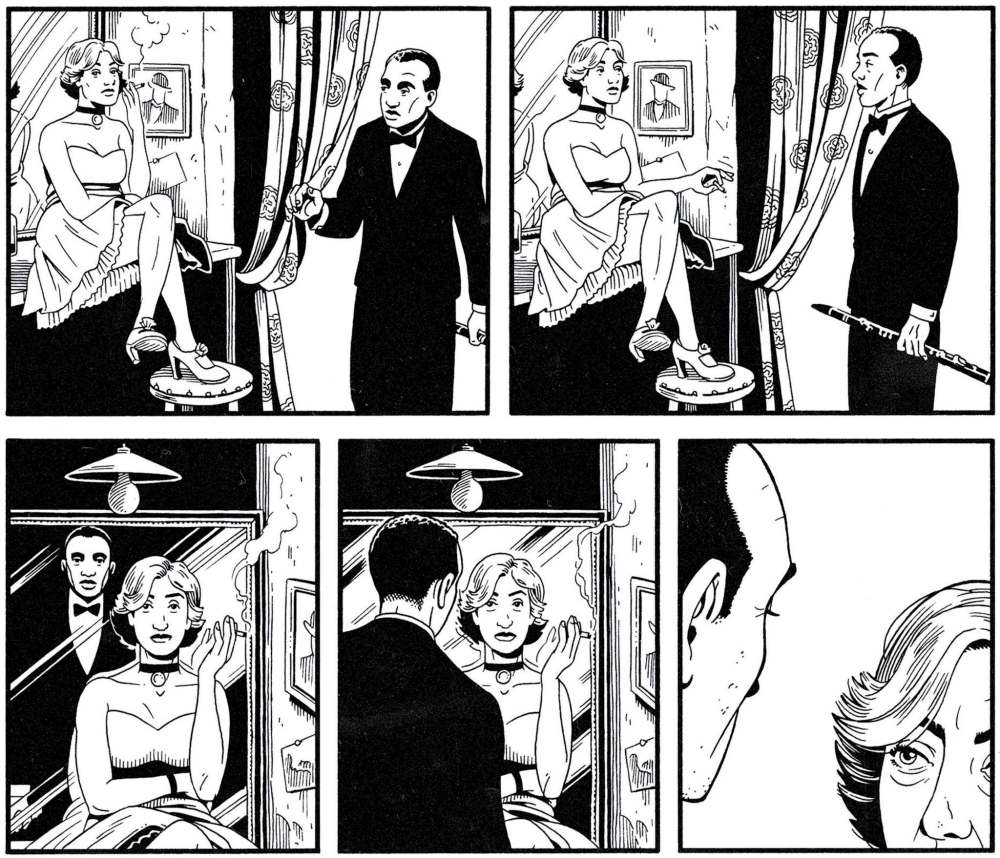
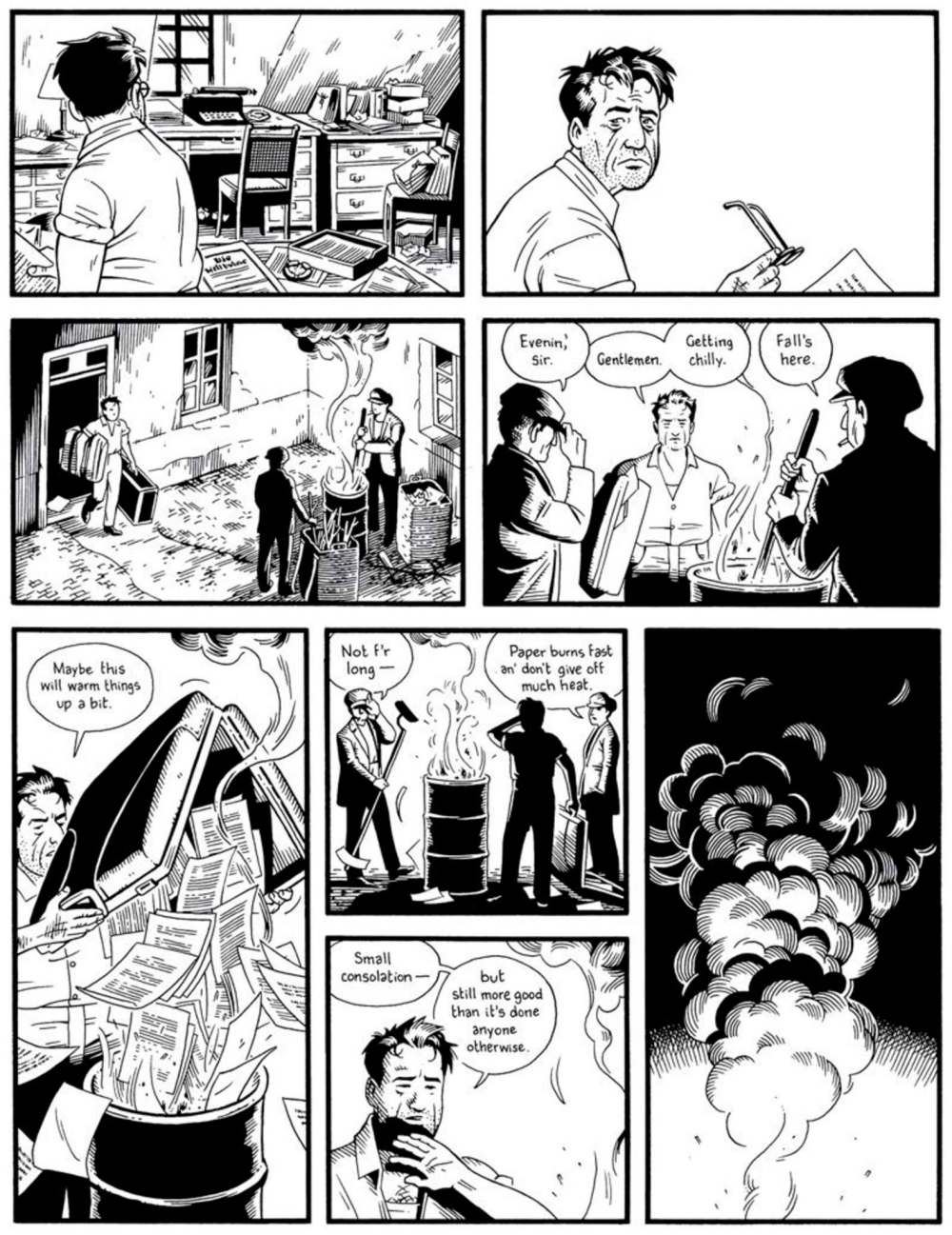
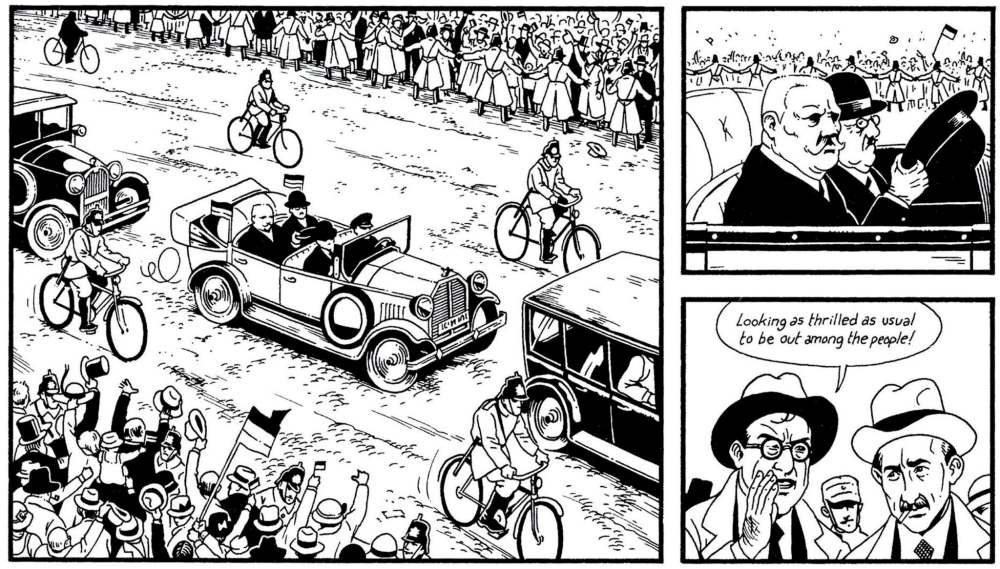
Lutes’s fine arts training and design skills are evident in every elegantly composed, meticulously rendered black-and-white panel. He adopts a cinematic, noir-ish visual style that echoes the Weimar films of Fritz Lang and a kaleidoscopic narrative approach he admits is indebted to Alfred Döblin’s 1929 novel Berlin Alexanderplatz.

There are three main character groups whose stories Lutes follows from 1928 to 1933. The graphic novel begins with art student Marthe Müller’s arrival from provincial Cologne and her chance encounter with the jaded left-wing newspaper journalist Kurt Severing. They eventually become lovers, but their relationship is complicated by Kurt’s wealthy ex-lover, Margarethe, and Marthe’s transgender best friend, Anna.

A second main storyline follows a working-class family tragically divided between communism and Nazism. Through them, Lutes introduces key historical events, including the bloody 1929 May Day demonstrations and the electoral victory of the National Socialists in 1930. Most of the characters are fictional, but some historical figures also appear, including Joseph Goebbels, Adolf Hitler and 1935 Nobel Peace Prize winner Carl von Ossietzky, whose exposure of clandestine German re-armament led to his arrest and death in Gestapo custody.

Another plotline about a visiting African-American jazz quartet features real-life dancer Josephine Baker. Lutes also folds in a variety of minor characters to represent the cosmopolitan world of Weimar Berlin, taking care to represent the Jewish community as culturally and economically diverse. Female characters are equally strong and multifaceted, from the wealthy heiress to the radical Communist to the cabaret performers and sex workers.

Even when they only appear in a few panels, Lutes’s expressive linework and subtle facial expressions convey the characters’ back stories and present dilemmas with devastating clarity. He also exploits the simultaneity of comics when he inserts Marthe’s letters in text boxes over the events she describes and draws crowd scenes with thought balloons over each person to reveal their largely banal inner lives.
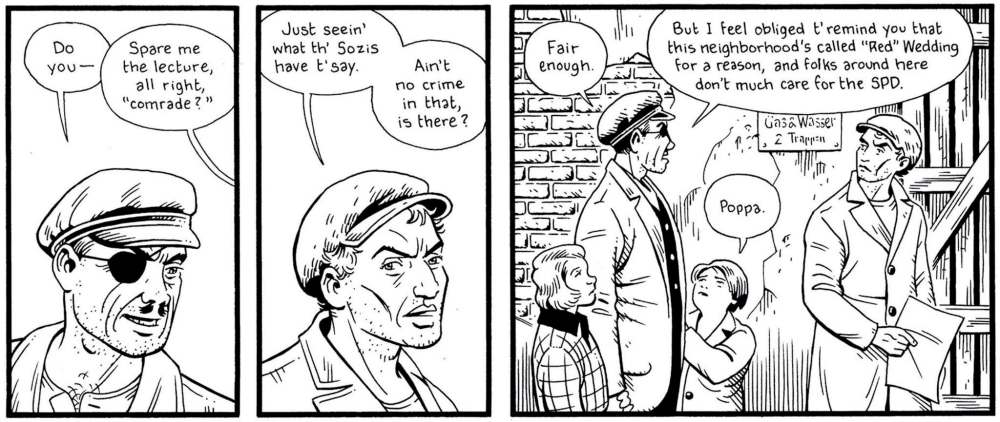
Most strikingly, Lutes doesn’t fetishize the surface glitz of this era. He draws characters realistically, both emotionally and physically, and takes us through the squalid areas of the city as well as the halls of power.

In keeping with the long history of screen culture’s fascination with Weimar Berlin, from the 1972 film Cabaret to the recent German television series Babylon Berlin, Lutes frames all of the human drama as a product of the living city. His precise line drawings of Berlin’s streets, parks, office buildings, tenements, restaurants, and nightclubs — all criss-crossed by cars, buses, and trains — invite us to linger on the scenes contemplatively even as they pull us into the feverish action.

Berlin is a big book in every sense, an epic narrative drawn over many compelling pages and a landmark of contemporary historical fiction that uses the form of comics to bring that past alive.

Candida Rifkind is an associate professor in the department of English at the University of Winnipeg, where she teaches and researches comics, graphic narratives and Canadian literature and culture.
Supplied
Supplied
Report Error Submit a Tip

More Stories

Another strong outing from Skinner, but Jets unable to lock down lead

Ken Wiebe 7 minute read Preview

Another strong outing from Skinner, but Jets unable to lock down lead

Ken Wiebe 7 minute read Updated: Yesterday at 9:46 AM CDT

DALLAS — Stuart Skinner did everything in his power to ger the Winnipeg Jets back in the win column.

A 35-save effort included plenty of highlight-reel moments, but the Jets were unable to lock down a lead late in the third period and lost 3-2 in overtime to the Dallas Stars on Thursday at American Airlines Center.

“Stu kind of got us a point there, to be honest with you,” said Jets forward Gabriel Vilardi. “They were better than us. Their structure, they played a really tight checking game, and we couldn’t really get much going offensively. They obviously outplayed us, and when you give up that many chances, eventually, Stu can’t stop everything.”

Both of the goals the Jets allowed in regulation came with Stars goalie Jake Oettinger on the bench in favour of an extra attacker — once on a delayed penalty call during the third period and then with two minutes to go in the third period when Mikko Rantanen found Roope Hintz alone in the slot.

Read
Updated: Yesterday at 9:46 AM CDT

Alberta: More federalist than you thought

David McLaughlin 5 minute read Preview

Alberta: More federalist than you thought

David McLaughlin 5 minute read 2:02 AM CDT

Avert your eyes if you don’t like hard-core. This is a hard-core column about the hard-core Alberta separatists who hijacked a party, corrupted a process and failed in their fevered fervour to break up Canada.

First, be of good cheer. Canada won Monday night’s referendum in Alberta. Decisively. Three-quarters of the votes cast were for Option 1: “Alberta should remain a province of Canada.” Only one in four Alberta voters opted for a referendum on separation.

Alberta won, too. That strong vote against separation means the province can look ahead, confident the independence fever dream is boxed. A true win-win and a sad rarity in politics these days.

Be warned, though. Those hard-core separatists are hard dogs to keep on the porch, as the expression goes. They are already agitating to be taken more seriously than the votes warrant. They intend to flex whatever muscle memory remains to depose Premier Danielle Smith from her leadership of the United Conservative Party. Dis-united Conservative Party, anyone?

Read
2:02 AM CDT

Down-to-earth diner fuses Filipino flavours, family and fortitude

David Sanderson 8 minute read Preview

Down-to-earth diner fuses Filipino flavours, family and fortitude

David Sanderson 8 minute read 2:00 AM CDT

There is a photomontage on one wall of Charlee’s Restaurant & Lounge devoted entirely to enduring Elmwood businesses such as the Thirsty Duck Café, Kool Deelites, Bath Fitter and Video Cellar.

Little did Charlee’s owner Charlie Villapando know as he was stringing the black-and-white shots together that his no-nonsense, homestyle diner at 185 Stadacona St. would grow to be a pillar of the working-class community, as well.

It was definitely a struggle for the first year and a half, Villapando admits, seated inside the 160-seat establishment that will toast its 20th anniversary in December. Besides relying largely on friends and family members who were willing to wait on tables for free, he was alone in the kitchen for 15 hours a day, seven days a week.

“I can’t tell you how many times I slept here on four chairs pushed together, simply because it would be 2 a.m. by the time I was done cleaning and whatnot, leaving just a few hours before I had to be back for breakfast,” he continues, casually dressed in jeans, sneakers and a dark cotton hoodie. “Thinking about it now, I probably should have put a cot in my office, except I never wanted to make it too comfortable. Thankfully, more people started to find us, I was finally able to afford staff and here we are, almost 20 years later, with me sleeping much better.”

Read
2:00 AM CDT

Letters, Oct. 24

6 minute read 2:02 AM CDT

A little background info

Re: Bring Power Smart home (Think Tank, Oct. 21)

Steven Fletcher’s op-ed column overlooks important history behind Efficiency Manitoba and the need to reconsider its targets.

In December 2003, Gary Doer’s NDP government announced plans for a separate agency to co-ordinate energy efficiency, water conservation and waste reduction. Provisionally named Efficiency Manitoba in 2004, the initiative became Green Manitoba, a special operating agency launched in April 2006.

Province orders ban on private teacher-student messaging

Maggie Macintosh 4 minute read Preview

Province orders ban on private teacher-student messaging

Maggie Macintosh 4 minute read Updated: Yesterday at 6:14 PM CDT

Manitoba teachers are no longer allowed to text or use social media to contact a student – regardless of whether they coach a school sports team or supervise other activities outside typical instruction times.

Read
Updated: Yesterday at 6:14 PM CDT

With 18,000 students in 59 government-funded schools, independent schools are playing an increasingly important role in Manitoba.

Many of these schools are religious schools like The King’s School, Dasmesh School, Springs Christian Academy, Mennonite Brethren Collegiate Institute, Beautiful Saviour Lutheran School, Linden Christian School, Steinbach Christian School and IQRA Islamic School.

On its website, the provincial government says it “strongly supports the rights of parents and guardians to choose their child’s education. Parents choose independent schools for reasons such as faith, philosophy of teaching and learning, and tradition.”

This is quite a contrast to 110 years ago. That’s when the province passed the School Attendance Act of 1916 as a way, during wartime, to promote integration and social cohesion.