Canada complicit in Vietnam War effort

Advertisement

Advertise with us

Canada has been working tremendously hard as of late to return to the prestigious and strategic table of the UN Security Council. During the gloomy Stephen Harper days, many moaned when we lost out to Portugal, lamenting our tarnished reputation. But last year, despite a kinder and gentler leadership, Canada again lost its bid for a seat. And this time with fewer votes.

Read this article for free:


or

Already have an account? Log in here »

To continue reading, please subscribe:

Subscribe and receive a limited-edition Free Press branded hat or tote.

Digital Subscription

One year of digital access for only $205*

  • Enjoy unlimited reading on winnipegfreepress.com
  • Read the E-Edition, our digital replica newspaper
  • Access News Break, our award-winning app
  • Play interactive puzzles

*First annual payment billed as $205.00 + GST for one year. This annual subscription will automatically renew at $233.00 + GST every 52 weeks (10% off the regular annual price of $259.35). Offer available to new and qualified returning subscribers only. Cancel any time.

To continue reading, please subscribe:

Add Free Press access to your Brandon Sun subscription for only an additional

$1 for the first 4 weeks*

  • Enjoy unlimited reading on winnipegfreepress.com
  • Read the E-Edition, our digital replica newspaper
  • Access News Break, our award-winning app
  • Play interactive puzzles
Start now

*Your next Brandon Sun subscription payment will increase by $1.00 and you will be charged $17.95 plus GST for four weeks. After four weeks, your payment will increase to $24.95 plus GST every four weeks.

Hey there, time traveller!
This article was published 17/07/2021 (1854 days ago), so information in it may no longer be current.

Canada has been working tremendously hard as of late to return to the prestigious and strategic table of the UN Security Council. During the gloomy Stephen Harper days, many moaned when we lost out to Portugal, lamenting our tarnished reputation. But last year, despite a kinder and gentler leadership, Canada again lost its bid for a seat. And this time with fewer votes.

For many Canadians, history and myth become blurred when we think of our international reputation. We recall the halcyon days of prime minister Lester B. Pearson, the Blue Helmets, the Universal Declaration of Human Rights and peacekeeping. But perhaps, like all memory, our historic recollection is fraught with story and legend rather than the hard truth.

Such is the task of historians, popular and academic alike. John Boyko, author of Blood and Daring and Cold Fire, confronts Canada’s dubious complicity in international conflict through his investigation of our participation in the Vietnam War.
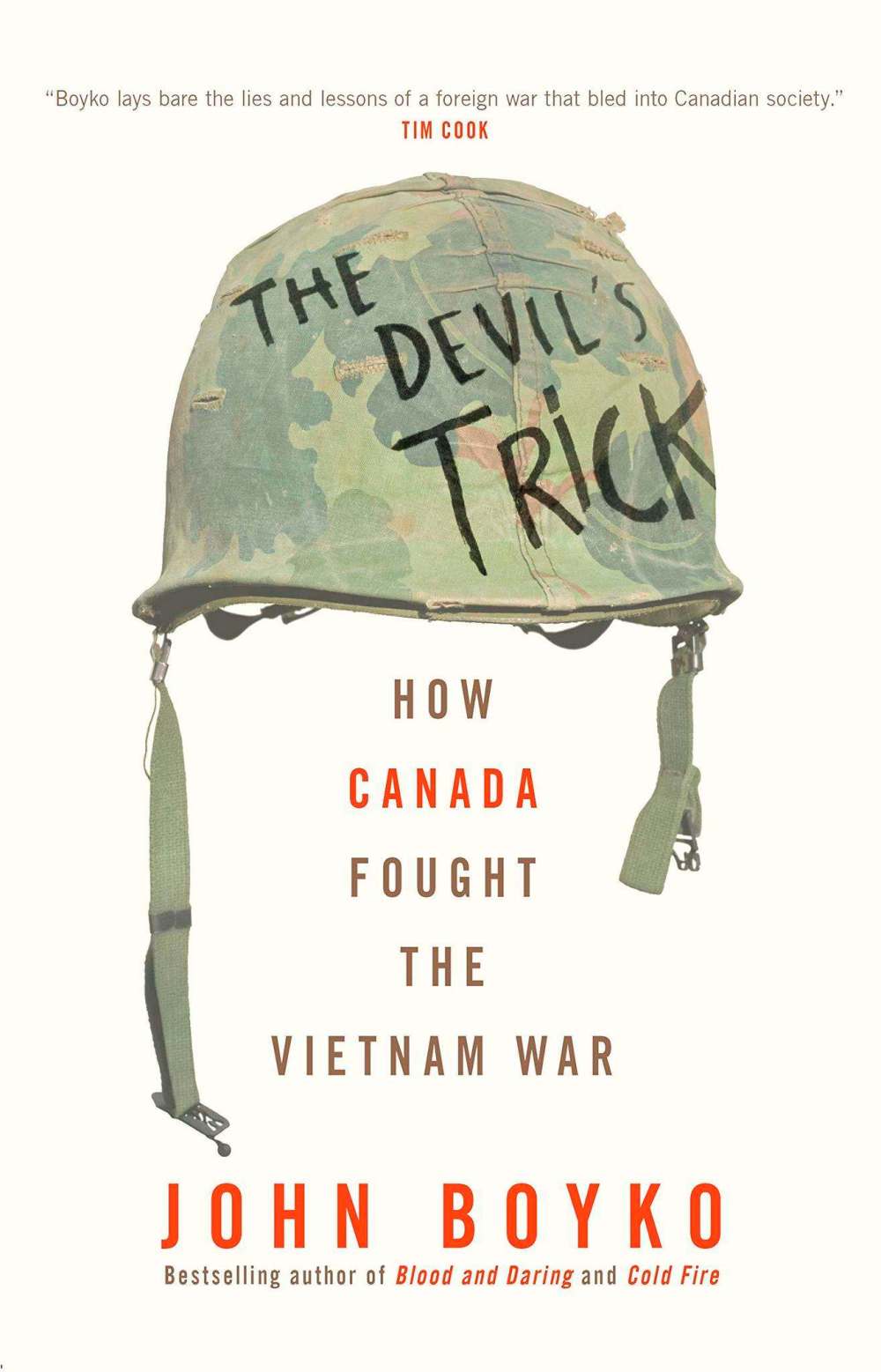
In The Devil’s Trick: How Canada Fought the Vietnam War, Boyko reveals that even in the heyday of the Liberal Party’s international influence under Pearson and Louis St. Laurent, our struggle to reconcile economic growth with moral action persisted.

Methodologically, Boyko uses the stories of six individuals to tell the story of how Canada supported the war effort, conspired with the CIA, sold arms and resources as a means to profit from the war, welcomed and then despised draft dodgers and deserters, and held similar views of refugees who were fleeing the horrors of Vietnam.

Through the stories of two diplomats, Sherwood Lett and Blair Seaborn, Boyko explains how Canada reluctantly became involved in the conflict, due mostly to the gravitational pull of allyship. Coming out of the Second World War, Canada enjoyed what Boyko describes as a “quiet diplomacy,” but Vietnam was about to force Canada, St. Laurent and Pearson to make significant decisions that were not only ideological but moral in nature.

Despite Canada’s urging in the 1950s for the Americans and the international community not to become further involved in the conflict, U.S. president John F. Kennedy’s (and later Lyndon Johnson’s) obsession with the domino theory proved to be a runaway train.

Despite secret dispatches of Canadian diplomats to sue for peace with Ho Chi Minh, the Americans were determined to prop up phony governments in the South and eradicate a communist foe in the North. Canada would be drawn into the horrifying conflict, despite the pleas of the likes of diplomat J. Blair Seaborn: “If we are not doing anything really useful, why do we not pull out, if need be, unilaterally?”

Boyko then shifts his focus to other personalities, namely the radical nurse Claire Culhane, who served in a hospital in South Vietnam while at the same time observing how Canada was handing over medical records to the CIA. Disgusted, Culhaine returned to Canada, held a famous hunger strike and even met with then-prime minister Pierre Trudeau to register her abhorrence to our complicity in war profiteering.

“All cabinet members knew for decades Canada had been swapping sovereignty or security and principle for jobs, but the Faustian bargain was acceptable when the threats and wars were believed to be just,” Boyko reveals.

Despite pressure from the likes of Tommy Douglas and David Lewis, critical voices when even unpopular, the Liberal governments chose economics time and time again — this despite the fact that the war machine produced nearly 6,000 jobs in Winnipeg and draft dodgers like Joe Erickson were able to start a new life in St. Vital. War is complex. War is hell. Even at home.

According to Boyko, as history now tends to rhyme with itself, à la Mark Twain, “Vietnam buried what remained of Canada’s golden age.” If it ever existed. Now as we supply Saudi Arabia with munitions for its exploits in Yemen and are caught up in America’s request for extraditions, we need to find a new moral stance

As Boyko argues, our task may be to “understand who we are and to somehow, hopefully with grace, make ourselves a little better tomorrow than we are today.” And this might in fact be the purpose of history.

Matt Henderson is assistant superintendent of Seven Oaks School Division.
Report Error Submit a Tip

More Stories

Psychologist sentenced to house arrest after affair with patient

Dean Pritchard 5 minute read Updated: Yesterday at 5:31 PM CDT

A psychologist who didn’t disclose her sexual affair with a mental-health patient under her care when she testified on his behalf before the Criminal Code Review Board has been sentenced to 18 months house arrest.

“The offence represents a significant affront to the administration of justice,” provincial court Judge Kusham Sharma said at a sentencing hearing for woman earlier this week.

A court-order bars the publication of details that could identify those involved in the case, after the patient pleaded guilty in 2024 to criminally harassing the psychologist’s husband. The patient has anti-social and borderline personality disorders with psychopathic traits.

Sharma convicted the woman last March of one count each of breach of trust by a public official and attempting to obstruct justice.

Spotty service, U.S. roaming charges leave Somerset woman calling for answers

Nicole Buffie 6 minute read Preview

Spotty service, U.S. roaming charges leave Somerset woman calling for answers

Nicole Buffie 6 minute read Wednesday, Aug. 12, 2026

A southwestern Manitoba woman is voicing her concerns about cell service in the area after she was billed more than $100 in U.S. roaming charges despite never leaving her community.

Teresa Acheson received a notification on her phone Monday at about 7:30 a.m. saying she had entered the United States and would be charged $13 per day for unlimited calls and text messages.

The only problem is that she was not in the U.S. She was lying in bed at her home near Somerset, some 50 kilometres away from the U.S. border.

“People have said to watch if you’re driving close to the border because you’ll get dinged, but I was sitting at home,” she said Wednesday.

Read
Wednesday, Aug. 12, 2026

Manitoba supports MAID delay: Asagwara

Carol Sanders 5 minute read Preview

Manitoba supports MAID delay: Asagwara

Carol Sanders 5 minute read 2:00 AM CDT

The number of Manitobans receiving medical assistance in dying in 2026 is on track with previous years while the plan to extend it to those suffering from mental illness is delayed indefinitely by the federal government — a move Manitoba’s health minister supports.

“There’s so much more work that needs to be done,” Uzoma Asagwara said.

The parliamentary committee that issued its recommendation in June was the third special committee of Parliament struck to assess the eligibility of people with mental illness since 2021, when MAID eligibility was expanded to include people who were not at the end of their lives.

A key condition for MAID eligibility is that a patient must be suffering from a grievous and irremediable medical condition.

Read
2:00 AM CDT

PCs say Hutterite colonies singled out by Bill 21

Alex Lambert 4 minute read Preview

PCs say Hutterite colonies singled out by Bill 21

Alex Lambert 4 minute read 2:01 AM CDT

SOURIS — Members of Hutterite colonies in the province took aim at the NDP government’s proposed changes to drinking water legislation during a public meeting Thursday in Souris.

The meeting was hosted by Progressive Conservative MLA Colleen Robbins (Spruce Woods) to hear from rural residents about their concerns over Bill 21, which the government says will improve oversight on wells and other water systems in the province.

“There’s not enough clarity, but I feel that the overreach that this bill will bring is not clearly defined, and it could have a lot of negative consequences,” attendee Gilbert Hofer, a member of Green Acres colony near Wawanesa, said after the meeting, which drew about 20 people.

The legislation would allow public health officers to designate the type of water source based on its intended use, water quality and use duration rather than solely the number of connections it has.

Read
2:01 AM CDT

Canada complicit in Vietnam War effort

Reviewed by Matt Henderson  4 minute read Preview

Canada complicit in Vietnam War effort

Reviewed by Matt Henderson  4 minute read Saturday, Jul. 17, 2021

Canada has been working tremendously hard as of late to return to the prestigious and strategic table of the UN Security Council. During the gloomy Stephen Harper days, many moaned when we lost out to Portugal, lamenting our tarnished reputation. But last year, despite a kinder and gentler leadership, Canada again lost its bid for a seat. And this time with fewer votes.

For many Canadians, history and myth become blurred when we think of our international reputation. We recall the halcyon days of prime minister Lester B. Pearson, the Blue Helmets, the Universal Declaration of Human Rights and peacekeeping. But perhaps, like all memory, our historic recollection is fraught with story and legend rather than the hard truth.

Such is the task of historians, popular and academic alike. John Boyko, author of Blood and Daring and Cold Fire, confronts Canada’s dubious complicity in international conflict through his investigation of our participation in the Vietnam War.

In The Devil’s Trick: How Canada Fought the Vietnam War, Boyko reveals that even in the heyday of the Liberal Party’s international influence under Pearson and Louis St. Laurent, our struggle to reconcile economic growth with moral action persisted.

Read
Saturday, Jul. 17, 2021

Europe anxious as ever about immigration

Kyle Volpi Hiebert 5 minute read 2:00 AM CDT

It was only a matter of time before immigration would again panic Europe. The issue has roiled the continent’s politics ever since its 2015 migrant crisis, when 1.3 million unauthorized migrants crossed its borders that summer. They exposed a broken immigration system in the process, triggering a populist backlash that hasn’t dimmed.

All those same tensions were reignited in late July, when 72,000 migrants converged on the Spanish exclave of Ceuta in just 24 hours. The city — a holdover from Spain’s colonial era — is Europe’s only land border with Africa, nestled next to Morocco. It was almost instantly overrun.

Dozens of people died in the chaos, while the reasons for the sudden influx remain unknown. However, virtually all the arrivals were sent back to Morocco almost immediately; some spent a few days in makeshift holding centres. None were recorded as finding their way to mainland Europe.

Still, the episode inflamed divisions in a region caught in existential limbo. Ultranationalist political parties are ascendant — yet low birth rates and stagnant productivity mean Europe’s future largely hinges on accepting more newcomers.