Fictional trio leave civilization behind in dense dystopian drama
Doctorow goes off the grid

Advertisement
Read this article for free:
or
Already have an account? Log in here »
To continue reading, please subscribe:

Digital Subscription
One year of digital access for only $205*
- Enjoy unlimited reading on winnipegfreepress.com
- Read the E-Edition, our digital replica newspaper
- Access News Break, our award-winning app
- Play interactive puzzles
*First annual payment billed as $205.00 + GST for one year. This annual subscription will automatically renew at $233.00 + GST every 52 weeks (10% off the regular annual price of $259.35). Offer available to new and qualified returning subscribers only. Cancel any time.
To continue reading, please subscribe:
Add Free Press access to your Brandon Sun subscription for only an additional
$1 for the first 4 weeks*
- Enjoy unlimited reading on winnipegfreepress.com
- Read the E-Edition, our digital replica newspaper
- Access News Break, our award-winning app
- Play interactive puzzles
*Your next Brandon Sun subscription payment will increase by $1.00 and you will be charged $17.95 plus GST for four weeks. After four weeks, your payment will increase to $24.95 plus GST every four weeks.
Read unlimited articles for free today:
or
Already have an account? Log in here »
Hey there, time traveller!
This article was published 13/05/2017 (3389 days ago), so information in it may no longer be current.
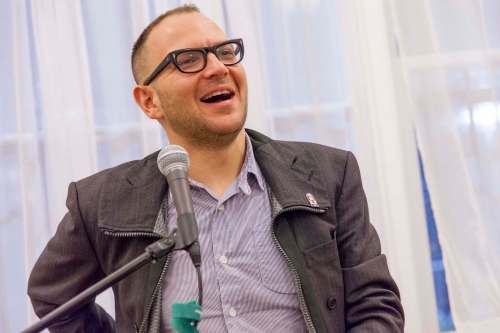
Canadian-born, Los Angeles-based journalist and activist Cory Doctorow’s latest novel for adult audiences, Walkaway, sees cyber “maker” culture meet post-scarcity in the Canadian wilderness in a story that is either a dystopian or utopian look to the future, depending on your feelings on meritocracy.
The novel unfolds over some 50 years in the lives of our protagonists, a group of young adults who meet in near-future Toronto, complete with believably futuristic details. We’ve got the fun predictions (self-cooking pizzas, robot waitresses, illegally hacked self-driving cars) as well as the dire (profound income inequality, mass unemployment, universal surveillance).
Unemployed nobodies Hubert and Seth meet ultra-rich “zotta” Natalie at an illegal furniture-manufacturing rave in a derelict factory (“putting the ‘party’ back in ‘Communist Party’”). After the party is busted, the trio spends the next day hiding, recovering and arguing about philosophy in Natalie’s parents’ mansion before deciding to “go walkaway” — that is, walk out of the city (and law-and-order civilization) into the no man’s land that is the Niagara Escarpment.

Walkaway territory is an anarchic hinterland; it exists in ex-urban areas around the globe. With the futuristic equivalent of today’s 3D printers — as well as renewable energy and raw materials sourced from amply available scrap — anyone can print nearly anything needed, so walkaways do a type of digital homesteading in the wastelands by manufacturing their own food, medicine, shelter and technology.
Walkaway residents form communities based on common needs or belief systems, with several larger communities — Akron, Lagos, Krakow — referenced or roughly sketched. Differences in belief systems form the core of the novel, and our protagonists face threats from rival walkaway communities, from the “default” society that fears them and from Natalie’s zillionaire father, who seeks to return her to the sheltered life befitting an heiress.
Doctorow does a cogent job of introducing the reader to walkaway society through his characters; just as the reader wonders how something works, someone in the book encounters that very issue. The book’s perspective moves seamlessly between several men and women of varying age and experience, and the characters Doctorow draws are fully three-dimensional — except the villains of default society, who often come across as cardboard cut-outs of greed.
While the world Doctorow draws is convincingly realistic, some of the conversations of the cast that populates it are not: Walkaway is long on ideology, with characters having sometimes laughably protracted discussions of economic theory. As in some of his previous novels, the philosophizing is heavy-handed at times, almost evangelical.
“Private property is the most productive property. Temporary inefficiencies don’t change that,” argues Natalie’s father, the book’s main antagonist, early in the book. “Only kleptocrats use terms like ‘temporary inefficiencies’ for wasteful abominations,” retorts Natalie. Much of the book’s dialogue is similarly steeped in policy-speak.
If your novel’s going to spend a lot of time sermonizing on economic theory, you’d best add some spicy bits to keep the reader attentive, and Doctorow accommodates. The book includes several battle scenes with mecha robots and exploding zeppelins, easily imagined on the silver screen.
Doctorow also liberally infuses the book with sex. In this venue, it offers a delightful fluidity of sexuality and gender that feels believably near-future: characters feel desire for and move between relationships with members of the same or opposite sex without comment; one character’s transgender status is only remarked upon in passing.
A leap even further into the future at the end of the book feels a bit forced — like a sequel that didn’t quite materialize — but overall Doctorow has drawn a satisfyingly credible and compelling world that could exist if the modern world continues on its trajectory, with ample thought given to how the choices we make in dealing with individuals shapes the foundation of the society in which we live.
Wendy Sawatzky is associate editor digital news for the Winnipeg Free Press and commander in chief at wendysawatzky.com.
Wendy Sawatzky
Associate Editor Digital News
Wendy Sawatzky is associate editor of digital news for the Free Press. A born-and-bred Manitoban, she has degrees from the University of Winnipeg and the University of King’s College. She joined the Free Press in 2008. Read more about Wendy.
Wendy oversees the team that publishes news on the Free Press’s website and apps. It’s part of the Free Press‘s tradition, since 1872, of producing reliable independent journalism. Read more about Free Press’s history and mandate, and learn how our newsroom operates.
Our newsroom depends on a growing audience of readers to power our journalism. If you are not a paid reader, please consider becoming a subscriber.
Our newsroom depends on its audience of readers to power our journalism. Thank you for your support.

By Cory Doctorow
Tor, 384 pages, $35
Wendy Sawatzky
Associate Editor Digital News
Wendy Sawatzky is associate editor of digital news for the Free Press. A born-and-bred Manitoban, she has degrees from the University of Winnipeg and the University of King’s College. She joined the Free Press in 2008. Read more about Wendy.
Wendy oversees the team that publishes news on the Free Press’s website and apps. It’s part of the Free Press‘s tradition, since 1872, of producing reliable independent journalism. Read more about Free Press’s history and mandate, and learn how our newsroom operates.
Our newsroom depends on a growing audience of readers to power our journalism. If you are not a paid reader, please consider becoming a subscriber.
Our newsroom depends on its audience of readers to power our journalism. Thank you for your support.
Advertisement Advertise With Us
Advertisement Advertise With Us
History
Updated on Saturday, May 13, 2017 10:54 AM CDT: Cutline fixed.