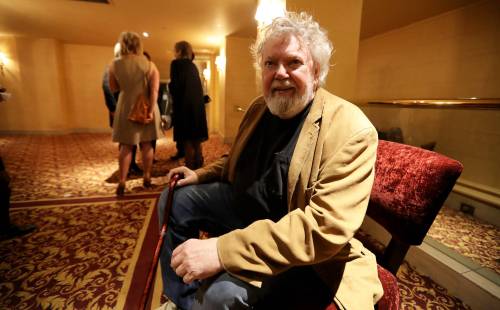
Gray brings subjects to life during Klondike gold rush
Advertisement
Read this article for free:
or
Already have an account? Log in here »
To continue reading, please subscribe:

Digital Subscription
One year of digital access for only $205*
- Enjoy unlimited reading on winnipegfreepress.com
- Read the E-Edition, our digital replica newspaper
- Access News Break, our award-winning app
- Play interactive puzzles
*First annual payment billed as $205.00 + GST for one year. This annual subscription will automatically renew at $233.00 + GST every 52 weeks (10% off the regular annual price of $259.35). Offer available to new and qualified returning subscribers only. Cancel any time.
To continue reading, please subscribe:
Add Free Press access to your Brandon Sun subscription for only an additional
$1 for the first 4 weeks*
- Enjoy unlimited reading on winnipegfreepress.com
- Read the E-Edition, our digital replica newspaper
- Access News Break, our award-winning app
- Play interactive puzzles
*Your next Brandon Sun subscription payment will increase by $1.00 and you will be charged $17.95 plus GST for four weeks. After four weeks, your payment will increase to $24.95 plus GST every four weeks.
Read unlimited articles for free today:
or
Already have an account? Log in here »
Hey there, time traveller!
This article was published 25/09/2010 (5835 days ago), so information in it may no longer be current.
Gold Diggers
Striking it Rich in the Klondike
By Charlotte Gray

HarperCollins, 398 pages, $35
IN this fascinating study of the Yukon gold rush of 1896 — “the most legendary event” in Canadian history — Ottawa’s Charlotte Gray sets out to pull the threads of historical fact from the mythical narratives woven around it.
To do so, she must take on her predecessor in the field: Pierre Berton, not only legendary himself, but also born and raised in the Yukon and among its gold miners.
Gray expresses sincere gratitude for his books on the gold rush, but she wants to go beyond the “sweaty machismo” and patriotism that dominate his version of things.
Despite her suspicions about Canadian nationalism and her British origins, Gray is nonetheless one of Canada’s best-loved writers of popular history and literary biography.
Her biographies (of such figures as Alexander Graham Bell, Nelly McClung and Pauline Johnson) have not only landed her numerous awards for excellence in literary non-fiction, but also prestigious membership in the Order of Canada and the Royal Society of Canada.
This is her most ambitious work yet, covering the history of a city, Dawson, and the lives of six people as they converged on the Klondike, a tributary of the Yukon River, during the gold rush of 1896 to 1899.
Each of the men and women whom she introduces is as fascinating as the last, each as shockingly intrepid, ingenious and wild as the sled dogs that pull them there.
With details garnered from a trove of historical sources, Gray brings these men and women to life as they trek toward the Canadian North in search of something more interesting than their predictable lives below the Arctic Circle.
It would not be an overstatement to say that every angle of this perspective on “the last great gold rush in history” (as Grey reminds us) is both worthwhile and fascinating: from the chronicles of Belinda Mulrooney’s entrepreneurial brilliance, which helped turn the muddy encampment into a city, to the ordeals of the ruggedly handsome Jack London (always manly, even without his two front teeth), whose tales of the Klondike mark the progression of his literary career.
Gray begins with the miner Bill Haskel, as he refuses to converse with the Han First Nations people and sails right by the “soft yellow stones that glittered” in the river where their children swam.
She follows his story with that of Father William Judge, a “scrawny Catholic priest with a soft voice and intense gaze,” whose primary goal was to build a hospital near the Klondike River.
The last two figures whom Gray introduces, British journalist Flora Shaw and Mountie Sam Steele, permit outsiders’ views on the city that developed around the gold-miners, with its corrupt administration and its fleecing by Ottawa. Canada’s history as a nation is thus illuminated in all its ad-hoc, opportunistic, nepotistic glory.

The most compelling sections of the book cover the descriptions of Dawson itself. Turn the pages and watch the city unfold, as saloon owners, newspaper men and bankers set up around the gold prospectors — and as women “rouged within an inch of their lives” followed to dance for them.
Read the book for reactions to the landscape and its surrounding splendour, for accounts of “such beauty that you couldn’t keep your eyes off it,” and for stories of working dogs whose paws often sported little leather moccasins.
Finally, bear witness to the racism against the First Nations who made room for the prospectors, saw the Tr’ondëk mispronounced as Klondike and renamed altogether, and then lost their traditional fishing and hunting grounds to men and women who literally staked their claims along the river banks.
Although Gray might have fleshed out a seventh biographical figure for the assemblage through which she views “Klondike fever,” she never swerves from the fact that the gold rush was also an invasion.
Dana Medoro is a professor in the department of English, film and theatre at the University of Manitoba.