Head count

Exploration of census's impact on society more than just a number crunch

Advertisement

Advertise with us

Andrew Whitby, a transplanted Australian now living in the United States, has written a fascinating history of the census, just in time for the launch of the 2020 U.S. census and a year prior to the 2021 Canadian census. Along with his international perspective, as both an economist and computer scientist, The Sum of the People: How the Census Has Shaped Nations, From the Ancient World to the Modern Age brings together a historical, technical and sociological understanding of the census in both ancient and moderns times.

Read this article for free:


or

Already have an account? Log in here »

To continue reading, please subscribe:

Subscribe and receive a limited-edition Free Press branded hat or tote.

Digital Subscription

One year of digital access for only $205*

  • Enjoy unlimited reading on winnipegfreepress.com
  • Read the E-Edition, our digital replica newspaper
  • Access News Break, our award-winning app
  • Play interactive puzzles

*First annual payment billed as $205.00 + GST for one year. This annual subscription will automatically renew at $233.00 + GST every 52 weeks (10% off the regular annual price of $259.35). Offer available to new and qualified returning subscribers only. Cancel any time.

To continue reading, please subscribe:

Add Free Press access to your Brandon Sun subscription for only an additional

$1 for the first 4 weeks*

  • Enjoy unlimited reading on winnipegfreepress.com
  • Read the E-Edition, our digital replica newspaper
  • Access News Break, our award-winning app
  • Play interactive puzzles
Start now

*Your next Brandon Sun subscription payment will increase by $1.00 and you will be charged $17.95 plus GST for four weeks. After four weeks, your payment will increase to $24.95 plus GST every four weeks.

Hey there, time traveller!
This article was published 18/04/2020 (2312 days ago), so information in it may no longer be current.

Andrew Whitby, a transplanted Australian now living in the United States, has written a fascinating history of the census, just in time for the launch of the 2020 U.S. census and a year prior to the 2021 Canadian census. Along with his international perspective, as both an economist and computer scientist, The Sum of the People: How the Census Has Shaped Nations, From the Ancient World to the Modern Age brings together a historical, technical and sociological understanding of the census in both ancient and moderns times.

The American Constitution of 1787 established the first modern decennial (i.e. once a decade) census in Article 1, where it refers to establishing an “Enumeration” to be conducted of “the whole Number of free Persons.” Going forward, and as the population changed, the census would determine each state’s proportionate size within the House of Representatives. The calculation excluded “Indians not taxed” while slaves would be worth “three fifths” of other individuals when doing the count.

Whitby writes that Sweden and the U.S. were the only countries conducting a decennial count in the 18th century, with the U.K. soon to follow. In what would later become Canada, a very early census was conducted in New France in 1666. Not mentioned by the author are the pre-Confederation censuses in the colonies such as those of 1851-52 and 1860-61 in the United Province of Canada.

Sean Kilpatrick / The Canadian Press files
The next U.S. census is slated to take place this year; Canada’s next census will be in 2021.
Sean Kilpatrick / The Canadian Press files The next U.S. census is slated to take place this year; Canada’s next census will be in 2021.

For those seeking detailed information about the early days of the Canadian census, Bruce Curtis’ 2001 book The Politics of Population provides a reliable account of the period spanning the 1840s to the 1870s. Another decent and well-received work is David Worton’s 1998 work The History of the Dominion Bureau of Statistics, which includes chapters on this period as well as up to the early 1970s.

Whitby’s most fascinating chapter is focused on the historical development of punch cards and data processing in the late 1800s. The “Electric Tabulating Machine” designed by Herman Hollerith was first adopted for the 1890 U.S. census. The machine enabled a single operator to “count fifty thousand people a day.” Not mentioned is that the Canadian government also used the machine, as a test case, for its 1891 national census. Hollerith later sold his firm in 1911, and after merging with three other firms, the new company name became the Computing-Tabulating-Recording Company. In 1924 it was renamed International Business Machines — better known as IBM.

The Sum of the People examines the topic of not only who is counted in a national census, but who gets left out, remaining uncounted. This includes population counts in South Africa prior the end of apartheid, Indigenous peoples in the U.S. and Australia (and, not mentioned, in Canada as well) and transient populations with no fixed address. To compensate, statisticians often resort to creating population “estimates” for these hard-to-reach populations.

A fascinating part of Whitby’s work is how, historically, the census is more than a simple counting of heads. As a government tool, it was used to collect taxes in biblical times, for establishing sovereignty in disputed parts of a region (such as modern-day Israel) and, most chillingly, by the Nazis to identify the Jews in occupied Europe.

Andrew Whitby’s Sum of the People is a highly readable, well-written account of how nations have implemented their census. Writing about the census might seem to be somewhat dull at first glance, but readers will soon appreciate how the topic is significant for a number of historical, social and political reasons.

Christopher Adams is writing a history of polling in Canada. He is a past pollster and is the rector of St. Paul’s College at the University of Manitoba.
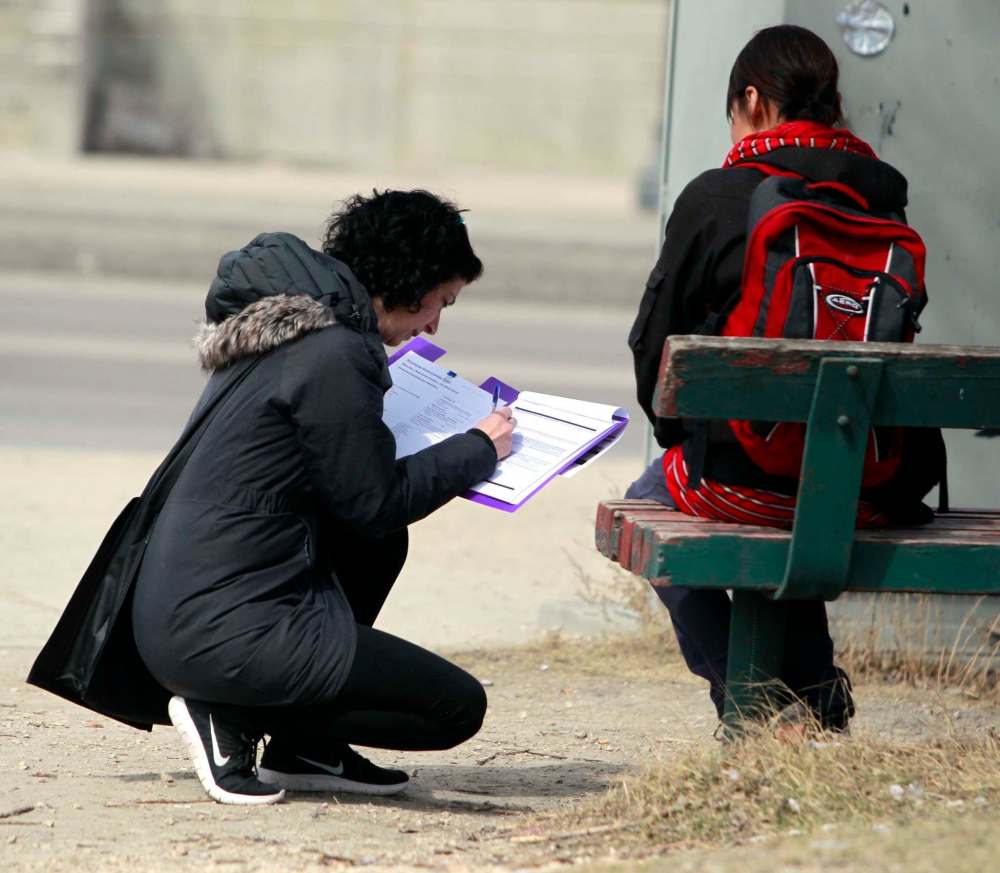

BORIS MINKEVICH / WINNIPEG FREE PRESS files
In this 2018 photo, a volunteer interviews a homeless Winnipegger at the corner of Higgins Avenue and Main Street. Statisticians are often forced to resort to creating population estimates for these hard-to-reach populations.
BORIS MINKEVICH / WINNIPEG FREE PRESS files In this 2018 photo, a volunteer interviews a homeless Winnipegger at the corner of Higgins Avenue and Main Street. Statisticians are often forced to resort to creating population estimates for these hard-to-reach populations.
Report Error Submit a Tip

More Stories

Foster mom pleads guilty to assault that left six-year-old-girl paralyzed

Dean Pritchard 4 minute read Preview

Foster mom pleads guilty to assault that left six-year-old-girl paralyzed

Dean Pritchard 4 minute read Friday, Aug. 14, 2026

A Winnipeg foster mother has admitted to violently assaulting her ill foster daughter and leaving her paralyzed after the girl resisted the woman’s efforts to provide her with medication, a court has heard.

Marilyn Keno, 26, pleaded guilty Friday to one count of aggravated assault.

Keno remains in custody and will be sentenced at a later date following the completion of a court-ordered pre-sentence report.

The maximum sentence for aggravated assault is 14 years in prison. Crown attorney Alanna Littman and defence lawyer Jeremy Kostiuk did not disclose what sentences they will be recommending.

Read
Friday, Aug. 14, 2026

WRHA directs three care homes to accommodate surge of hospital patients

Malak Abas 5 minute read Preview

WRHA directs three care homes to accommodate surge of hospital patients

Malak Abas 5 minute read Friday, Aug. 14, 2026

The Winnipeg Regional Health Authority has directed three long-term care centres to make space for hospital patients, citing “exceptionally high demand for care across the health-care system.”

Read
Friday, Aug. 14, 2026

Corroded Arlington overpass yields way for new hope of spanning urban chasm

Melissa Martin 6 minute read Preview

Corroded Arlington overpass yields way for new hope of spanning urban chasm

Melissa Martin 6 minute read Yesterday at 2:00 AM CDT

It’s an interesting quirk of timing, perhaps, that the end of two of Winnipeg’s most unlovely features are coming into view in the same few weeks. The rail lines that split the city in half, and the bridge that was built to tie it back together. The original problem, and the solution.

And in the confluence of those two ends, we have an opportunity to dream of what a better Winnipeg can be.

At a news conference on Wednesday, former federal transport minister Lloyd Axworthy laid out a vision for a rail line bypass that would remove more than 120 railway crossings from Winnipeg, route them through Crown and Manitoba Hydro corridor land south of the city, and reclaim 250 acres in the urban core for greenspace and development.

The next step is to focus on how to make it happen. Nothing of this scope comes easy. This new bypass plan emerged from a two-year feasibility study that Premier Wab Kinew had tasked Axworthy with back in 2024. Now, Axworthy will helm a new 90-day feasibility study zooming in on that route specifically.

Read
Yesterday at 2:00 AM CDT

West Kildonan Industrial residents call for speed bumps after child hit by truck

Morgan Modjeski 3 minute read Preview

West Kildonan Industrial residents call for speed bumps after child hit by truck

Morgan Modjeski 3 minute read Updated: Yesterday at 3:09 PM CDT

Residents in the West Kildonan Industrial neighbourhood are calling on the city to install speed bumps in their area after a child was hit and dragged by a vehicle Thursday.

Katelyn Bemister lives near the area where the child — who was hospitalized as a result of the incident and has been upgraded to stable condition — was struck. She says people frequently speed in the area.

“They’re going really fast, and they’re not really paying attention at all to the pedestrians in the area,” says Bemister.

In video supplied to the Free Press by a resident, the child can be seen riding a bike down a sidewalk along the 500 block of North Point Boulevard.

Read
Updated: Yesterday at 3:09 PM CDT

Today’s horoscope

Georgia Nicols 4 minute read Preview

Today’s horoscope

Georgia Nicols 4 minute read 2:00 AM CDT

MOON ALERT: There are no restrictions to shopping or important decisions today. The moon is in Libra.

ARIES (March 21-April 19)

The day is a mixed bag. For the most part, it’s romantic, friendly, congenial and a great time to socialize with others and enjoy playful activities with kids. Nevertheless, you might meet a real sourpuss or someone who is a wet blanket. Keep things light!

TAURUS (April 20-May 20)

Read
2:00 AM CDT

Exploration of census's impact on society more than just a number crunch

Reviewed by Christopher Adams 4 minute read Preview

Exploration of census's impact on society more than just a number crunch

Reviewed by Christopher Adams 4 minute read Saturday, Apr. 18, 2020

Andrew Whitby, a transplanted Australian now living in the United States, has written a fascinating history of the census, just in time for the launch of the 2020 U.S. census and a year prior to the 2021 Canadian census. Along with his international perspective, as both an economist and computer scientist, The Sum of the People: How the Census Has Shaped Nations, From the Ancient World to the Modern Age brings together a historical, technical and sociological understanding of the census in both ancient and moderns times.

The American Constitution of 1787 established the first modern decennial (i.e. once a decade) census in Article 1, where it refers to establishing an “Enumeration” to be conducted of “the whole Number of free Persons.” Going forward, and as the population changed, the census would determine each state’s proportionate size within the House of Representatives. The calculation excluded “Indians not taxed” while slaves would be worth “three fifths” of other individuals when doing the count.

Whitby writes that Sweden and the U.S. were the only countries conducting a decennial count in the 18th century, with the U.K. soon to follow. In what would later become Canada, a very early census was conducted in New France in 1666. Not mentioned by the author are the pre-Confederation censuses in the colonies such as those of 1851-52 and 1860-61 in the United Province of Canada.

For those seeking detailed information about the early days of the Canadian census, Bruce Curtis’ 2001 book The Politics of Population provides a reliable account of the period spanning the 1840s to the 1870s. Another decent and well-received work is David Worton’s 1998 work The History of the Dominion Bureau of Statistics, which includes chapters on this period as well as up to the early 1970s.

Read
Saturday, Apr. 18, 2020