Legacy of shame

Lengthy history of anti-blackness in Canada detailed

Advertisement

Advertise with us

In 2003 Chevranna Abdi, a 26-year-old black transgender woman in Hamilton, was arrested by police and dragged down seven flights of stairs face-down.

Read this article for free:


or

Already have an account? Log in here »

To continue reading, please subscribe:

Subscribe and receive a limited-edition Free Press branded hat or tote.

Digital Subscription

One year of digital access for only $205*

  • Enjoy unlimited reading on winnipegfreepress.com
  • Read the E-Edition, our digital replica newspaper
  • Access News Break, our award-winning app
  • Play interactive puzzles

*First annual payment billed as $205.00 + GST for one year. This annual subscription will automatically renew at $233.00 + GST every 52 weeks (10% off the regular annual price of $259.35). Offer available to new and qualified returning subscribers only. Cancel any time.

To continue reading, please subscribe:

Add Free Press access to your Brandon Sun subscription for only an additional

$1 for the first 4 weeks*

  • Enjoy unlimited reading on winnipegfreepress.com
  • Read the E-Edition, our digital replica newspaper
  • Access News Break, our award-winning app
  • Play interactive puzzles
Start now

*Your next Brandon Sun subscription payment will increase by $1.00 and you will be charged $17.95 plus GST for four weeks. After four weeks, your payment will increase to $24.95 plus GST every four weeks.

Hey there, time traveller!
This article was published 18/11/2017 (3227 days ago), so information in it may no longer be current.

In 2003 Chevranna Abdi, a 26-year-old black transgender woman in Hamilton, was arrested by police and dragged down seven flights of stairs face-down.

By the time they reached the lobby, she was not breathing. She died in police custody. Her death was ruled “accidental.”

If a middle-class white woman died after such treatment, there would be public outrage. But because Abdi was black, poor and transgender, police, the media and the public all treated the death with indifference.

It’s just one of the stories of blatant racism that Robyn Maynard recounts in Policing Black Lives: State Violence in Canada From Slavery to the Present.

According to her bio, Maynard is “a black feminist writer, grassroots community organizer and intellectual” based in Montreal. Her work has appeared in newspapers and journals.

In her first book, Maynard combines riveting true stories of racism in Canada with statistics and studies to put the individual experiences in perspective.

She deliberately avoids American examples, being all too familiar with the rationalization among white Canadians that anti-black racism exists in the U.S., but not here.

Think again.

“The long history of anti-blackness in Canada has, for the most part, occurred alongside the disavowal of its existence,” Maynard maintains.

Her aim is to shake white Canadians out of their smug complacency by providing irrefutable proof of their complicity in state violence — arbitrary control and mistreatment by the police, courts, immigration, child welfare and school systems — against people because they were black.

If you know systemic racism exists, can see it traumatizing its victims and do nothing to stop it, then it is done in your name, she argues.

Today’s negative view of black people is the legacy of slavery, which had a 200-year history in Canada under French and English colonial regimes. Slavery was abolished in Canada a mere 31 years before it was ended in the U.S.

Maynard argues persuasively that the negative stereotypes of black men and women created to justify slave ownership persist today, affecting everyone from Chevranna Abdi to black mothers dealing with hostile child-welfare workers and school authorities.

Being black often intersects with being poor, resulting in double discrimination.

Almost all the agencies working on behalf of the state have demonstrated systemic racism in study after study cited by Maynard. For instance, Montreal police use photos of black faces for target practice.

Stacey Lee photo
Author Robyn Maynard combines true stories of racism in Canada with statistics and studies that put the individuals’ experiences in a big-picture perspective.
Stacey Lee photo Author Robyn Maynard combines true stories of racism in Canada with statistics and studies that put the individuals’ experiences in a big-picture perspective.

Maynard has a passion for those people who are overlooked and undervalued by society. While she examines the issues facing black men, she focuses more on black women.

Maynard does not divide “black folks” into those who deserve oppression and those who don’t. Instead, she deliberately tells the stories of those ignored or marginalized by others, including black transgender women and sex-trade workers.

She makes common cause with Indigenous people, especially women. Indigenous people were also enslaved during the colonial regimes and experience similar racism and discrimination from officialdom today.

While many black people have been abused and murdered, Maynard concedes the scale and uniqueness to the Indigenous community of residential schools and missing and murdered Indigenous women and girls.

Black immigrants, however, face a potential form of state violence unknown to anyone born in Canada. They can be deported to a country where their lives may be in danger because of their political beliefs or sexual identity. While they are waiting for a decision, some are held in jail indefinitely.

Despite overwhelming evidence of racism in Canada, Maynard strikes a hopeful note at the end, calling for economic, racial and gender justice in a world that invests in education, health and safety over “criminalization and cages.”

Every Canadian — black, white, Indigenous or otherwise — could benefit from reading Maynard’s frank and thorough assessment of racism in Canada.

Donald Benham is senior public affairs adviser at Winnipeg Harvest.

Robyn Maynard will be speaking about her new book at the West End Cultural Centre on Wednesday.

Report Error Submit a Tip

More Stories

Klein has burned bridges with PM, Gillingham says

Joyanne Pursaga 3 minute read Preview

Klein has burned bridges with PM, Gillingham says

Joyanne Pursaga 3 minute read Yesterday at 5:51 PM CDT

One mayoral candidate accused another of writing a column so critical it could compromise his ability to work with the federal government.

Read
Yesterday at 5:51 PM CDT

Give-and-take relationship of Roman leaders takes centre stage in Harris’s historical fiction

Reviewed by Kathryne Cardwell 4 minute read Preview

Give-and-take relationship of Roman leaders takes centre stage in Harris’s historical fiction

Reviewed by Kathryne Cardwell 4 minute read 2:01 AM CDT

British novelist Robert Harris’s latest work is a reflection on tyranny, corruption and betrayal among all-powerful political leaders.

You might be forgiven for thinking it’s a contemporary thriller — it’s actually historical fiction set in ancient Rome.

A former BBC journalist, Harris debuted as a novelist in 1992 with Fatherland, an alternative history where Nazi Germany won the Second World War.

Since then, the prolific author has become best-known for his works of historical fiction, especially his ancient Rome trilogy released from 2006-2015 and the novel Conclave, which was published in 2016 and was made into the film of the same name in 2024.

Read
2:01 AM CDT

Canada-U.S. trade relationship is broken, but the damage can — and will — be repaired

Tom Brodbeck 5 minute read Preview

Canada-U.S. trade relationship is broken, but the damage can — and will — be repaired

Tom Brodbeck 5 minute read Thursday, Sep. 17, 2026

Canada needs to get serious about diversifying its trade beyond the United States. But at the same time, Canadians should expect relations with the U.S. to normalize after Donald Trump is no longer in the White House.

For generations, Canada-U.S. trade was considered almost a fact of geography. The two countries share the world’s longest undefended border, deeply integrated supply chains and a century of commercial relationships.

Canadian manufacturers depend on American customers. American manufacturers depend on Canadian suppliers. Energy, agriculture, automotive production and countless other industries operate across the border as though it barely exists.

That isn’t going to change dramatically, even in the midst of a bitter trade war unleashed by the U.S. president.

Read
Thursday, Sep. 17, 2026

Grieving child builds backyard rocket ship

Harriet Zaidman 4 minute read 2:01 AM CDT

I Built a Rocket Ship (Kids Can Press, 32 pages, hardcover, $22) by Winnipegger Anna Lazowski is a tender story for children ages 4-8 about a little girl trying to make sense of her mother’s death. The child engages in conversation with her late mom, agreeing and disagreeing about things said as she carries objects (and of course, the cat) to the backyard. There, she is building a rocket ship she will pilot into the skies to find her mom again.

Jennica Lounsbury’s varied perspectives show the range of emotions the little girl experiences.

● ● ●

Northwoods Lullaby by Mary Casanova (University of Minnesota Press, 32 pages, hardover, $25) is a bedtime book for readers up to age eight, perfect to bring a busy, happy day to a close. Just like children who are listening to adults reading the book, all the animal babies are being tucked into their nests and burrows by loving parents: “Thump and scamper,/nimble clover./ Soon it’s time to rest. Baby loon/ nestles in/as Papa floats along.”

A Winnipeg lawyer has been disbarred after admitting to six counts of professional misconduct and two counts of providing incompetent service involving eight clients.

The career-ending decision marks the sixth time Gisele Champagne has been disciplined by the Law Society of Manitoba since she was called to the bar in 1992.

“Disbarment is the appropriate remedy when a lawyer has demonstrated a repeated pattern of conduct that violates professional standards,” a law society panel said in a written decision released Wednesday.

“A lawyer who has been unable to learn from past discipline proceedings to fulfill his or her obligation to provide ethical and high-quality legal services must at some point lose the privilege of practising law.”

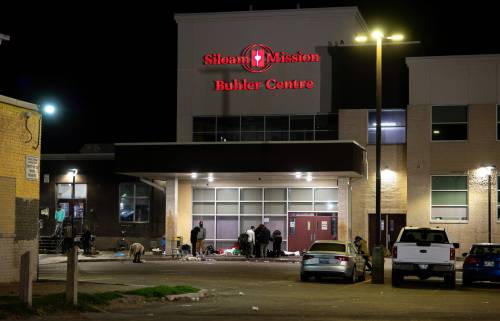
Siloam Mission, WFPS discussing on-site paramedic to reduce staggering number of emergency calls

Scott Billeck 4 minute read Preview

Siloam Mission, WFPS discussing on-site paramedic to reduce staggering number of emergency calls

Scott Billeck 4 minute read Yesterday at 2:00 AM CDT

Winnipeg’s fire-paramedic service and its largest homeless-serving organization are discussing what it would look like to station at least one paramedic at Siloam Mission, as emergency calls to the downtown facility surge.

The ongoing discussions come as Winnipeg Fire Paramedic Service crews were dispatched 1,771 times during the first eight months of the year to the two adjacent Siloam properties at 303 Stanley St. and 300 Princess St.

WFPS said most of the calls were related to overdoses or other consequences of substance use, with the total nearly double the 854 calls recorded over the same period last year. By comparison, there were 831 calls during the same span in 2024, and 591 in 2023.

“The number of emergency calls isn’t sustainable for us as a service, but it’s certainly not sustainable for them as an agency trying to provide services,” WFPS chief Ryan Sneath told the Free Press. “And they recognize that they’re impacting emergency services, not them specifically, but the site in a significant way.”

Read
Yesterday at 2:00 AM CDT