Liu’s sci-fi trilogy a modern-day classic
Advertisement
Read this article for free:
or
Already have an account? Log in here »
To continue reading, please subscribe:
Digital Subscription
One year of digital access for only $1.44 a week*
- Enjoy unlimited reading on winnipegfreepress.com
- Read the E-Edition, our digital replica newspaper
- Access News Break, our award-winning app
- Play interactive puzzles
*Billed as $5.77 plus GST every four weeks. After 52 weeks, price increases to the regular rate of $19.95 plus GST every four weeks. Offer available to new and qualified returning subscribers only. Cancel any time.
To continue reading, please subscribe:
Add Free Press access to your Brandon Sun subscription for only an additional
$1 for the first 4 weeks*
- Enjoy unlimited reading on winnipegfreepress.com
- Read the E-Edition, our digital replica newspaper
- Access News Break, our award-winning app
- Play interactive puzzles
*Your next Brandon Sun subscription payment will increase by $1.00 and you will be charged $17.95 plus GST for four weeks. After four weeks, your payment will increase to $24.95 plus GST every four weeks.
Read unlimited articles for free today:
or
Already have an account? Log in here »
Hey there, time traveller!
This article was published 15/10/2016 (3657 days ago), so information in it may no longer be current.
Chinese literary star Cixin Liu has, in the scant two years since his first in-translation release, won or been nominated for most of the major English science-fiction awards, opened the gates for additional English-language releases of China’s authors, and provided a springboard for an ongoing discussion of non-Western perspectives in the literature of ideas. With this final volume of his trilogy, he’s also stuck the landing and validated the loyalty of his new Western readers.
The trilogy (featuring The Three-Body Problem, The Dark Forest and Death’s End) was first published in China a decade ago. As a series it is largely considered his greatest work. Thoroughly modern in some ways (some have even described aspects of Liu’s writing as Murakami-like, referring to the international sensation out of Kyoto, Japan), there’s a definite classicism to this story, similar in flavour to old-school, hard science-fiction masterpieces such as Arthur C. Clarke’s 2001: A Space Odyssey (most famous for its highly acclaimed Kubrick-directed film version), or Isaac Asimov’s Foundation series (never yet filmed, though perpetually in development).
It’s not just a matter of the epic scope or existential queries being posed that invite such comparisons. The view of the universe Liu poses is, arguably, quite dark. In a post-contact universe humankind, no longer alone, is fighting for its very survival against an almost overwhelmingly superior alien race: one threat, it turns out, of many. Many of the human characters tasked with preserving the species are at best morally ambiguous, and at worst pragmatic monsters.
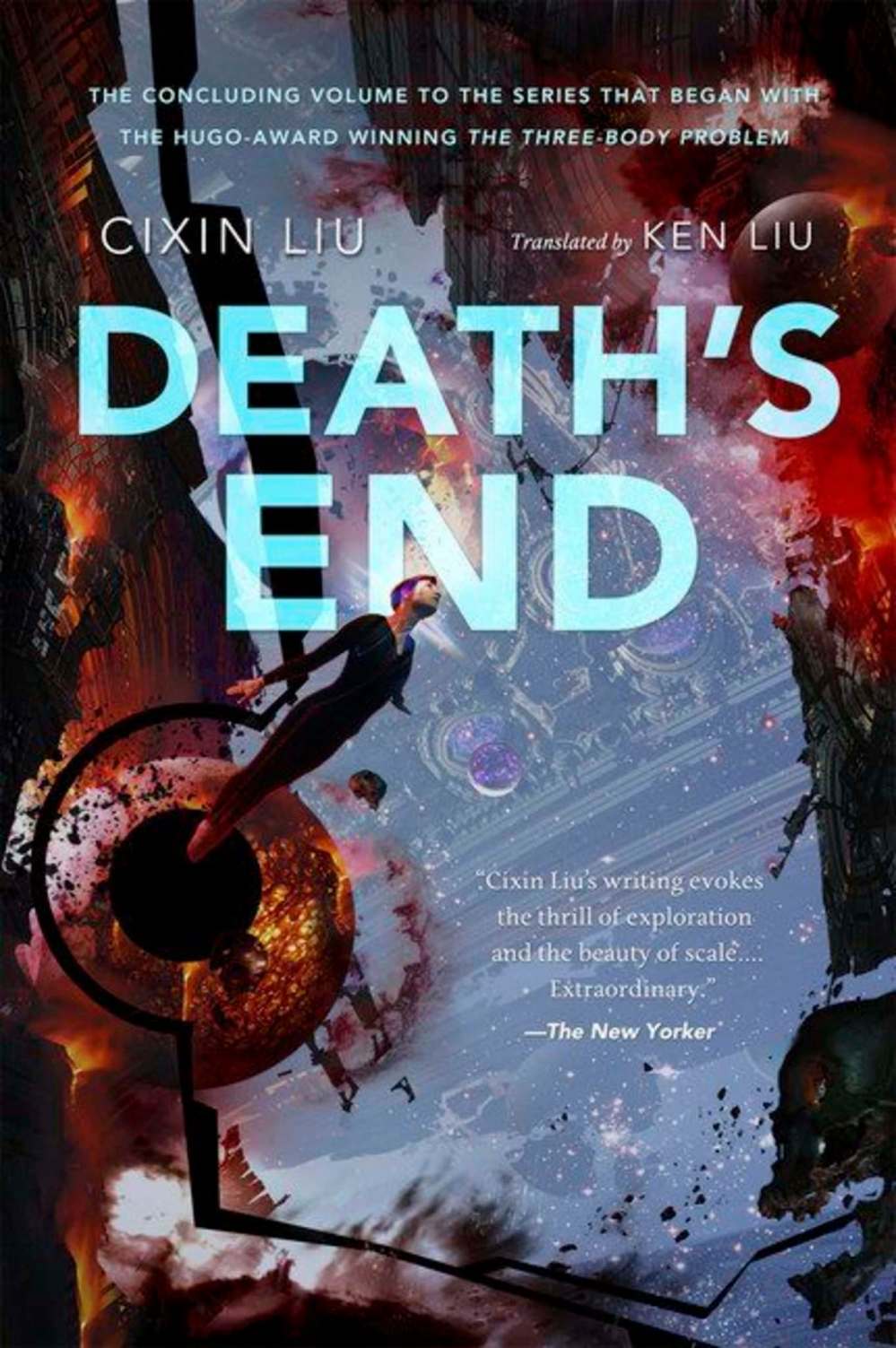
Liu still seems to believe goodness can and does exist. A happy ending may not be a foregone conclusion — on the scale of individual lives, species, or the universe as a whole — but hope springs eternal. That hard-nosed realist bent, girded with an undercurrent of restrained optimism, is a hallmark of those old universe- and eternity-spanning tales written by the old masters.
The story of humanity and its interstellar neighbours-cum-would-be-conquerors, the Trisolarans, spans centuries. The Three-Body Problem, the first entry in this series, jumps back and forth between the turbulent Cultural Revolution of 1960s China and the present day. It ends with humanity at large realizing what a select few have known for decades: we are not alone, and neither are we safe.
The second volume, The Dark Forest, starts again in the present day, focusing on an almost entirely different set of characters. Through advances in cryonic-freezing techniques, this narrative followed their exploits centuries into the future, waking up at intervals as the multi-generational project to defend against the invading fleet continued apace. The book ends with the invading fleet still en route, but apparently thwarted by one man’s epiphany in strategy.
This final novel takes us back one more time to the present day, focusing on yet another group of characters working on an entirely different long-term defense project. It catches up to the point in future history where the second book left off and continues well beyond. All the while, it focuses on one unassuming young Chinese woman, Cheng Xin, a gifted engineer whose decisions will, again and again, shape the future of humanity.
Critically, this final protagonist is compassionate, courageous and honourable. Liu has presented flawed heroes before, and Cheng Xin too makes her share of errors. But she justifies the narrative assumption that ours is a species that deserves to continue on, and the emotional and intellectual investment readers have made to see humanity through to its final fate.

In the final analysis, this is a near-perfect story told over three books, destined to be an enduring classic.
Joel Boyce is a Winnipeg writer and educator.