Out with the old

Author argues true reconciliation requires drastic changes to Indigenous agencies

Advertisement

Advertise with us

Most non-indigenous Canadians are unaware of the history of treaties, the annuities promised in these treaties and how the evolution of the Indian Act and the Department of Indigenous Affairs (in all its forms) have fundamentally created flawed relationships between Indigenous peoples and Canada — rendering “ordinary Indigenous people” voiceless.

Read this article for free:

or

Already have an account? Log in here »

To continue reading, please subscribe:

Subscribe and receive a limited-edition Free Press branded hat or tote.

Digital Subscription

One year of digital access for only $205*

  • Enjoy unlimited reading on winnipegfreepress.com
  • Read the E-Edition, our digital replica newspaper
  • Access News Break, our award-winning app
  • Play interactive puzzles

*First annual payment billed as $205.00 + GST for one year. This annual subscription will automatically renew at $233.00 + GST every 52 weeks (10% off the regular annual price of $259.35). Offer available to new and qualified returning subscribers only. Cancel any time.

To continue reading, please subscribe:

Add Free Press access to your Brandon Sun subscription for only an additional

$1 for the first 4 weeks*

  • Enjoy unlimited reading on winnipegfreepress.com
  • Read the E-Edition, our digital replica newspaper
  • Access News Break, our award-winning app
  • Play interactive puzzles
Start now

*Your next Brandon Sun subscription payment will increase by $1.00 and you will be charged $17.95 plus GST for four weeks. After four weeks, your payment will increase to $24.95 plus GST every four weeks.

Hey there, time traveller!
This article was published 15/02/2020 (2342 days ago), so information in it may no longer be current.

Most non-indigenous Canadians are unaware of the history of treaties, the annuities promised in these treaties and how the evolution of the Indian Act and the Department of Indigenous Affairs (in all its forms) have fundamentally created flawed relationships between Indigenous peoples and Canada — rendering “ordinary Indigenous people” voiceless.

Such is the claim of Sheilla Jones, Winnipeg journalist, author, and senior fellow with the Frontier Centre for Public Policy. In Let the People Speak: Oppression in a Time of Reconciliation, Jones argues that we will not truly seek out a path towards reconciliation until we come to the truth about how First Nations are funded and governed, and how the emergence of the monolithic Department of Indigenous Affairs has created a system “that has been unable to solve the issues of Indigenous poverty and suffering, no matter how much money was spent over the past fifty years.”

Supported by former MKO Chief and fellow journalist Sheila North, who wrote the book’s foreword, Jones chronicles the land grab that first witnessed the signing of the numbered treaties in the West, followed by the consolidation of these treaties in the Indian Act, and then the mad attempt of the federal government to wash its hands of its responsibilities — all of which has been a strategic ploy on the part of Canada to assume control of resources.

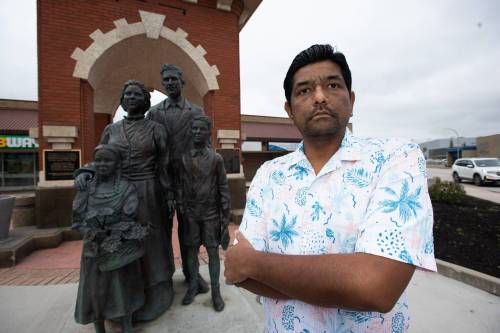
In this 2008 photo, Saskatoon RCMP officer David Kisters hands out the annual five dollar annuity still given to treaty members. Some consider the practice a slap in the face, while others see it as a symbolic gesture. (Gord Waldner / The Canadian Press files)

As Jones argues, even in 2019 “It is the land, again, that is at the nexus of the conflict between Indigenous and non-Indigenous people, just as it has been from the start.”

The conflict that Jones surfaces is highly complex and multifaceted; however, she manages to succinctly boil down an essential theory as to the massive gaps in social, political and economic inequity which persists in our prosperous country. According to Jones, as treaties were being signed, annuities, or yearly payments, were negotiated in order to avoid massive lump-sum payments, and also to provide a basis for a livelihood for people living on reserve. As treaties such as Treaty 1 (1871) were being signed, Indigenous leaders new full well that their lives were going to radically change.

Treaties 1 and 2 both originally had annuities of three dollars, later negotiated to five dollars following the signing of future treaties. In 2019, the annuity remains at five dollars. That’s right — for those who are party to treaties in Winnipeg and the surrounding areas, which includes some of the most fertile and resource-rich land in the world, the annuity or annual payment is five dollars. Treaty Days, or the day when Indigenous Affairs bureaucrats come to pay out the annuity, occur each year, considered a slap in the face by some and a symbolic gesture by others.

Jones asks a salient question that perhaps should re-enter the national conversation around reconciliation: “If annuities were intended as a form of family support, along with the freedom to pursue traditional vocations, why did the value of the annuity never increase again after Parliament voted its approval in 1878? “

For Jones, the annuity and the lack of an “escalator clause” is the fundamental cause of inequity. She argues that if annuities were modernized and given directly to First Nations peoples (and not band councils), that the standard of life for ordinary Indigenous people would, coupled with the advent of more democratic and accountable models of self-governance, substantially improve. A fair and equitable annuity would not only see funds go directly to ordinary people, but would reinforce the notion of “the annuity being linked directly to the land through the treaties” — a critical first step towards reconciliation.

Jones asserts that through the Indian Act, the very piece of legislation that has gobbled up the treaties, Canada has created a system in which band councils and representative organizations have become so dependent on the Department of Indigenous Affairs funding that it is impossible for them to properly represent their constituents on and off reserve. Calling into question the legitimacy of the Assembly of First Nations in particular, Jones posits firmly that power and voice can only be placed in the hands of the people once the top-down colonial and patriarchal constructs of the Indian Act are supplanted by the original intent of the treaties and the negotiated annuities.

Reconciliation still requires substantial part on settlers to accept the truth and then take meaningful action to affect positive change. Sheilla Jones offers a provocative possibility towards a future where we all of the means for a decent life.

Matt Henderson is assistant superintendent of Seven Oaks School Division.
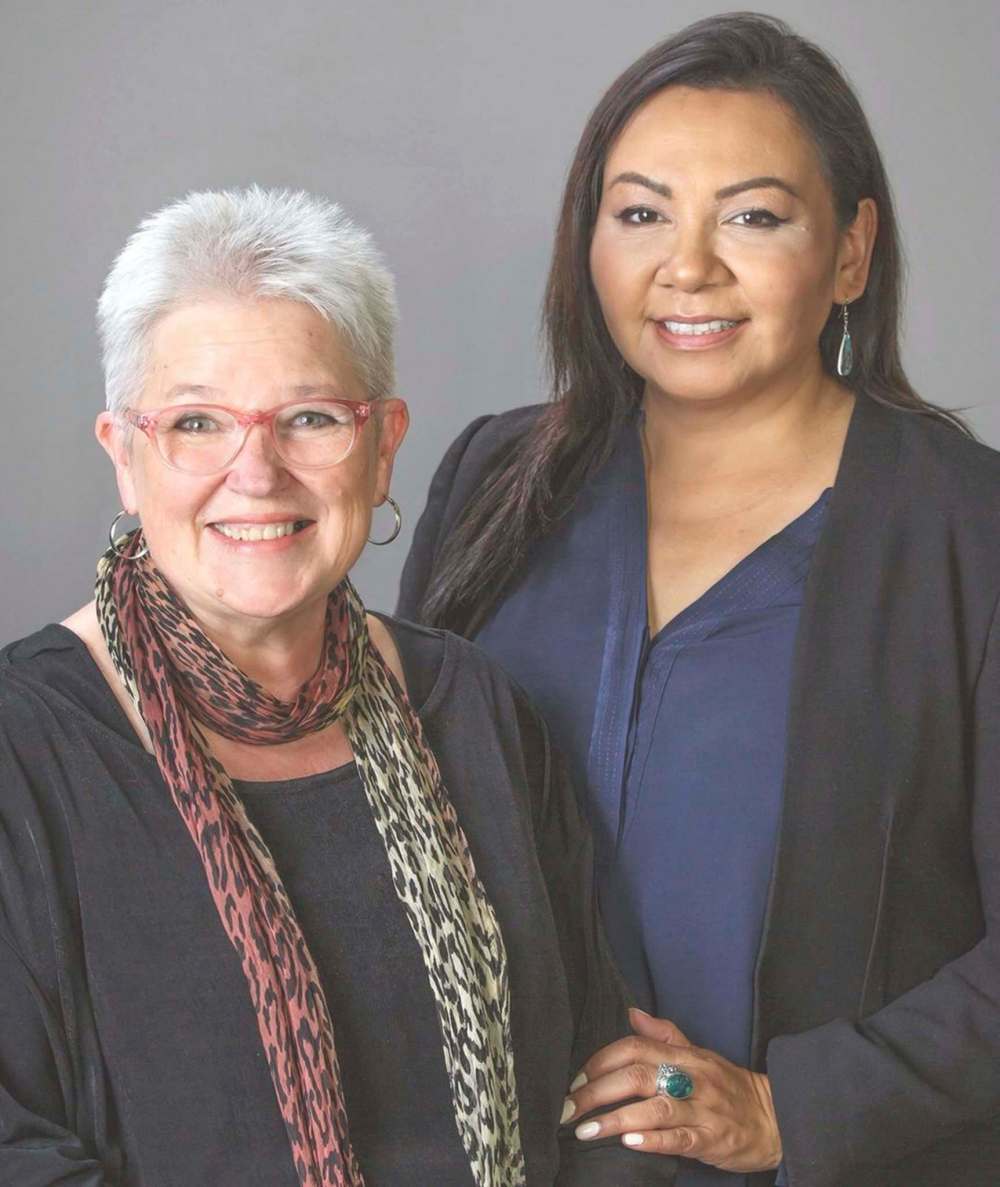
Author Sheilla Jones (left), with Sheila North, who wrote the introduction to Let the People Speak. (Supplied)
Report Error Submit a Tip

More Stories

WestJet cabin crews issue warning

Gabrielle Piché 5 minute read Preview

WestJet cabin crews issue warning

Gabrielle Piché 5 minute read Yesterday at 7:22 PM CDT

Travellers leaving Winnipeg got an unexpected view Tuesday — a line of silent WestJet flight attendants, wearing sunglasses and holding signs protesting unfair wages.

“Ready to Strike” and “Unpaid Work Won’t Fly!” boards faced passersby hurrying into the Winnipeg Richardson International Airport’s departures level.

Some 66 Manitoba-based WestJet workers stood silently outside the terminal for a half-hour, before noon.

Elsewhere, their colleagues cast strike votes. Some 4,400 flight attendants across Canada began voting July 9; the vote closes Wednesday.

Read
Yesterday at 7:22 PM CDT

Folk fest donates leftover food to Siloam Mission

Scott Billeck 2 minute read Preview

Folk fest donates leftover food to Siloam Mission

Scott Billeck 2 minute read Monday, Jul. 13, 2026

Thousands of meals will be served at Siloam Mission this week thanks to a massive food donation from the Winnipeg Folk Festival.

More than 4,200 pounds — about two tonnes — of surplus food from the four-day festival that wrapped up Sunday was delivered to the mission on Monday.

The donation, consisting of prepared food, protein, dairy and fresh produce, is expected to provide enough ingredients to prepare about 6,000 meals for people experiencing homelessness and poverty.

“We are part of the Winnipeg community and when we can give back, we do,” said folk festival executive director Valerie Shantz.

Read
Monday, Jul. 13, 2026

Police to report Tuesday on Linden Woods shooting

1 minute read Updated: Yesterday at 2:35 PM CDT

The Winnipeg Police Service will hold a news conference Tuesday to provide details about a shooting involving an officer in the Linden Woods neighbourhood Monday night.

No other details have been released.

The 1 p.m. news conference will be livestreamed on the WPS's YouTube page.

Former Manitoba MP Inky Mark charged with firearms offences; more than 400 weapons seized from home

Tyler Searle 6 minute read Preview

Former Manitoba MP Inky Mark charged with firearms offences; more than 400 weapons seized from home

Tyler Searle 6 minute read Monday, Jul. 13, 2026

A former member of Parliament from Manitoba has been charged after a stockpile of ammunition and firearms — including an antique cannon — and $300,000 in cash were seized from a Dauphin home last week.

Manitoba RCMP charged Inky Mark, 78, with a dozen firearms-related charges, including firearms trafficking, possession of property obtained by crime, unsafe storage and careless use of a firearm.

In total, RCMP seized 439 firearms from Mark’s property, Mounties said at a news conference Monday morning.

It is expected to take investigators weeks to sort through the arsenal and determine how many of the weapons were legally possessed, but police have already identified three guns that are believed to have been illegally trafficked, and one that had a tampered serial number, RCMP Cpl. Barry Kirby said.

Read
Monday, Jul. 13, 2026

Canadian AI: What kind, and who will own it

Fred Wilson and Robert Chernomas 5 minute read 2:00 AM CDT

What is it we should fear about AI? That it will take our jobs? Overload our electricity networks and make our own energy needs more expensive? Put scarce freshwater resources at risk? Or is it that it will be unregulated, breach privacy laws and be used for a wide range of perverse purposes?

If Canadians are among the most distrustful of the AI revolution, it isn’t because they are uninformed or technologically regressive. Their reluctance is because there is no plan for Canadian AI guided by an overarching public interest.

To the contrary, the hundreds of AI data centre proposals in Canada are driven by an investor frenzy completely disconnected from Canadian needs or economic and social goals.

A Canadian Press freedom of information request from the federal government revealed that power demands from current proposals total more than 20 GW, a massive capacity comparable to the total power needs of all Canadian households, and 25 times greater than the roughly 850 MW the federal government has projected that known sovereign AI proposals will reach by 2030.

Brandon hoping worst of flooding is over

Alex Lambert 3 minute read Preview

Brandon hoping worst of flooding is over

Alex Lambert 3 minute read 2:00 AM CDT

BRANDON — City of Brandon officials continued to monitor and inspect flood infrastructure as the level of the Assiniboine River slowly receded Tuesday.

The river was measured at 1,179.21 feet above sea level at 8 a.m. on Tuesday, compared to the 1,179.49-foot crest at 2 a.m. on Monday.

“Our next steps are really focusing on monitoring and inspecting, and (continuing) to communicate to the public … our current state, and that we need to keep an eye on things very closely,” the city’s emergency co-ordinator, Tobin Praznik, said on Tuesday.

“It’s really making sure that people are still aware that we are in a significant high-water event, and it’s going to take some time before that water recedes — from a comfort level.”

Read
2:00 AM CDT