WEATHER ALERT

Pro-aboriginal polemic a challenge to decipher

Advertisement

Advertise with us

This locally published left-wing history lesson outlines Canadian aboriginal difficulties over several generations from coast to coast to coast.

Read this article for free:

or

Already have an account? Log in here »

To continue reading, please subscribe:

Subscribe and receive a limited-edition Free Press branded hat or tote.

Digital Subscription

One year of digital access for only $205*

  • Enjoy unlimited reading on winnipegfreepress.com
  • Read the E-Edition, our digital replica newspaper
  • Access News Break, our award-winning app
  • Play interactive puzzles

*First annual payment billed as $205.00 + GST for one year. This annual subscription will automatically renew at $233.00 + GST every 52 weeks (10% off the regular annual price of $259.35). Offer available to new and qualified returning subscribers only. Cancel any time.

To continue reading, please subscribe:

Add Free Press access to your Brandon Sun subscription for only an additional

$1 for the first 4 weeks*

  • Enjoy unlimited reading on winnipegfreepress.com
  • Read the E-Edition, our digital replica newspaper
  • Access News Break, our award-winning app
  • Play interactive puzzles
Start now

*Your next Brandon Sun subscription payment will increase by $1.00 and you will be charged $17.95 plus GST for four weeks. After four weeks, your payment will increase to $24.95 plus GST every four weeks.

Hey there, time traveller!
This article was published 24/08/2013 (4719 days ago), so information in it may no longer be current.

This locally published left-wing history lesson outlines Canadian aboriginal difficulties over several generations from coast to coast to coast.

Author Peter Kulchyski, a University of Manitoba native studies professor, has long taken an aggressive stand on behalf of aboriginal rights in journals like Canadian Dimension, Briarpatch and the Journal of Canadian Studies.

Here he examines documents ranging from elements of Canada’s constitution to the United Nations Declaration on Human Rights.
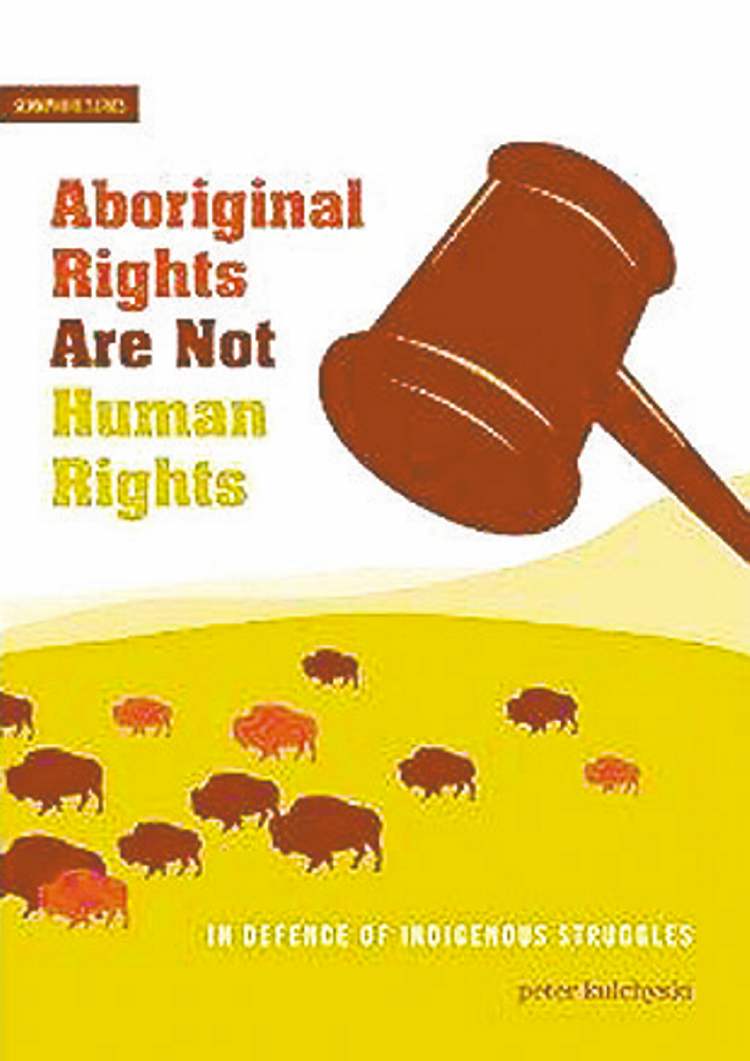
Alas, from its opening pages, Aboriginal Rights Are Not Human Rights is exasperating, largely because the material is a challenge to decipher.

Kulchyski’s decision to use limited capitalization and punctuation leaves the reader little choice but to work through the text with a pencil in hand to sort out sentences — and to separate lengthy chunks of material into paragraphs.

Does he think the conventions of English typography are to be disregarded as the tools of running-dog capitalists?

A further stylistic interference is his tendency to drop terms into his text without warning. For example, he refers to “undrip” (a term that turns out to be an acronym for United Nations Declaration on the Rights of Indigenous Peoples).

He is also inclined to sarcasm and bombast, especially when he is writing about some of his favourite bogeymen, like Manitoba Hydro.

Kulchyski has proved in the past, in books like The Sound of a Drum, that he can write forcefully. What is unfortunate about his style this time around is it diminishes the impact of his viewpoint and argument. The reader may find signs of an impressive perspective but will have difficulty untangling it.

He argues that indigenous cultures have developed uniquely, largely through struggle against domination by the state (for which he uses the term totalization).

As Kulchyski notes, when the Canadian Constitution was repatriated, aboriginal rights were included. He cites Section 35 as establishing the legal status of aboriginal rights and declaring that they cannot be overridden by human rights.

One of the most interesting sections is the one labelled “socialism and native americans.” Here Kulchyski observes the contrast between the strength of Canadian socialists’ support for solidarity around the world and the “less inspiring record of socialist support for indigenous struggles in their own backyard.”

Demonstrations against imperial ventures in Africa and Latin America seem to attract all kinds of activists. On the other hand, what he calls colonialism in Canada’s own Far North appears, at times, to have drawn rather tepid responses.

Kulchyski does give credit to some earlier activists, such as those who organized around issues involved with Haida Gwai, Grassy Narrows and the Lubicon Cree. He includes himself as one of those earlier campaigners.

He speculates the reason for the lack of “a mass outpouring of support,” such as has arisen in the past 10 years, has been the failure of the political left to appreciate the “particularity of oppression.” He insists “the left and aboriginal people in Canada have a lot to say to each other if they could really start talking.”

Kulchyski, however, should know he is more likely to find a receptive audience if he spoke in a language people understand.

Ron Kirbyson is a Winnipeg writer with a longtime interest in aboriginal issues.
Report Error Submit a Tip

More Stories

Trailblazer returns to share success, inspire next generation

Grace Penner 6 minute read Preview

Trailblazer returns to share success, inspire next generation

Grace Penner 6 minute read Yesterday at 5:14 PM CDT

Starstruck kids and fans zigzagged throughout the rink, anxiously waiting to get an autograph from Kati Tabin and to see their role model on the same side of the glass.

Tabin, Montreal Victoire defender and Team Canada silver medallist, on Saturday came home to the rink where it all began, the Oakbank Community Club. She brought the PWHL championship trophy, the Walter Cup, won in her third season with the club, as well as her 2026 Milan Cortina Olympic medal.

The arena was packed to the brim with fans from all over coming to see Tabin — the local player who made history in women’s hockey. Hundreds of enthusiasts of all ages lined up with their Victoire or Team Canada merchandise, some waiting over two hours to see their idol.

Eight-year-old Loxley Cierzan came with her mother, Ainsley, and other family members to meet the one and only Tabin. Cierzan has loved seeing other girls grace the ice and play the competitive sport she adores. When the PWHL takeover stopped in Winnipeg in March, she not only got to watch the game but also a practice beforehand where Tabin signed her Victoire hat.

Read
Yesterday at 5:14 PM CDT

Hospital window smasher gets 90 days in jail

Tessa Adamski 4 minute read Yesterday at 2:01 AM CDT

BRANDON — A 35-year-old man from The Pas was sentenced to 90 days in jail after he admitted to smashing a garage window in the ambulance bay of the Brandon hospital while intoxicated.

James Constant pleaded guilty in Brandon provincial court on Thursday to mischief under $5,000 and breaching a probation order that prohibited him from possessing weapons. Two additional charges, involving failing to comply with a probation order and possessing a dangerous weapon, were stayed.

On July 15, Constant was taken to the Brandon Regional Health Centre by ambulance after he overdosed and became “aggressive” and “unco-operative” with paramedics, says an agreed statement of facts read in court by Crown attorney Rich Lonstrup.

“He took a piece of wood and smashed the garage-door window within the ambulance bay,” Lonstrup said.

Daycare grapples with five-year-old’s outbursts, choking incidents

Maggie Macintosh 4 minute read Preview

Daycare grapples with five-year-old’s outbursts, choking incidents

Maggie Macintosh 4 minute read Friday, Jul. 24, 2026

A Windsor Park child-care facility is weighing a five-year-old’s right to care versus the safety of other children who have been choked.

Little People’s Place expelled a pre-schooler in the spring in response to his aggressive behaviour toward other children and staff.

The child’s family has appealed to the province for him to be reinstated.

The case is raising concerns about inclusion support resources and measures to protect everyone at the Cottonwood Road daycare.

Read
Friday, Jul. 24, 2026

Automation reaches new heights on farm

Laura Rance-Unger 4 minute read Preview

Automation reaches new heights on farm

Laura Rance-Unger 4 minute read Yesterday at 2:01 AM CDT

LANGHAM, Sask. — The thousands of farmers from across the Prairies who flock to the annual Ag in Motion show every July seem oblivious to the possibility the technology on display could one day replace many of them.

Families with children in tow, Hutterite colony workers, grandparents and young couples just starting out roamed through the 600 or more exhibitor displays, amazed at how everything about farming just keeps getting bigger, more efficient and increasingly more automated.

It’s now possible to seed using a 100-foot-wide drill — a 12-foot jump over the widest available a few years ago — provided the farmer can afford a tractor with enough horsepower to pull it. Those sell for around $850,000 and up.

Granted, the number of farms with enough acres to justify that kind of width and drawing power is still relatively small, but farms continue to grow. And it’s no secret the number of people who have the interest, skills and financial wherewithal to run them continues to shrink.

Read
Yesterday at 2:01 AM CDT

A 39-year-old woman has been charged after police say a retail theft attempt led to a knife being used against a security guard at a store on Portage Avenue.

The Winnipeg Police Service said Central District General Patrol officers arrested the woman at about 5:30 p.m. on Thursday in connection with a robbery at a retail store in the 300 block of Portage Avenue.

Police said the woman entered the store shortly before 2 p.m. and attempted to steal merchandise before being confronted by store security. Police said the suspect then brandished a knife and assaulted a security guard.

Security was able to gain control of the suspect, and police were contacted.

Pro-aboriginal polemic a challenge to decipher

Reviewed by Ron Kirbyson 3 minute read Preview

Pro-aboriginal polemic a challenge to decipher

Reviewed by Ron Kirbyson 3 minute read Saturday, Aug. 24, 2013

This locally published left-wing history lesson outlines Canadian aboriginal difficulties over several generations from coast to coast to coast.

Author Peter Kulchyski, a University of Manitoba native studies professor, has long taken an aggressive stand on behalf of aboriginal rights in journals like Canadian Dimension, Briarpatch and the Journal of Canadian Studies.

Here he examines documents ranging from elements of Canada's constitution to the United Nations Declaration on Human Rights.

Alas, from its opening pages, Aboriginal Rights Are Not Human Rights is exasperating, largely because the material is a challenge to decipher.

Read
Saturday, Aug. 24, 2013