Reconciliation and reality

Brief treatise on Indian Act makes our difficult history accessible

Advertisement

Advertise with us

Scan the online comments section of any major media outlet following an article about Indigenous issues and you will inevitably encounter some variation of “Why don’t they just get over it?”

Read this article for free:

or

Already have an account? Log in here »

To continue reading, please subscribe:

Subscribe and receive a limited-edition Free Press branded hat or tote.

Digital Subscription

One year of digital access for only $205*

  • Enjoy unlimited reading on winnipegfreepress.com
  • Read the E-Edition, our digital replica newspaper
  • Access News Break, our award-winning app
  • Play interactive puzzles

*First annual payment billed as $205.00 + GST for one year. This annual subscription will automatically renew at $233.00 + GST every 52 weeks (10% off the regular annual price of $259.35). Offer available to new and qualified returning subscribers only. Cancel any time.

To continue reading, please subscribe:

Add Free Press access to your Brandon Sun subscription for only an additional

$1 for the first 4 weeks*

  • Enjoy unlimited reading on winnipegfreepress.com
  • Read the E-Edition, our digital replica newspaper
  • Access News Break, our award-winning app
  • Play interactive puzzles
Start now

*Your next Brandon Sun subscription payment will increase by $1.00 and you will be charged $17.95 plus GST for four weeks. After four weeks, your payment will increase to $24.95 plus GST every four weeks.

Hey there, time traveller!
This article was published 14/04/2018 (3013 days ago), so information in it may no longer be current.

Scan the online comments section of any major media outlet following an article about Indigenous issues and you will inevitably encounter some variation of “Why don’t they just get over it?”

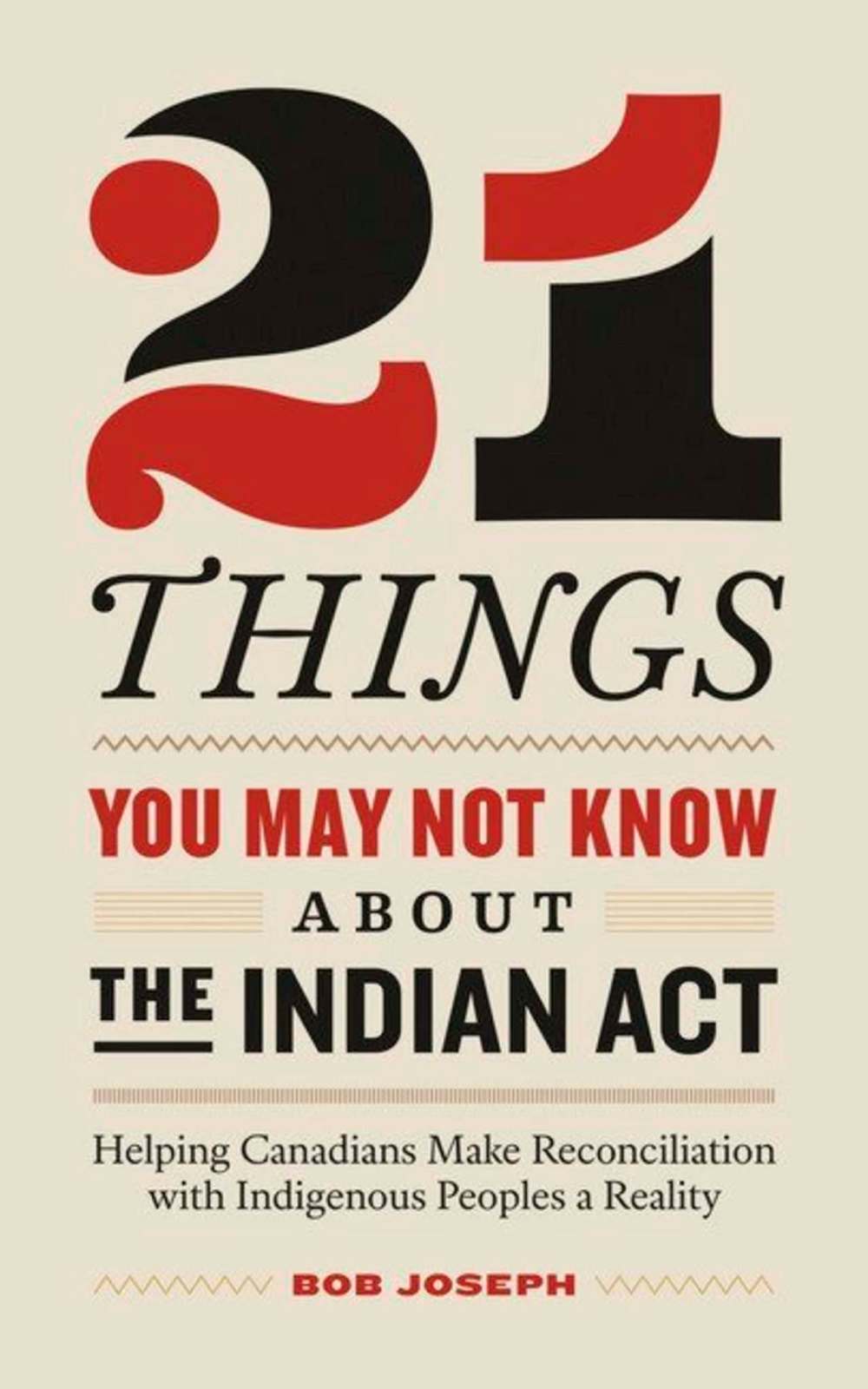
Bob Joseph has the definitive response to that racially charged rhetorical question — and, more importantly, to the ignorance behind it — that the Indian Act has made “getting over” colonialism impossible.

In his slim but powerful new book 21 Things You May Not Know About the Indian Act, Joseph documents the harsh discrimination, controls, humiliations, political dysfunctions and “catch-22s” successive Canadian governments have imposed on Indigenous peoples for the purpose of subjugating and assimilating them.

Supplied photo
Bob Joseph illustrates ways the Indian Act has affected generations of Indigenous people.
Supplied photo Bob Joseph illustrates ways the Indian Act has affected generations of Indigenous people.

Joseph is a member of the Gwawaenuk Nation in the Queen Charlotte Strait region of British Columbia. A certified trainer, Joseph is the CEO and president of Indigenous Corporate Training Inc., which he founded in 2002. His father is Chief Dr. Robert Joseph, who is the Hereditary Chief of the Gwawaenuk First Nation and member of the National Assembly of First Nations Elders Council.

Yet like his father and many others in the Gwawaenuk Nation, “Bob Joseph” owes his legal name to the assimilationist requirements of the Act and an unknown Indian agent who travelled through Joseph’s ancestral region decades ago, imposing Christian names on the band and thereby erasing their traditional hereditary and clan names.

Joseph shows how this was just one of the many ways the Indian Act controlled and harmed the lives of generations of Indigenous people. Since its passage in 1876, the act (with its various amendments) was responsible for creating the reserve system and residential schools, stripping women of their Indian status if they married a non-status man and denying Indigenous people the vote — or granting them the vote at the cost of their status.

The Indian Act imposed European-style farming practices on reserves, but made it impossible for bands to sell their produce to non-Indian customers. Even if these sales had been permitted, it would have required leaving the reserve by obtaining written permission of the Indian agent, which was rarely granted.

Joseph makes this difficult history quite accessible, methodically describing these and other human rights violations in a highly readable prose over a brief 160 pages. Following the main text is a glossary of terms, a chronology of the history of residential schools and the text of the 94 Calls to Action of the Truth and Reconciliation Commission. The book also includes discussion questions and suggested further reading, making it ideal for book club or classroom use.

WAYNE GLOWACKI/WINNIPEG FREE PRESS files
In this 2008 photo, Ron Evans, then-Grand Chief of the Assembly of Manitoba Chiefs, listens to the apology from prime minister Stephen Harper on behalf of the Canadian government for the residential schools program.
WAYNE GLOWACKI/WINNIPEG FREE PRESS files In this 2008 photo, Ron Evans, then-Grand Chief of the Assembly of Manitoba Chiefs, listens to the apology from prime minister Stephen Harper on behalf of the Canadian government for the residential schools program.

In the book’s closing pages, Joseph offers a selection of damning quotes from former prime minister Sir John A. MacDonald and Duncan Campbell Scott (who oversaw the cruelties of the residential school system between 1913 and 1932 and made attendance compulsory), including the latter’s fervent wish that “Indians… finally disappear as a separate and distinct people” through their assimilation.

The book’s final chapter sets out what Canada must do next: dismantle the act and instead work with Indigenous people on forms of self-government and self-determination, allowing First Nations to generate their own revenues through development royalties and taxes and thereby become self-reliant.

We may not as Canadians ever be able to “get over” our colonial past — nor should we — but in the future, Joseph prescribes, Indigenous and non-Indigenous Canadians will be able to transcend it and build true nation-to-nations relationships in the spirit of reconciliation.

Michael Dudley is the librarian for Indigenous Studies at the University of Winnipeg.
Report Error Submit a Tip

More Stories

More mayoral candidates would mean more ideas

Editorial 4 minute read Preview

More mayoral candidates would mean more ideas

Editorial 4 minute read 2:00 AM CDT

The absence of a competitive race for Winnipeg mayor is shaping up as one of the biggest disappointments of this year’s civic election.

Read
2:00 AM CDT

Would-be mayors respond to extreme heat

Marsha McLeod 3 minute read Preview

Would-be mayors respond to extreme heat

Marsha McLeod 3 minute read Yesterday at 7:00 AM CDT

With Winnipeg in the midst of an intense heat wave, the city has yet to introduce maximum heat legislation for rental housing.

In 2023, the Free Press and the Narwhal reported on calls by tenants and environmental advocates to enact a law that would require indoor temperatures in rental units not exceed 26 C. It would be similar to how Winnipeg landlords, under the city’s neighbourhood livability bylaw, must maintain a minimum daytime temperature of 21 C during cold weather.

On Sunday, the Free Press emailed all nine registered mayoral candidates asking for their policy plans to tackle the dangers of extreme heat, and specifically, whether they would support a change to the city’s bylaw to create heat protections for renters.

Eight candidates responded, and of them, six — Noah Redden, Don Woodstock, Mazher Alam, Christopher Clacio, Michael Vogiatzakis and Umar Hayat — said they would support (or support exploring) a bylaw amendment to establish a maximum indoor temperature threshold.

Read
Yesterday at 7:00 AM CDT

Toys ‘R’ Us closing Polo Park store

Free Press staff 2 minute read Preview

Toys ‘R’ Us closing Polo Park store

Free Press staff 2 minute read Yesterday at 8:39 PM CDT

Embattled toy retailer Toys “R” Us is closing its store in Winnipeg’s Polo Park area.

Staff hung signs sharing the news — and advertising liquidation pricing — on Friday. The signage does not indicate when the store, located at 1445 St. Matthews Ave., will close for good.

A store manager declined to comment on Monday, directing a reporter to Toys “R” Us Canada Ltd.’s head office. The company did not respond to interview requests.

Toys “R” Us announced in January it would close its Polo Park location, but reversed course a few weeks later. The Canada-wide company has been in creditor protection since February.

Read
Yesterday at 8:39 PM CDT

Mom spearheads fight for rehab services

Zoe Pierce 4 minute read Preview

Mom spearheads fight for rehab services

Zoe Pierce 4 minute read Yesterday at 2:01 AM CDT

Four years ago, a car crash permanently changed Will Castor’s life.

The 28-year-old suffered a traumatic brain injury that required a long recovery as he worked to relearn skills many people take for granted, such as eating, speaking and getting out of bed.

A key part of that journey was First Steps Wellness Centre, a Winnipeg rehabilitation facility, where Will worked with therapists to regain independence and connect with others facing similar challenges.

But on June 5, financial constraints forced First Steps to close, leaving families without the specialized therapy they had come to rely on.

Read
Yesterday at 2:01 AM CDT

U of W falls back on tuition hikes amid budget crunch

Maggie Macintosh 5 minute read Preview

U of W falls back on tuition hikes amid budget crunch

Maggie Macintosh 5 minute read Yesterday at 6:00 AM CDT

The University of Winnipeg has joined other public post-secondary institutions across the province in hiking tuition rates by four per cent — as high as possible — for the fall.

Domestic fees are increasing by more annually in 2026-27 than they have in eight years in Manitoba.

International rates, which are unregulated and roughly four times those paid by their Canadian peers, are rising even higher.

U of W’s board of regents approved a $180.7-million budget on June 22 that increases costs in undergraduate and graduate programs and phases out “low rate” courses on the downtown campus.

Read
Yesterday at 6:00 AM CDT

Artist Bistyek enjoys the freedom of living a creative life in full colour

Ben Waldman 7 minute read Preview

Artist Bistyek enjoys the freedom of living a creative life in full colour

Ben Waldman 7 minute read 2:01 AM CDT

In pants nearly as wide at the ankle as a downtown sidewalk, Bistyek cuts a striking silhouette on his daily marches through the Exchange District, an area the painter has made his muse since arriving in Winnipeg nine years ago.

He likes it here, loves it even, but as he’s established himself as one of the city’s most vibrant visual artists — with a street-honed style that pays homage to both Japanese anime series Dragon Ball Z and graffiti-inspired American painter Jean-Michel Basquiat — Bistyek won’t forget where he came from: he can’t.

Though the 30-year-old has built an enviable life here, he’s eminently aware that his circumstances are defined as much by sheer luck as they are by determination or talent. When he was growing up in Afrin, a village in Syria, his family was torn apart by civil war and discrimination against the Kurdish minority under the rule of dictator Bashar al Assad.

“I was living in Lebanon as a refugee for seven years, with a big group of friends, but day after day they started to cross the sea from Turkey or Greece. Some of them made it, some of them did not,” says the artist born Ormeya Zagros. “I turned to Mom and said, ‘I want to go across the sea. I cannot stay here. I don’t see a future here. I don’t see opportunities. There is so much discrimination and racism. I cannot build a life.’”

Read
2:01 AM CDT