The strength to endure

Plight of African citizens detailed in stories of courage, selflessness

Advertisement

Advertise with us

The meme “first-world problems” refers, sometimes flippantly, to insignificant inconveniences faced only by those who live in relative luxury in stable, free countries.

Read this article for free:

or

Already have an account? Log in here »

To continue reading, please subscribe:

Subscribe and receive a limited-edition Free Press branded hat or tote.

Digital Subscription

One year of digital access for only $205*

  • Enjoy unlimited reading on winnipegfreepress.com
  • Read the E-Edition, our digital replica newspaper
  • Access News Break, our award-winning app
  • Play interactive puzzles

*First annual payment billed as $205.00 + GST for one year. This annual subscription will automatically renew at $233.00 + GST every 52 weeks (10% off the regular annual price of $259.35). Offer available to new and qualified returning subscribers only. Cancel any time.

To continue reading, please subscribe:

Add Free Press access to your Brandon Sun subscription for only an additional

$1 for the first 4 weeks*

  • Enjoy unlimited reading on winnipegfreepress.com
  • Read the E-Edition, our digital replica newspaper
  • Access News Break, our award-winning app
  • Play interactive puzzles
Start now

*Your next Brandon Sun subscription payment will increase by $1.00 and you will be charged $17.95 plus GST for four weeks. After four weeks, your payment will increase to $24.95 plus GST every four weeks.

Hey there, time traveller!
This article was published 21/10/2017 (3192 days ago), so information in it may no longer be current.

The meme “first-world problems” refers, sometimes flippantly, to insignificant inconveniences faced only by those who live in relative luxury in stable, free countries.

People in much of the rest of the world, meanwhile, have to deal with real problems.

New Yorker staff writer Alexis Okeowo examines four areas of Africa where real problems are a way of life in her gripping and sobering first book.
Stuart Price / The Associated Press files
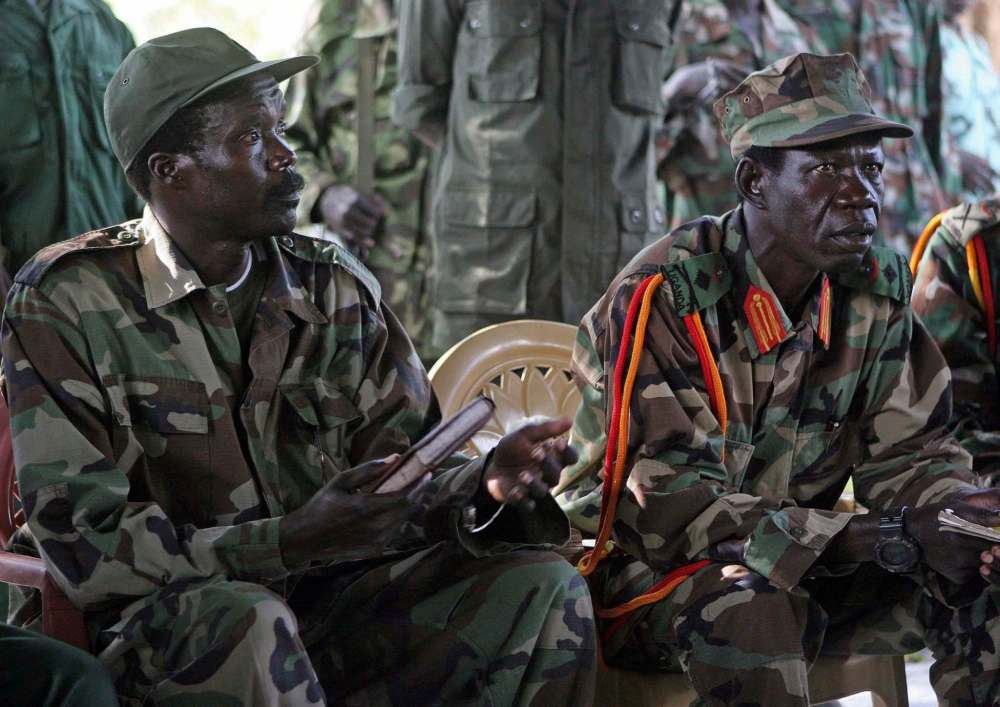
In this 2006 photo, Joseph Kony (left), leader of the Lord’s Resistance Army, and his deputy Vincent Otti sit inside a tent at Ri-Kwamba in southern Sudan.
Stuart Price / The Associated Press files In this 2006 photo, Joseph Kony (left), leader of the Lord’s Resistance Army, and his deputy Vincent Otti sit inside a tent at Ri-Kwamba in southern Sudan.

Born to Nigerian parents in the U.S., Okeowo visited Nigeria once as a child, and interned at a newspaper in Uganda (looking for adventure, she says) after growing up in Alabama and graduating from Princeton University. In America and Nigeria, Okeowo describes feeling “as an outsider in both places, an observer at the fringes.”

This “third-culture” perspective gives her observations of African issues simultaneously startling and dispassionate qualities, allowing the reader to experience the devastation endured, and sometimes transcended, by the “ordinary women and men” whose stories she tells.

The book opens with four introductory chapters, setting the personal and historical situations in Uganda, Mauritania, Nigeria and Somalia, through the lives and circumstances of particular people. Part two shows the aftermaths of these devastating experiences, and the desperate attempts to live “normal” lives in spite of the evils they have undergone.

In Uganda, Eunice’s story begins when she was kidnapped by the vicious Lord’s Resistance Army of Joseph Kony and forcibly married to LRA member Bosco. She was initially raped, but the two eventually committed to each other and to their children, and escaped back to freedom.

Their lives after the LRA show the ambivalence of their families and their culture to those who experienced — and committed — unspeakable atrocities.

The story of Haby, a Haratin (dark African) slave of lighter-skinned “white Moors” who form the upper-class oppressors in Mauritania, introduces Biram Dah Abeid, a Haratin working to free slaves, individually and collectively, against the racism of the white Moors and the failure of his beloved Islam to counter either racism or slavery.

Okeowo’s almost casual description of Mauritania’s entrenched, actually systemic race slavery provides an infuriating revelation to westerners, who have perhaps not even heard of the country. At one point she scoffs at a white Moor’s attempt to show equivalence between actual slavery and the high level of African-American incarceration in the U.S.

Biram’s first chapter ends with a cliffhanger, but the conclusion is a real-life anticlimax, frustrating for those who would like a storybook ending where Biram succeeds in eliminating slavery in his country.

The Nigerian story concerns two characters, Abba and Rebecca, whose parallel experiences eventually lead them to the vicious depredations of Boko Haram, and the attempts by Abba — now called “Elder” — to stand up to another extremist corruption of his understanding of Islam.

Aisha, a Somali woman, finds her bliss playing basketball in spite of fundamentalist opposition to sports and western culture in her country, both by the governing sharia of the Islamic Courts Union, and the militant al-Shabab — “the youth.”

The ability of people who have suffered such depraved wickedness to somehow continue to live, and sometimes even thrive, is a testament to human resilience which provides some hope even in the face of such suffering.

If Okeowo’s “outsider” perspective can awake more awareness and action in first-world readers, perhaps it will lead to even more hopeful progress.

Bill Rambo, a “third-culture kid” whose American parents grew up in India and took the family to live in the Congo during his formative years, has lived in Manitoba since 1990.

Report Error Submit a Tip

More Stories

Nine years for man who kidnapped delivery driver

Erik Pindera 5 minute read Preview

Nine years for man who kidnapped delivery driver

Erik Pindera 5 minute read Yesterday at 2:01 AM CDT

A delivery driver was kidnapped after the break-up of a business partnership involving “grey-market vapes” that were sold at Winnipeg convenience stores, a Manitoba judge has been told.

The Winnipeg Police Service said last week that investigators recently arrested a third suspect in the Oct. 11, 2024 incident, in which three men are accused of kidnapping the 22-year-old driver and holding him at gunpoint for hours as they stole merchandise from a storage facility.

One of the men arrested, 43-year-old Jonathon Ranger, pleaded guilty earlier this year to forcible confinement and two offences related to the stolen gun that was found when he was arrested in December 2024.

In June, he was sentenced to nine years in prison, minus time served, based on a joint recommendation from the Crown and defence as part of a plea bargain.

Read
Yesterday at 2:01 AM CDT

‘Harm is profound’: judge sentences man to 12 years for sexual abuse of girls

Dean Pritchard 4 minute read Preview

‘Harm is profound’: judge sentences man to 12 years for sexual abuse of girls

Dean Pritchard 4 minute read 5:39 PM CDT

A Winnipeg man has been sentenced to 12 years in prison after admitting to sexually assaulting two young girls he had lured through social media.

“Because you are young and I love it,” then-21-year-old Nathan Marinko told a 12-year-old victim in April 2023 when she asked why he liked her. “It’s hot that you are young.”

Marinko’s offending “covers the gamut of crimes of sexual violence against children,” provincial court Judge Lisa Labossiere said in a written decision released Tuesday.

“The harm is profound, multifaceted and long term, encompassing physical and psychological injuries,” Labossiere said. “The harm also extends deeply into their families, with lasting consequences that will continue well into the future.”

Read
5:39 PM CDT

Fringe reviews #2: No cheat codes required

Free Press review team 9 minute read Preview

Fringe reviews #2: No cheat codes required

Free Press review team 9 minute read Updated: 1:35 PM CDT

Dangerous Curves, Elon Muskrat, Evolution of a Broken Heart, Fool's Gambit, Hair Brained, Happy Valley, Lies of a Promiscuous Woman, Mr. Loopy Pants, Pete Seeger Tribute, Tymisha Harris

Read
Updated: 1:35 PM CDT

Order of Manitoba awarded to 12 high-achievers

Morgan Modjeski 4 minute read Preview

Order of Manitoba awarded to 12 high-achievers

Morgan Modjeski 4 minute read Yesterday at 9:03 PM CDT

It was a full circle moment for a CFL superstar whose game included giving back.

Former Winnipeg Blue Bombers running back Andrew Harris was one of 12 Order of Manitoba recipients honoured at the Manitoba legislature on Thursday.

“It’s an indescribable feeling,” Harris said after the ceremony while holding one of his sons in his arms.

Harris joined Juno award-winning artist Chantal Kreviazuk, Canada’s chief public health officer Dr. Joss Reimer, former premier Brian Pallister and others who have enriched the province, said Lt.-Gov. Anita Neville as she honoured the recipients.

Read
Yesterday at 9:03 PM CDT

Blue Bombers’ Reese picks up the pieces

Ken Wiebe 7 minute read Preview

Blue Bombers’ Reese picks up the pieces

Ken Wiebe 7 minute read 8:03 PM CDT

David Reese admits his new routine took some getting used to.

No, the Winnipeg Blue Bombers rookie defensive end wasn’t talking about the transition to the CFL game.

That’s been relatively smooth, especially over the past two games as his playing time has increased and he worked his way into a starting role.

But after spending eight years in the NCAA due to a host of injuries and circumstances such as a global pandemic, Reese said there were times he wondered if he shouldn’t be walking into a classroom, burying his head in a textbook or preparing for the next exam.

Read
8:03 PM CDT

The strength to endure

Reviewed by Bill Rambo 4 minute read Preview

The strength to endure

Reviewed by Bill Rambo 4 minute read Saturday, Oct. 21, 2017

The meme “first-world problems” refers, sometimes flippantly, to insignificant inconveniences faced only by those who live in relative luxury in stable, free countries.

People in much of the rest of the world, meanwhile, have to deal with real problems.

New Yorker staff writer Alexis Okeowo examines four areas of Africa where real problems are a way of life in her gripping and sobering first book.

Born to Nigerian parents in the U.S., Okeowo visited Nigeria once as a child, and interned at a newspaper in Uganda (looking for adventure, she says) after growing up in Alabama and graduating from Princeton University. In America and Nigeria, Okeowo describes feeling “as an outsider in both places, an observer at the fringes.”

Read
Saturday, Oct. 21, 2017