Townspeople perplexed by mysterious train trip
Advertisement
Read this article for free:
or
Already have an account? Log in here »
To continue reading, please subscribe:
Digital Subscription
One year of digital access for only $1.44 a week*
- Enjoy unlimited reading on winnipegfreepress.com
- Read the E-Edition, our digital replica newspaper
- Access News Break, our award-winning app
- Play interactive puzzles
*Billed as $5.77 plus GST every four weeks. After 52 weeks, price increases to the regular rate of $19.95 plus GST every four weeks. Offer available to new and qualified returning subscribers only. Cancel any time.
To continue reading, please subscribe:
Add Free Press access to your Brandon Sun subscription for only an additional
$1 for the first 4 weeks*
- Enjoy unlimited reading on winnipegfreepress.com
- Read the E-Edition, our digital replica newspaper
- Access News Break, our award-winning app
- Play interactive puzzles
*Your next Brandon Sun subscription payment will increase by $1.00 and you will be charged $17.95 plus GST for four weeks. After four weeks, your payment will increase to $24.95 plus GST every four weeks.
Read unlimited articles for free today:
or
Already have an account? Log in here »
Hey there, time traveller!
This article was published 31/07/2021 (1907 days ago), so information in it may no longer be current.
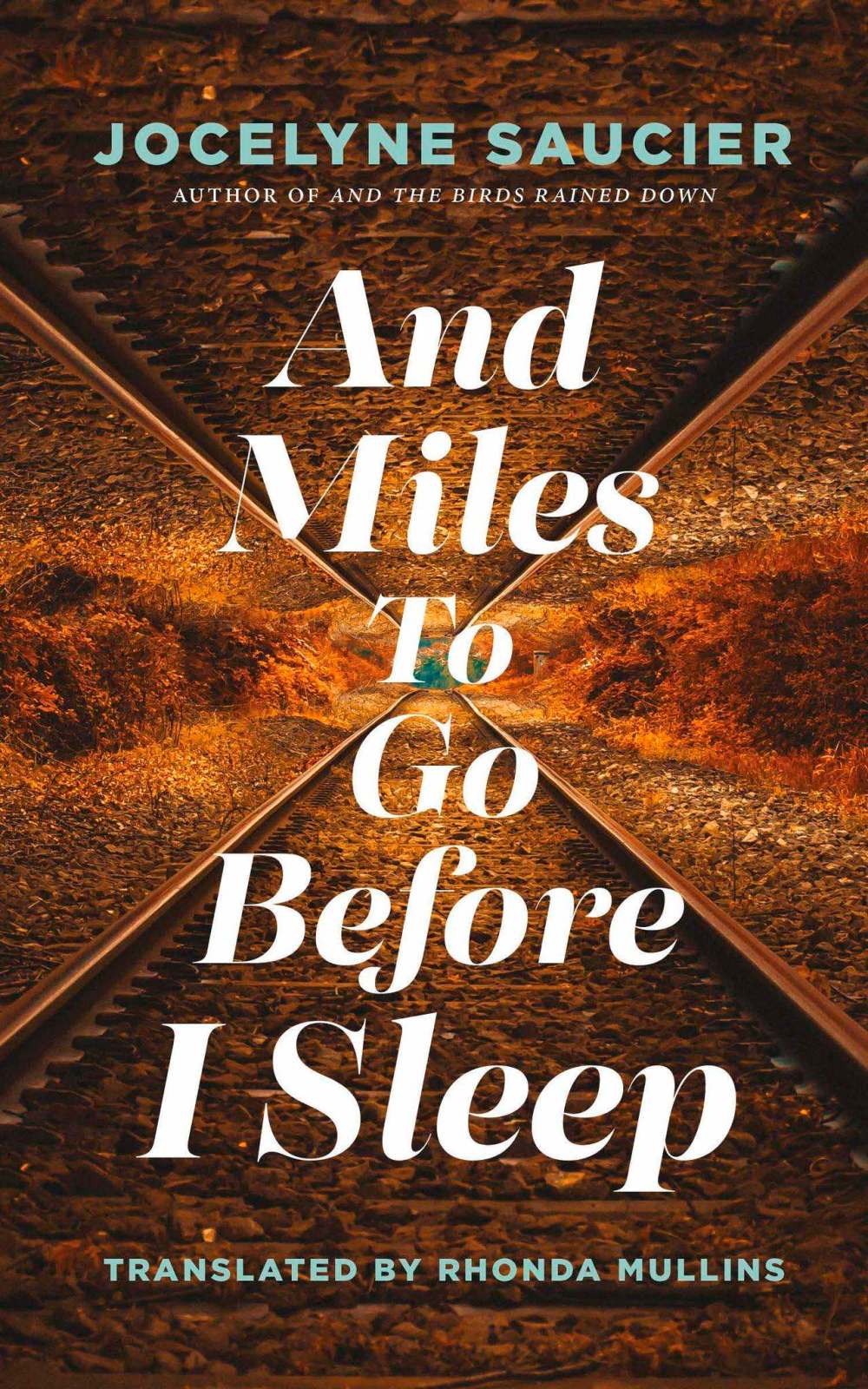
Three-time Governor General’s Literary Award finalist Jocelyne Saucier’s latest novel, And Miles to Go Before I Sleep, is a compelling philosophical novel, attentive to death, the nature and power of storytelling and what we can really know about each other.
While there are many compelling aspects to the novel — the narrator’s persona and voice, the varied secondary and tertiary characters, and Saucier’s detailed attention to languages — the novel’s first acts are mired by a conflict that has no satisfying resolution.
For the first two-thirds of the novel, the action centres on Gladys Comeau, the way her community tries to make meaning of her nostalgia-driven train journey, and what she leaves behind in Swastika (“To hell with Hitler; it was our name first”), a small town in northern Ontario.
Gladys’s neighbours, her friends and even those who know her far more distantly all describe her as optimistic, gregarious and popular. For all that her silent departure contradicts their way of knowing her, Gladys’s neighbours and friends maintain the fiction that they have a special knowledge of her and that they have a right to “repatriate” her.
Swastika is, as the the narrator comments, “not an easy place to leave,” which is one of the reasons Gladys’s unexplained departure draws such such attention. The other reason her departure draws the community’s attention and ire is that she leaves behind her daughter Lisana, who has been afflicted with major depression since she was a young woman.
Though now a woman in her 50s, Lisana is framed by the community as a constant burden — first on Gladys, then on themselves. “What was most incomprehensible, most inconceivable, is that Gladys had dumped Lisana on them,” Saucier writes. These attitudes toward Lisana are repeated in order to provide a plausible impetus to the conflict between the townspeople’s desire to have Gladys back, both to relieve them of this unwanted caregiving burden and to reassure themselves that the shape of their lives will remain stable.

The narrator, himself a train enthusiast as Gladys is, fits into this situation because he has been commissioned to write a report about the detrimental effects of decommissioning the Northern trains in Ontario and Quebec.
The first three-quarters of the novel takes the form of a mystery with no solution: Gladys’s friends and neighbours follow her journey from afar, improbably late to every possible connection, the narrator organizing the threads of his retelling to shadow her stops. There is, however, no satisfying resolution to the conundrum Gladys presents.
Because the first acts of the plot are so focused on Gladys — who knows her and how, her life story, why she is taking this journey now, where she intends to go — her death three-quarters of the way through the novel would seem to leave nothing to say. To all appearances, Gladys has tied up all of her life’s loose threads in the way of her choosing.
However, the way Gladys’s story outlives itself in the last act is a revelation of writerly skill. This is truly an ending — so open and insightful to the remaining characters’ lives and the way they tell story that remains to them — that makes the novel livelier the more one thinks about it.
Melanie Brannagan Frederiksen is a Winnipeg writer and critic.