Tribute details Brat Pack’s impact on a generation
Advertisement
Read this article for free:
or
Already have an account? Log in here »
To continue reading, please subscribe:

Digital Subscription
One year of digital access for only $205*
- Enjoy unlimited reading on winnipegfreepress.com
- Read the E-Edition, our digital replica newspaper
- Access News Break, our award-winning app
- Play interactive puzzles
*First annual payment billed as $205.00 + GST for one year. This annual subscription will automatically renew at $233.00 + GST every 52 weeks (10% off the regular annual price of $259.35). Offer available to new and qualified returning subscribers only. Cancel any time.
To continue reading, please subscribe:
Add Free Press access to your Brandon Sun subscription for only an additional
$1 for the first 4 weeks*
- Enjoy unlimited reading on winnipegfreepress.com
- Read the E-Edition, our digital replica newspaper
- Access News Break, our award-winning app
- Play interactive puzzles
*Your next Brandon Sun subscription payment will increase by $1.00 and you will be charged $17.95 plus GST for four weeks. After four weeks, your payment will increase to $24.95 plus GST every four weeks.
Read unlimited articles for free today:
or
Already have an account? Log in here »
Hey there, time traveller!
This article was published 06/03/2010 (6050 days ago), so information in it may no longer be current.
You Couldn’t Ignore Me if You Tried
The Brat Pack, John Hughes, and Their Impact on a Generation
By Susannah Gora

Crown, 365 pages, $32
Talk about your exercise in nostalgia.
If you loved The Breakfast Club and Pretty in Pink, you’ll be fascinated by this laudatory and extremely exhaustive tribute to a series of ’80s Hollywood teen comedies starring actors labelled the Brat Pack.
American film journalist Susannah Gora interviewed everyone from Molly Ringwald and Judd Nelson to Rob Lowe and Matthew Broderick for her in-depth analysis of a bygone era whose films are still being rented and reminisced about more than two decades later.
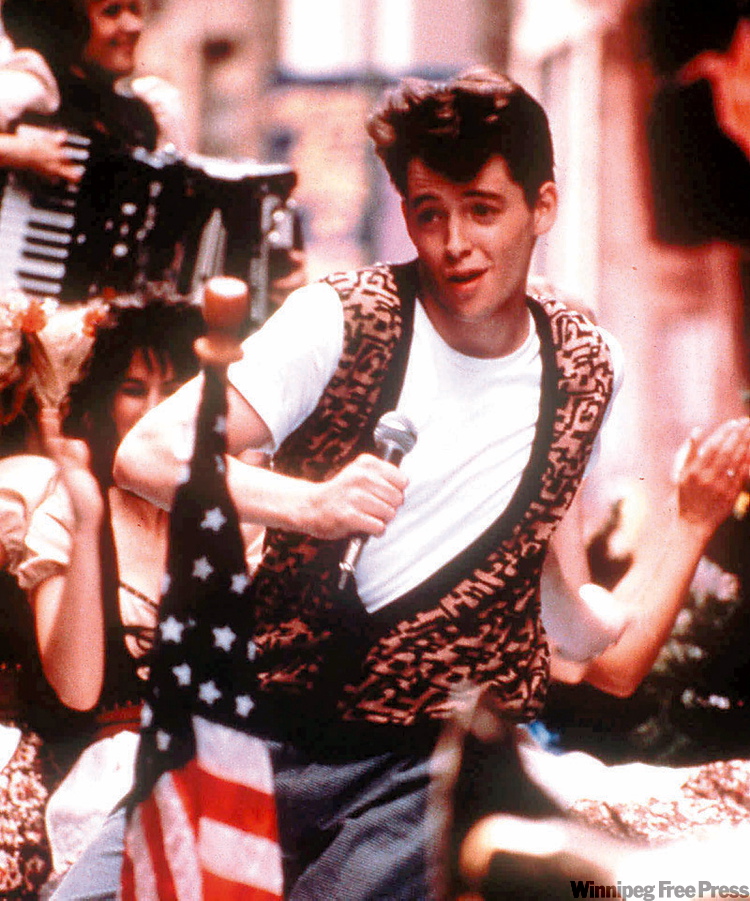
Examining such classics as Ferris Bueller’s Day Off and Sixteen Candles, Gora gives a behind-the-scenes tour of the late director/screenwriter John Hughes’s cinematic creations.
She also discusses contemporaries of Hughes who took their lead from him (Gora says Hughes was the "godfather of the genre") and created their own: filmmakers such as Cameron Crowe, Joel Schumacher and Howard Deutch.
Although Hughes never consented to be interviewed for the book prior to his sudden death from a heart attack last August at age 59, almost everyone else associated with his movies agreed to talk to Gora about him and his legendary odes to teenage angst.
The book’s somewhat vague and lengthy title is actually a line from The Breakfast Club. Gora might have been better served by calling it The Brat Pack Book, which is one of her on-line domain names and would have been far easier to remember.
The Brat Pack moniker resulted from a 1985 New York magazine story by writer David Blum.
Gora explains that the label limited the careers of such teen heartthrobs as Ringwald and Anthony Michael Hall. Yet the title is now regarded as a compliment to the enduring success they achieved together.
One of the stars of that time, Andrew McCarthy describes the films as having "defined a generation."
"These melodramas gave dignity and a voice to that age of people (teenagers) who hadn’t had a voice before."

Gora assesses the appeal of these films as "instilling a sense of optimism." At an age when young people were "struggling to find their way," these movies showed that "the nerd could get the babe, the jock could have a heart, that an awesome pink prom dress could be crafted from hand-me-downs, that anything was possible."
Gora gives readers every bit of analysis and minutiae possible, sometimes to the point of being redundant. To devotees of the productions, it will be highly informative and appealing.
She quotes film critics and sociologists as evidence of how widespread and long-lasting the fascination with these works has been.
After his final Brat Pack classic, Ferris Buehler’s Day Off (1986), Hughes directed just four other films, the final being 1991’s Curly Sue, which Gora calls "abysmal."
However, as a writer and producer, Hughes had several major hits, including the Home Alone and Beethoven comedy series.
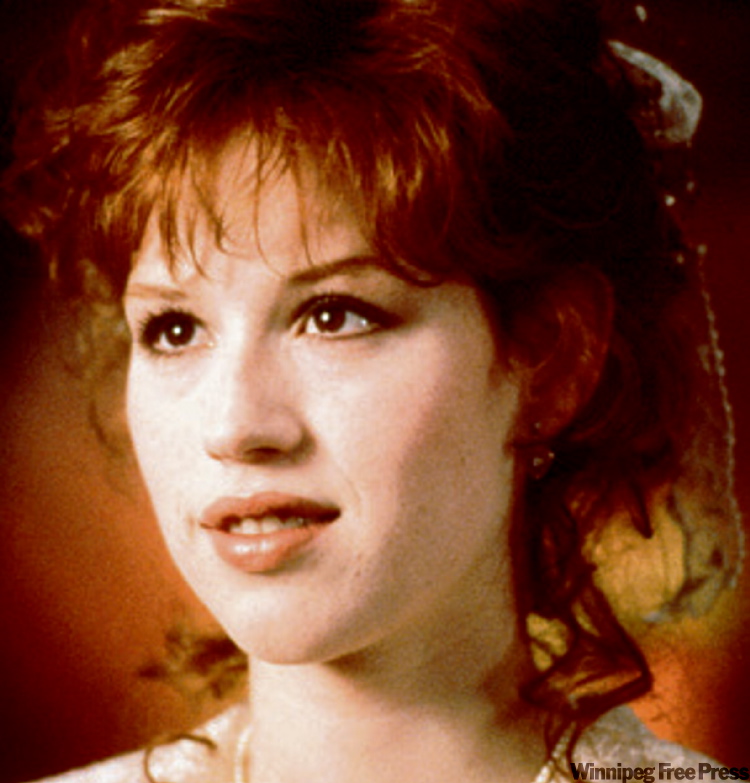
Ringwald peaked with Pretty in Pink in 1986. A year later, she set Winnipeg on its ear when she came here to shoot the disappointing teen-pregnancy comedy For Keeps.
She and many of her Brat Pack cohorts are all still working in Hollywood, Hughes moved back to his hometown of Chicago in the mid-’90s and became a recluse who shunned his show-business colleagues.
He was compared with the late J.D. Salinger due to their mutual evasion of the spotlight.
Apart from the absence of a Hughes interview, this book is missing one other important element: any photographs, which would have helped to illustrate her work.
One suspects that an unco-operative Hughes and/or his movie studio refused to give Gora’s publisher, an arm of the Random House empire, the rights to use any publicity images from the films.
Still, Gora has written a book that will form the basis of sociology and film studies courses as an important tribute to teenagers everywhere.
As Hughes himself once said about why his films have lasted: "I dealt primarily with the immutable things in human character, like belonging and loneliness. Those are all the things that are never going to change."
Brenlee Carrington, a Winnipeg lawyer, mediator and journalist, is the Law Society of Manitoba’s equity ombudswoman.
Brat Pack charter members:
Matthew Broderick
Jon Cryer
John Cusack
Anthony Michael Hall
Rob Lowe
Andrew McCarthy
Demi Moore
Judd Nelson
Molly Ringwald
Ally Sheedy
Brat Pack movies:
Sixteen Candles — 1984
The Breakfast Club — 1985

St. Elmo’s Fire — 1985
Pretty in Pink — 1986
Ferris Bueller’s Day Off — 1986
Some Kind of Wonderful — 1987
Say Anything — 1987