Walking, talking and the spectre of stalking
Fleeting glimpses and a lusty stag tale in the woods at the edge of night
Advertisement
Read this article for free:
or
Already have an account? Log in here »
To continue reading, please subscribe:
Digital Subscription
One year of digital access for only $1.44 a week*
- Enjoy unlimited reading on winnipegfreepress.com
- Read the E-Edition, our digital replica newspaper
- Access News Break, our award-winning app
- Play interactive puzzles
*Billed as $5.77 plus GST every four weeks. After 52 weeks, price increases to the regular rate of $19.95 plus GST every four weeks. Offer available to new and qualified returning subscribers only. Cancel any time.
To continue reading, please subscribe:
Add Free Press access to your Brandon Sun subscription for only an additional
$1 for the first 4 weeks*
- Enjoy unlimited reading on winnipegfreepress.com
- Read the E-Edition, our digital replica newspaper
- Access News Break, our award-winning app
- Play interactive puzzles
*Your next Brandon Sun subscription payment will increase by $1.00 and you will be charged $17.95 plus GST for four weeks. After four weeks, your payment will increase to $24.95 plus GST every four weeks.
Read unlimited articles for free today:
or
Already have an account? Log in here »
Hey there, time traveller!
This article was published 18/06/2022 (1585 days ago), so information in it may no longer be current.
Excerpt from Animal Presence in Straggle: Adventures in Walking While Female, by Tanis MacDonald
(Wolkak & Wynn, spring 2022)
In this wide-ranging collection of essays, former Winnipegger Tanis MacDonald walks the reader down many paths, pointing out the sights, exclaiming over birds, sharing stories and asking questions about just who gets to walk freely through our cities, parks and wilderness. Deer move mysteriously through these essays, knowing just when they vanish from sight, as do predators, both human and animal. She walks to begin to understand the place she now calls home in southern Ontario, catalogues the fauna around her in FaunaWatch and continues walking through illness. From a young woman watching her own distinctive walk be imitated in an acting class, to a worried daughter helping her mother relearn how to walk after a bad fall on a busy road, MacDonald shares how walking has shaped her life and the lives of many others. Wry, smart, political and lyrical, these essays share the joy of walking as well its danger and uncovers the promise it offers — of healing, of companionship and of understanding.

…
The deer by the roadside haunts me not because she was beautiful and not because of the violence of her death; she haunts me because she reminds me of the dangers of boundary crossing. Like one in five women in North America, I’m an assault survivor, and yet I go into the woods. When I say the woods, I almost always mean parks and managed forests, spaces that are tended to and are not especially wild; spaces that are both offered and denied to women and non-white men. The place I am talking about has groomed trails and signage pointing to picnic areas. Walking there is nothing like hacking through dense bush or survivalist camping. But despite its relative tameness, the foliage is thick and obscuring, the better to convince me I am far from home. Though barely wild, there are places in that managed forest far enough away from roads that trying to get home with a broken ankle would be a problem; places where I would not want to be alone at night.
Every walk I take is a defiance of my parents’ warning to be careful because anything could happen. This is depressingly ironic, as something bad did happen when I was a kid; however, that crime was not perpetrated by a dark stranger in the woods but by someone my parents knew in our very ordinary suburb in a very ordinary North American city. So maybe I’m not as afraid of the woods as I ought to be. Survivor relativism tells me that the conservation area could be a place of danger, but so could my living room. You might expect assault survivors to be afraid of many things, and we often are. But it is also sometimes true that we are not afraid of things that scare other people, in part because we’ve lived through the unimaginable.
I go to the woods to remind myself that I live a life shaped by many ideas that are dangerous to me, and that the dangers of walking alone in the woods have the advantage of being more evident, less sneaky. The woods are not going to sweet-talk or gaslight me. The woods — cold, wet, full of unexpected encounters with forms of life I don’t really understand — never pretend to be anything more than they are. There’s a small herd of urban deer living in the green corridor that starts near my house and scoops southeast. It took me a few years to see any deer at all. These deer are not laissez-faire about public view like the mule deer in Banff, many of whom don’t even look up as you pass within a few feet. These aren’t even the white-tailed deer that Daniel Coleman writes about in Yardwork — he spots those deer more often than not whenever he ventures out into the wild space that abuts his home in Hamilton. My local deer are shy, easily startled. My first sighting was of a large brown flank disappearing into the brush, and I thought it was a trick of the light. But I found hoofprints there, which meant that I had been walking in a 30-acre conservation area for three years without seeing evidence of deer until then. I was either seriously inattentive or the deer were stealthy. Probably both.
But once I knew to look, I saw more; deer would coalesce, appearing from within a mix of branches and leaves and sunlight before just as quickly melting out of view as though their molecules had seeped into the undergrowth. This near-magical ability is a skill practised by white-tailed deer, I learned from Elizabeth Marshall Thomas’s book The Hidden Life of Deer. Thomas writes that deer know precisely where their vanishing point is, the exact spot they need to get to in order to “disappear” from human sight. “Fleeing deer re-enter the woods in all sorts of places, slowing down or stopping right after they know they have disappeared,” notes Thomas, adding that “to appreciate what the deer were doing we would need to enter the woods from a field and try to figure out at which point we could no longer be seen.” Reading this, I was a little relieved that it wasn’t just a deficiency of my eyesight. The molecule-bending ability of deer has also manifested on my walks as misrecognition, like the time I mistook a small deer nosing through the leaves for a large golden dog. The second I realized my error was a telescoping moment, like when the optometrist flicks stronger lenses into those steampunk diagnostic frames and it changes what you see. Dog; flick; deer.
My oddest deer encounter inevitably involved other humans. One evening, my partner and I were hiking up a sloped forest trail when we met a man talking to two women. He was in his early 40s; a short, compact, rugged type in boots and a dark-green down vest. My partner and I discovered later that the women didn’t know him, but when he and I went to pass the group on the trail, they drew us into their conversation. The man pointed down the treed slope of ash and poplar into a small valley where three or four deer were browsing, just visible and at a safe distance from us. We peered through the trees until we could make out their shapes, seeming to waver in and out of sight, and the man resumed the story he was telling the two women, which went something like this:
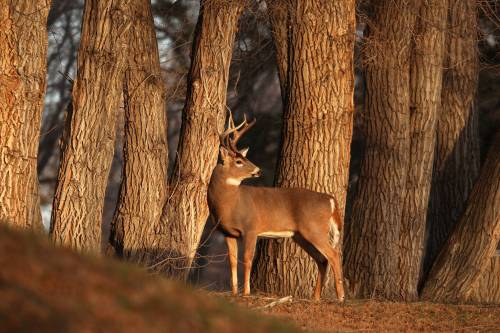
Each fall, a single stag comes all the way from the deep woods in the western part of the county, a great antlered beast who walks unseen down the narrow lines of windbreak trees in farmers’ fields, crossing roads in the dark of night. The stag makes his way into these woods, drawn by the overpowering scent of female deer in estrus. He impregnates the does and returns the way he came, following the lines of trees through neighbourhoods, over fields, around ponds to the deep Carolinian forest whence he came. Until next year.
I was willing to entertain the possibility of this deer procreation myth. I had never seen a stag in those woods, but since it took me three years to see the does, that proved nothing. I didn’t really care if the story was true, though; I cared about why he was telling it. He was eager to pull four strangers into his Lusty Stag tale, insistent about how sperm would triumph, about how nothing — fields of crops, paved roads, new suburbs — was going to stand in its way. What I liked about the story was the long link of spaces through which the stag travelled, that the county’s alignment of green spaces could mask the annual journey of a large wild mammal. If there were resident stags in the woods, the yearly appearance of an “outsider” stag could be genetically advantageous. But the story was also this guy’s fantasy of procreation, made creepily boastful when he started buttonholing women in the woods so that we would know that the mighty sperm of the Lusty Stag would not be denied. With all this doubt, something else ticks away like a metronome in the back of my head. Maggie O’Farrell’s essay Neck has stayed with me, enough to freeze my blood on this hot summer night. It’s her first-person account of an encounter with a man in a remote spot who takes advantage of her interest in wildlife to loop his binoculars around her neck from behind. This sets off O’Farrell’s alarm bells and she talks her way out of his grasp and sight, only to be visited later by the police when another young woman’s dead body is found just off the same path. We came upon the man telling two women the story, and when the story was done, the group broke up to go our separate ways. The two women walked ahead of us, and without discussing it, John, my partner, and I dropped back to create a barrier between the women and the Lusty Stag’s PR man. He might have been harmless, but he also might have had darker purposes — we could not be certain either way. We were in the woods and night was falling.
Tanis MacDonald is an essayist, poet, professor and free-range literary animal. She is the host of the podcast Watershed Writers, and the author of Out of Line: Daring to Be an Artist Outside the Big City (Wolsak & Wynn, 2018). Her essay Mondegreen Girls won The Malahat Review’s Open Seasons Award for Creative Nonfiction in 2021. She identifies as a bad birder, and lives near Ose’kowáhne in southwestern Ontario as a grateful guest on traditional Haudenosaunee territory.