Writer’s dementia chronicle compelling

Advertisement

Advertise with us

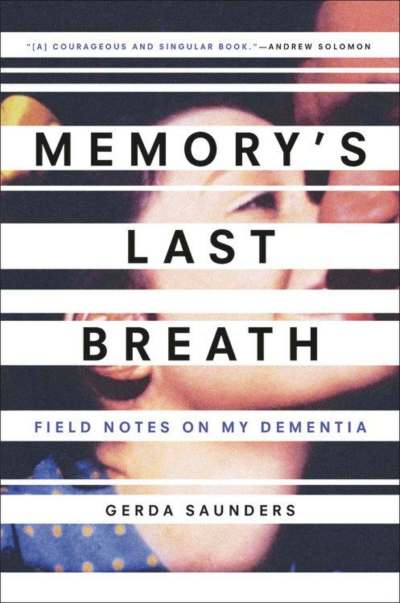
JUST before her 61st birthday in 2010, writer Gerda Saunders was diagnosed with early-onset dementia. That diagnosis triggered this book.

Read this article for free:


By clicking the button above, an account will be created and you will begin to receive some of our recommended newsletters. You may opt out of any newsletter by visiting your Email and Communication Preferences page or by clicking "unsubscribe" at the bottom of any email.

or

Already have an account? Log in here »

To continue reading, please subscribe:

Digital Subscription

One year of digital access for only $1.44 a week*

  • Enjoy unlimited reading on winnipegfreepress.com
  • Read the E-Edition, our digital replica newspaper
  • Access News Break, our award-winning app
  • Play interactive puzzles

*Billed as $5.77 plus GST every four weeks. After 52 weeks, price increases to the regular rate of $19.95 plus GST every four weeks. Offer available to new and qualified returning subscribers only. Cancel any time.

To continue reading, please subscribe:

Add Free Press access to your Brandon Sun subscription for only an additional

$1 for the first 4 weeks*

  • Enjoy unlimited reading on winnipegfreepress.com
  • Read the E-Edition, our digital replica newspaper
  • Access News Break, our award-winning app
  • Play interactive puzzles
Start now

*Your next Brandon Sun subscription payment will increase by $1.00 and you will be charged $17.95 plus GST for four weeks. After four weeks, your payment will increase to $24.95 plus GST every four weeks.

Hey there, time traveller!
This article was published 30/06/2017 (3404 days ago), so information in it may no longer be current.

JUST before her 61st birthday in 2010, writer Gerda Saunders was diagnosed with early-onset dementia. That diagnosis triggered this book.

Instead of sinking into despair, Saunders, a University of Utah associate director of gender studies, chose to robustly chronicle and investigate the awfulness of what she faced.

This is one fine record of how the disease attacks the brain of even the best and the brightest.

It’s a hybrid work — part memoir, part episodic journal entries she calls “Dementia Field Notes,” and part treatise on the neuroscience of her misfiring brain.

It’s also unbearably sad. We’re made to bear witness to a fiercely intellectual woman’s chronicle of how her brain betrays her.

Saunders, of Dutch Afrikaner descent, was born and raised in apartheid-era South Africa, but immigrated with her husband and two young children to the United States in 1984.

Her childhood memories of life in South Africa are splendidly recalled. But one of her recurring fears is that as dementia cripples her brain, she’ll revert to the unfiltered racism she learned as a child.

Her fear isn’t just speculative. Her late mother, a modest and civilized lady, also had dementia and the breakdown of her mental faculties occasioned some racist and unbecoming behaviour.

Saunders draws on workaday examples to chart the progress of her disease. She locks herself in a department store stairwell because the exit signage is no longer comprehensible to her. She gets lost while driving a short distance in her own neighbourhood because local streets and houses have become alien places. She steps out of a women’s-wear store fitting room and preens in front of a large public mirror, all the while never noticing she’s only half dressed.

It’s as if all her normal signposts, unthinking routines and familiar landscapes have vanished or been rendered unintelligible.

Saunders observes “both scholarly and popular writing frequently refers to persons with dementia as zombies.”

She confronts the brutal truth of that label.

“The disease progressively destroys the very self that used to be capable of love and its expression,” she writes.

“It eats its way into your brain, into the front and temporal lobes where (in a healthy brain) language is logically interpreted and reproduced… as the disease waxes, so you wane; as it burgeons, so you contract.”

Not wanting to ever number herself among the “living dead,” she embarked on extensive research on assisted-suicide techniques and law (inclusive of the five American states and the European countries that sanction it). Aided by legal counsel and unanimously supported by her husband and adult children, she has mapped out a plan to end her life.

The book’s only glaring weak spot lies in its final half-dozen pages. Saunders closes out her extraordinary account with a lyrical-cum-metaphysical meditation that, though clearly dear to her, comes off as affected and confusing.

But that quibble aside, this is an unflinching self-portrayal by a woman losing the key markers of her identity — her writing and speaking voices.

Absent them, she — and we — are left to wonder: is she still Gerda Saunders?

Douglas J. Johnston is a Winnipeg lawyer and writer.

Report Error Submit a Tip

More Stories

Winnipeg Jets trade Connor Hellebuyck to New Jersey Devils

Mike McIntyre 8 minute read Preview

Winnipeg Jets trade Connor Hellebuyck to New Jersey Devils

Mike McIntyre 8 minute read Friday, Oct. 23, 2026

Connor Hellebuyck finally got his wish. Kevin Cheveldayoff finally got an offer he couldn’t refuse. And a long-running sports soap opera has finally ended.

The Winnipeg Jets pulled off a blockbuster deal Friday morning, shipping their disgruntled franchise goaltender to the New Jersey Devils for a package including four players and two draft picks.

Although they liked the return, nobody within the organization was popping champagne. This was, in many ways, a dark but necessary day.

“It certainly hasn’t been fun. There’s no question about it. But at the end of the day, Connor made his choice. And, as an organization, we had to act accordingly and we did,” the general manager said during an afternoon news conference inside Canada Life Centre.

Read
Friday, Oct. 23, 2026

Mayor Gillingham poised for repeat

Chris Kitching 7 minute read Preview

Mayor Gillingham poised for repeat

Chris Kitching 7 minute read Friday, Oct. 23, 2026

Incumbent mayoral candidate Scott Gillingham remains in the lead among decided voters in a new poll that suggests a majority of Winnipeggers want change ahead of Wednesday’s election.

Gillingham was backed by 36 per cent of decided voters in an Abacus Data survey released Friday, followed by candidates Kevin Klein (19 per cent) and Mike Vogiatzakis and a surging Noah Redden, who were tied for third (both at 14 per cent).

While a majority of respondents expressed a desire for a new mayor, Curtis Brown, a vice-president with Abacus, said “none of the other candidates has convincingly made the case that they represent the best change.”

“In the absence of that, Scott Gillingham definitely has the advantage. He looks likely to be able to win,” Brown said.

Read
Friday, Oct. 23, 2026

Writer’s dementia chronicle compelling

Reviewed by Douglas J. Johnston 3 minute read Preview

Writer’s dementia chronicle compelling

Reviewed by Douglas J. Johnston 3 minute read Friday, Jun. 30, 2017

JUST before her 61st birthday in 2010, writer Gerda Saunders was diagnosed with early-onset dementia. That diagnosis triggered this book.

Instead of sinking into despair, Saunders, a University of Utah associate director of gender studies, chose to robustly chronicle and investigate the awfulness of what she faced.

This is one fine record of how the disease attacks the brain of even the best and the brightest.

It’s a hybrid work — part memoir, part episodic journal entries she calls “Dementia Field Notes,” and part treatise on the neuroscience of her misfiring brain.

Read
Friday, Jun. 30, 2017

Pedestrian dies after being struck by truck

1 minute read Yesterday at 12:24 PM CDT

A man in his 60s has died after he was struck by a pickup truck at a Main Street crosswalk Friday evening.

Police officers arrived at Main and Jarvis Avenue at 7:45 p.m. Investigators believe the man was crossing Main when he was hit by the truck,  the Winnipeg Police Service said in a news release Saturday.

The man was taken to hospital and later died.

The driver remained at the scene, police said.

Air force pays tribute to retiring CC-130H Hercules planes

Chris Kitching 5 minute read Preview

Air force pays tribute to retiring CC-130H Hercules planes

Chris Kitching 5 minute read Yesterday at 6:39 PM CDT

Royal Canadian Air Force personnel in Winnipeg bid farewell Saturday to the military branch’s last remaining CC-130H Hercules planes — “workhorses” that crews flew in seemingly countless combat, rescue and transport operations.

The federal government is phasing out Canada’s fleet of CC-130H Hercules aircraft, which entered service in 1974, in favour of modern planes, including the CC-295 Kingfisher, which will be used for search-and-rescue operations out of 17 Wing Winnipeg as of November.

“It’s really part of our family and one of us. This was the backbone of a lot of things that we do here out of Winnipeg,” Col. Curtis Wright, commander of 17 Wing Winnipeg, said of the “mighty Herc” after a retirement ceremony and a flypast.

The 435 Transport Search and Rescue Squadron, based at 17 Wing Winnipeg, is the final RCAF unit to fly the CC-130H Hercules. Two Winnipeg-based planes are still being flown. They will be taken out of service Nov. 1 and Nov. 18, Wright said.

Read
Yesterday at 6:39 PM CDT

Opening of Portage and Main shows even seemingly insurmountable impasses can be overcome

Jason Syvixay 10 minute read Preview

Opening of Portage and Main shows even seemingly insurmountable impasses can be overcome

Jason Syvixay 10 minute read Yesterday at 2:00 AM CDT

There are places in a city that become more than places. Portage and Main is one of them. For generations of Winnipeggers, the intersection has represented downtown, traffic, development and civic identity. Its reopening to pedestrians in 2025, after 46 years of closure, was about more than crossing a street. It was a reminder that decisions made by one generation can shape the choices available to another — and that even seemingly permanent decisions can be reconsidered.

I have spent much of my professional life thinking about Winnipeg as a planner, working in public, private and non-profit settings. My PhD research gave me an opportunity to examine Portage and Main differently: not simply as a debate about cars and pedestrians, but as a window into how power operates in a city. I reviewed 569 archival documents spanning the 1960s to the present, interviewed 48 planners with experience in Winnipeg, and mapped the relationships between planners, politicians, developers, engineers, residents, businesses and advocacy groups.

What emerged was a story about how planning decisions become embedded in a city’s institutions, agreements, infrastructure, professional practices and political expectations — shaping not only what gets built, but who gets to influence what gets built.

The closure of Portage and Main in 1979 did not remain a decision confined to a particular political moment. Over time, it was reinforced by development agreements, physical infrastructure, property relationships, traffic-engineering practices, administrative routines, and public narratives about mobility and downtown revitalization. The people who made many of those original decisions eventually left office. The arrangements they created remained. Later planners inherited them.

Read
Yesterday at 2:00 AM CDT