MLB hopes to gain control of local broadcast deals

Advertisement

Advertise with us

NEW YORK - Major League Baseball hopes to gain control of local broadcasting agreements involving its teams, the reason behind its bid to purchase regional sports networks from The Walt Disney Co.

Read this article for free:


or

Already have an account? Log in here »

To continue reading, please subscribe:

Subscribe and receive a limited-edition Free Press branded hat or tote.

Digital Subscription

One year of digital access for only $205*

  • Enjoy unlimited reading on winnipegfreepress.com
  • Read the E-Edition, our digital replica newspaper
  • Access News Break, our award-winning app
  • Play interactive puzzles

*First annual payment billed as $205.00 + GST for one year. This annual subscription will automatically renew at $233.00 + GST every 52 weeks (10% off the regular annual price of $259.35). Offer available to new and qualified returning subscribers only. Cancel any time.

To continue reading, please subscribe:

Add Free Press access to your Brandon Sun subscription for only an additional

$1 for the first 4 weeks*

  • Enjoy unlimited reading on winnipegfreepress.com
  • Read the E-Edition, our digital replica newspaper
  • Access News Break, our award-winning app
  • Play interactive puzzles
Start now

*Your next Brandon Sun subscription payment will increase by $1.00 and you will be charged $17.95 plus GST for four weeks. After four weeks, your payment will increase to $24.95 plus GST every four weeks.

Hey there, time traveller!
This article was published 27/03/2019 (2749 days ago), so information in it may no longer be current.

NEW YORK – Major League Baseball hopes to gain control of local broadcasting agreements involving its teams, the reason behind its bid to purchase regional sports networks from The Walt Disney Co.

Disney acquired 22 RSNs as part of its $71 billion purchase of 21st Century Fox’s entertainment business this month, and the Justice Department said last June that Disney had to sell the networks as a condition of the deal.

“There’s tremendous revenue disparity in our game, and I think that if we had more of a national model closer to where the NFL is it would solve a lot of those competitive issues for us, kind of level the playing field.” baseball Commissioner Rob Manfred said Wednesday.
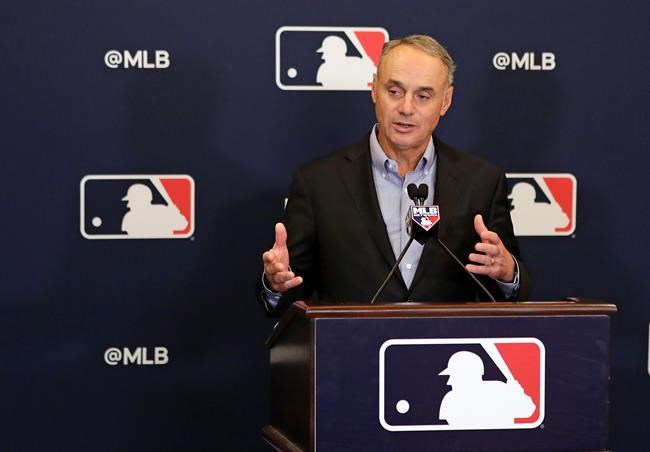
FILE - In this Feb. 8, 2019 file photo, Rob Manfred, commissioner of Major League Baseball, speaks during a news conference at owners meetings in Orlando, Fla. Major League Baseball and Reds are this season commemorating the 150th anniversary of the Cincinnati Red Stockings, who pioneered professional baseball. Manfred will be grand marshal Thursday, March 28 of the 100th Findlay Market Opening Day Parade in Cincinnati. The colorful parade featuring floats, marching bands and celebrities will begin winding through the city. (AP Photo/John Raoux, File)

“I think that all of the difficult issues for baseball, if you took that revenue disparity out of the picture, would be easier.”

The New York Yankees have a right of first refusal to buy back control of their YES Network and have arranged partners for their own deal. MLB wants to purchase the remaining networks.

“Strategically, it would be a very interesting move for us,” Manfred said during a breakfast at The Paley Center for Media.

“Our game has always had sort of a national broadcast component that’s come out of New York. But the bulk of our business has been local. And the idea of a central baseball having more control over local rights is one that’s really intriguing to us. If we do the transaction, we’ll do it on the theory that we will try to accumulate more.”

Leagues and teams are worried over the cord-cutting trend and how to react with the emergence of over-the-top digital streaming.

“You’re buying an ongoing RSN business, which generates really significant profits right now,” Manfred said. “I think everybody knows that it’s probably going to degrade over time as the cable model erodes.

“I think for us, we’d be prepared to live with that, run out of profitability and at the end of that runout, assuming it comes to some sort of a hard end, we would be in control of the content, which we fundamentally believe in, and we think that holding it as a lead better positions us to figure out exactly what that next distribution model is going to look like for the benefit of the league, as opposed to having some kind of private equity firm owning the RSNs.”

___

More AP MLB: https://apnews.com/MLB and https://twitter.com/AP_Sports

Report Error Submit a Tip

More Stories

The election of our discontent: City at a crumbling crossroads, grumbling residents say in poll

Matthew Frank 7 minute read Preview

The election of our discontent: City at a crumbling crossroads, grumbling residents say in poll

Matthew Frank 7 minute read Yesterday at 2:37 PM CDT

There’s an undercurrent of unhappiness running through the Winnipeg electorate as the municipal election day approaches.

One-half of Winnipeggers believe the city is heading in the wrong direction, according to a new Abacus Data poll, with nearly one-third unsure if Winnipeg is regressing or progressing.

Only 21 per cent of residents believe the city is on the right track, the Free Press-commissioned poll found.

That discontentment extends to how the city spends its tax dollars, with four in 10 Winnipeggers believing they receive poor value for what they pay in property taxes.

Read
Yesterday at 2:37 PM CDT

Letters, Oct. 5

7 minute read 2:01 AM CDT

Fighting the good fight

Re: Transit, roads and city council’s priorities (Oct. 2)

Many thanks to Erna Buffie for once again speaking up for transit.

When will Winnipeg finally make the shift from a car-dependent culture to a greener and more efficient way?

Three could prove an awkward crowd

Maureen Scurfield 4 minute read 2:00 AM CDT

DEAR MISS LONELYHEARTS: My girlfriend and I — two women in our late 20s — are finally getting married.

Previously, we were both living with guys and it didn’t ever work for us. She thinks marriage itself was not her problem, but that guys are basically not suited to “loving” in the special ways two women can love.

So, here I am getting ready to give marriage another go — but with her! She’s a woman who’s a wonderful chef, decorator and a mother of two from her previous marriage. The problem we have as partners? I don’t care for the domestic arts myself — but I’d still like to have a child of my own.

That brings up another issue. I also have a male friend who’d be happy to get me pregnant — an old pal of mine who is a bachelor and would like to be a father and continue being platonic friends with me. He’d also help support the child financially.

Bombers on outside looking in after beatdown from Als

Taylor Allen 7 minute read Preview

Bombers on outside looking in after beatdown from Als

Taylor Allen 7 minute read Yesterday at 6:34 PM CDT

The visitors’ locker room at Percival Molson Memorial Stadium was eerily quiet late Saturday night.

Many of the Winnipeg Blue Bombers sat in their stalls with dejected looks on their faces, trying to wrap their heads around what had just transpired: a 37-10 beatdown at the hands of the Montreal Alouettes.

“(That game) felt like s—-, honestly,” receiver Tim White told the Free Press postgame.

And the Bombers have plenty of reason to feel that way, especially when looking at the West Division standings.

Read
Yesterday at 6:34 PM CDT

Thank Manitoba’s teachers by investing in students

Lillian Klausen 5 minute read 2:00 AM CDT

Manitoba’s students are settling into a new school year. Whether you graduated in 1986 or 2006, today’s classrooms look very different from the ones you remember.

Students reflect the changing makeup of our communities — differences in social, emotional, physical and cognitive abilities and socioeconomic stresses are all increasingly present and adding to the complexity of our classrooms.

Meeting these differing individual needs is no easy feat. It requires manageable class sizes, school counsellors, social workers, specialized resource teachers and investment in the systems that can help students thrive. But when those supports aren’t available, students’ needs don’t disappear. Increasingly, it falls to classroom teachers to try to fill the gaps.

When I started working as a teacher more than 30 years ago, we had budgets for resources when we needed them. Today, the needs of students have diversified and increased, but the funding for our public schools is failing to meet them.

Puzzles Palace

1 minute read Monday, Jul. 27, 2026

To solve our puzzles, please subscribe with this special offer: |