Review: Alvarez returns with a stunning reflection on loss
Advertisement
Read this article for free:
or
Already have an account? Log in here »
To continue reading, please subscribe:

Digital Subscription
One year of digital access for only $205*
- Enjoy unlimited reading on winnipegfreepress.com
- Read the E-Edition, our digital replica newspaper
- Access News Break, our award-winning app
- Play interactive puzzles
*First annual payment billed as $205.00 + GST for one year. This annual subscription will automatically renew at $233.00 + GST every 52 weeks (10% off the regular annual price of $259.35). Offer available to new and qualified returning subscribers only. Cancel any time.
To continue reading, please subscribe:
Add Free Press access to your Brandon Sun subscription for only an additional
$1 for the first 4 weeks*
- Enjoy unlimited reading on winnipegfreepress.com
- Read the E-Edition, our digital replica newspaper
- Access News Break, our award-winning app
- Play interactive puzzles
*Your next Brandon Sun subscription payment will increase by $1.00 and you will be charged $17.95 plus GST for four weeks. After four weeks, your payment will increase to $24.95 plus GST every four weeks.
Read unlimited articles for free today:
or
Already have an account? Log in here »
Hey there, time traveller!
This article was published 08/04/2020 (2342 days ago), so information in it may no longer be current.
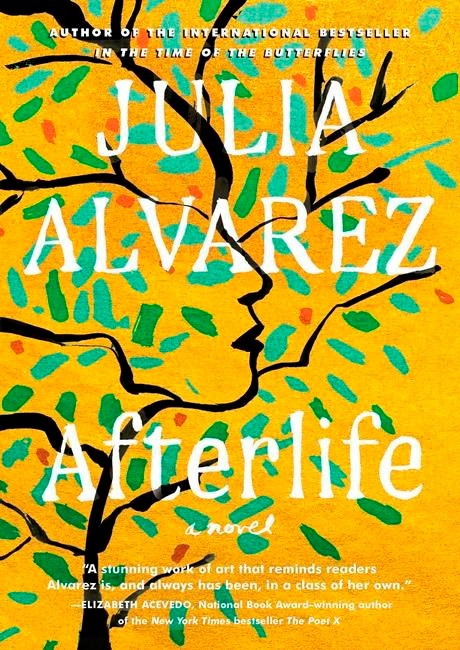
“Afterlife,” by Julia Alvarez (Algonquin Books)
I like to imagine fiction writers are a fairly collegial bunch when they’re not dreaming up stories. But more than a few of Julia Alvarez’s peers must be shaking their heads that she can take almost 15 years off from writing adult fiction and come back with a novel as striking and lovely as “Afterlife.”
The acclaimed author of “In the Time of the Butterflies” (1994) and “How the Garcia Girls Lost Their Accents” (1991) is back with another story grounded in her Dominican heritage. Set in Vermont, the book’s protagonist is Antonia Vega, a retired English professor. (Alvarez herself retired as a writer-in-residence from Middlebury College in 2016.) Widowed nine months ago after her husband Sam’s heart attack, Vega is now taking just “sips of sorrow, afraid the big wave might wash her away.” She misses the young people she used to teach and the words they shared, but mostly she misses Sam, talking to him often in her head, wondering about his afterlife and trying to figure out her own.
There are two main sub-plots of the story which test Antonia’s faith in humanity. The first involves a migrant worker on the farm that neighbours Antonia’s home. Young Mario has a girlfriend, Estela, who has employed smugglers to get her from Mexico to Colorado, but now they won’t let her get on a bus to Burlington without additional payment. Reluctantly, Antonia gets involved, helping translate and setting a series of events in motion that push her to reengage with society and navigate a broken immigration system.
The other plot involves Antonia’s “sisterhood.” She and her three sisters — Mona, Tilly and Izzy — were each born about 11 months apart and are spread out across the country. They have rotated phone calls to Antonia since Sam’s death, until Tilly invites them to Chicago to celebrate Antonia’s birthday. When eccentric Izzy doesn’t show up, the sisters are forced to hire a private detective, piecing together Izzy’s life and discovering she may have needed more than they ever gave.
Without spoiling any more plot, there are two things worth noting about this slim novel. The first is the way Alvarez inserts literary references into Antonia’s inner monologue. A slew of poets and authors play in her thoughts like a soundtrack and it’s fun for readers to either get the reference or look it up. “What happens after the worst that can happen has happened?” wonders Antonia, before the words of Wallace Stevens bubble up: “After the final no there comes a yes —?”
The second device worth noting is Alvarez’s refusal to use quotation marks. It’s jarring at first and sometimes difficult to figure out who’s talking, but you do get used to it.
Perhaps it’s just another way for Alvarez to maintain the economy of her writing. Like her main character, words are what drives her and while Antonia’s journey is all about finding more than just words to navigate a world without Sam, Alvarez finds the perfect words more often than not in this stunning novel.