AI learns to outsmart humans in video games – and real life
Advertisement
Read this article for free:
or
Already have an account? Log in here »
To continue reading, please subscribe:

Digital Subscription
One year of digital access for only $205*
- Enjoy unlimited reading on winnipegfreepress.com
- Read the E-Edition, our digital replica newspaper
- Access News Break, our award-winning app
- Play interactive puzzles
*First annual payment billed as $205.00 + GST for one year. This annual subscription will automatically renew at $233.00 + GST every 52 weeks (10% off the regular annual price of $259.35). Offer available to new and qualified returning subscribers only. Cancel any time.
To continue reading, please subscribe:
Add Free Press access to your Brandon Sun subscription for only an additional
$1 for the first 4 weeks*
- Enjoy unlimited reading on winnipegfreepress.com
- Read the E-Edition, our digital replica newspaper
- Access News Break, our award-winning app
- Play interactive puzzles
*Your next Brandon Sun subscription payment will increase by $1.00 and you will be charged $17.95 plus GST for four weeks. After four weeks, your payment will increase to $24.95 plus GST every four weeks.
Read unlimited articles for free today:
or
Already have an account? Log in here »
Hey there, time traveller!
This article was published 27/02/2023 (1320 days ago), so information in it may no longer be current.
Speed around a French village in the video game Gran Turismo and you might spot a Corvette behind you trying to catch your slipstream.
The technique of using the draft of an opponent’s racecar to speed up and overtake them is one favored by skilled players of PlayStation’s realistic racing game.
But this Corvette driver is not being controlled by a human — it’s GT Sophy, a powerful artificial intelligence agent built by PlayStation-maker Sony.
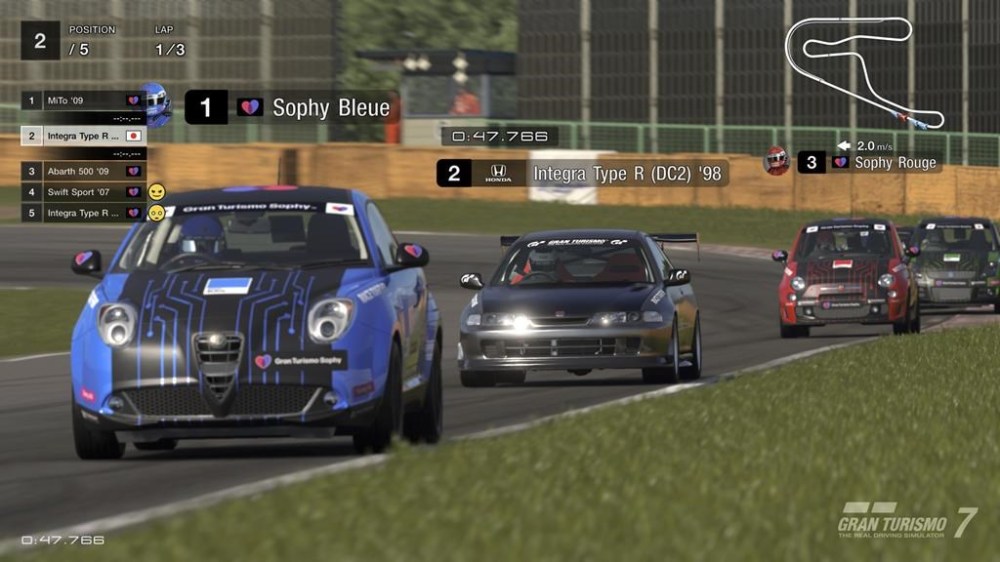
Gran Turismo players have been competing against computer-generated racecars since the franchise launched in the 1990s, but the new AI driver that was unleashed last week on Gran Turismo 7 is smarter and faster because it’s been trained using the latest AI methods.
“Gran Turismo had a built-in AI existing from the beginning of the game, but it has a very narrow band of performance and it isn’t very good,” said Michael Spranger, chief operating officer of Sony AI. “It’s very predictable. Once you get past a certain level, it doesn’t really entice you anymore.”
But now, he said, “this AI is going to put up a fight.”
Visit an artificial intelligence laboratory at universities and companies like Sony, Google, Meta, Microsoft and ChatGPT-maker OpenAI and it’s not unusual to find AI agents like Sophy racing cars, slinging angry birds at pigs, fighting epic interstellar battles or helping human gamers build new Minecraft worlds — all part of the job description for computer systems trying to learn how to get smarter in games.
But in some instances, they are also trying to learn how to get smarter in the real world. In a January paper, a University of Cambridge researcher who built an AI agent to control Pokémon characters argued it could “inspire all sorts of applications that require team management under conditions of extreme uncertainty, including managing a team of doctors, robots or employees in an ever-changing environment, like a pandemic-stricken region or a war zone.”
And while that might sound like a kid making a case for playing three more hours of Pokémon Violet, the study of games has been used to advance AI research — and train computers to solve complex problems — since the mid-20th century.
Initially, AI was used on games like checkers and chess to test at winning strategy games. Now a new branch of research is more focused on performing open-ended tasks in complex worlds and interacting with humans, not just for the purpose of beating them.
“Reality is like a super-complicated game,” said Nicholas Sarantinos, who authored the Pokémon paper and recently turned down a doctoral offer at Oxford University to start an AI company aiming to help corporate workplaces set up more collaborative teams.
In the web-based Pokémon Showdown battle simulator, Sarantinos developed an algorithm to analyze a team of six Pokémon — predicting how they would perform based on all the possible battle scenarios ahead of them and their comparative strengths and weaknesses.
Microsoft, which owns the popular Minecraft game franchise as well as the Xbox game system, has tasked AI agents with a variety of activities — from steering clear of lava to chopping trees and making furnaces. Researchers hope some of their learnings could eventually play a role in real-world technology, such as how to get a home robot to take on certain chores without having to program it to do so.
While it ”goes without stating” that real humans behave quite differently from fictional video game creatures, “the core ideas can still be used,” Sarantinos said. “If you use psychology tests, you can take this information to conclude how well they can work together.”
Amy Hoover, an assistant professor of informatics at the New Jersey Institute of Technology who’s built algorithms for the digital card game Hearthstone, said “there really is a reason for studying games” but it is not always easy to explain.
“People aren’t always understanding that the point is about the optimization method rather than the game,” she said.
Games also offer a useful testbed for AI — including for some real-world applications in robotics or health care — that’s safer to try in a virtual world, said Vanessa Volz, an AI researcher at the Danish startup Modl.ai, which builds AI systems for game development.
But, she adds, “it can get overhyped.”
“It’s probably not going to be one big breakthrough and that everything is going to be shifted to the real world,” Volz said.
Japanese electronics giant Sony launched its own AI research division in 2020 with entertainment in mind, but it’s nonetheless attracted broader academic attention. Its research paper introducing Sophy last year made it on the cover of the prestigious science journal Nature, which said it could potentially have effects on other applications such as drones and self-driving vehicles.
The technology behind Sophy is based on an algorithmic method known as reinforcement learning, which trains the system by rewarding it when it gets something right as it runs virtual races thousands of times.
“The reward is going to tell you that, ‘You’re making progress. This is good,’ or, ‘You’re off the track. Well, that’s not good,'” Spranger said.

The world’s best Gran Turismo players are still finishing ahead of Sophy at tournaments, but average players will find it hard to beat — and can adjust difficulty settings depending on how much they want to be challenged.
PlayStation players will only get to try racing against Sophy until March 31, on a limited number of circuits, so it can get some feedback and go back into testing. Peter Wurman, director of Sony AI America and project lead on GT Sophy, said it takes about two weeks for AI agents to train on 20 PlayStations.
“To get it spread throughout the whole game, it takes some more breakthroughs and some more time before we’re ready for that,” he said.
And to get it onto real streets or Formula One tracks? That could take a lot longer.
Self-driving car companies adopt similar machine-learning techniques, but “they don’t hand over complete control of the car the way we are able to,” Wurman said. “In a simulated world, there’s nobody’s life at risk. You know exactly the kinds of things you’re going to see in the environment. There’s no people crossing the road or anything like that.”

Advertisement Advertise With Us
Advertisement Advertise With Us