Ojibwe woman makes history as North Dakota poet laureate

Advertisement

Advertise with us

North Dakota lawmakers have appointed an Ojibwe woman as the state’s poet laureate, making her the first Native American to hold this position in the state and increasing attention to her expertise on the troubled history of Native American boarding schools.

Read this article for free:


or

Already have an account? Log in here »

To continue reading, please subscribe:

Subscribe and receive a limited-edition Free Press branded hat or tote.

Digital Subscription

One year of digital access for only $205*

  • Enjoy unlimited reading on winnipegfreepress.com
  • Read the E-Edition, our digital replica newspaper
  • Access News Break, our award-winning app
  • Play interactive puzzles

*First annual payment billed as $205.00 + GST for one year. This annual subscription will automatically renew at $233.00 + GST every 52 weeks (10% off the regular annual price of $259.35). Offer available to new and qualified returning subscribers only. Cancel any time.

To continue reading, please subscribe:

Add Free Press access to your Brandon Sun subscription for only an additional

$1 for the first 4 weeks*

  • Enjoy unlimited reading on winnipegfreepress.com
  • Read the E-Edition, our digital replica newspaper
  • Access News Break, our award-winning app
  • Play interactive puzzles
Start now

*Your next Brandon Sun subscription payment will increase by $1.00 and you will be charged $17.95 plus GST for four weeks. After four weeks, your payment will increase to $24.95 plus GST every four weeks.

Hey there, time traveller!
This article was published 07/04/2023 (1283 days ago), so information in it may no longer be current.

North Dakota lawmakers have appointed an Ojibwe woman as the state’s poet laureate, making her the first Native American to hold this position in the state and increasing attention to her expertise on the troubled history of Native American boarding schools.

Denise Lajimodiere, a citizen of the Turtle Mountain Band in Belcourt, has written several award-winning books of poetry. She’s considered a national expert on the history of Native American boarding schools and wrote an academic book called “Stringing Rosaries” in 2019 on the atrocities experienced by boarding school survivors.

“I’m honored and humbled to represent my tribe. They are and always will be my inspiration,” Lajimodiere said in an interview, following a bipartisan confirmation of her two-year term as poet laureate on Wednesday.
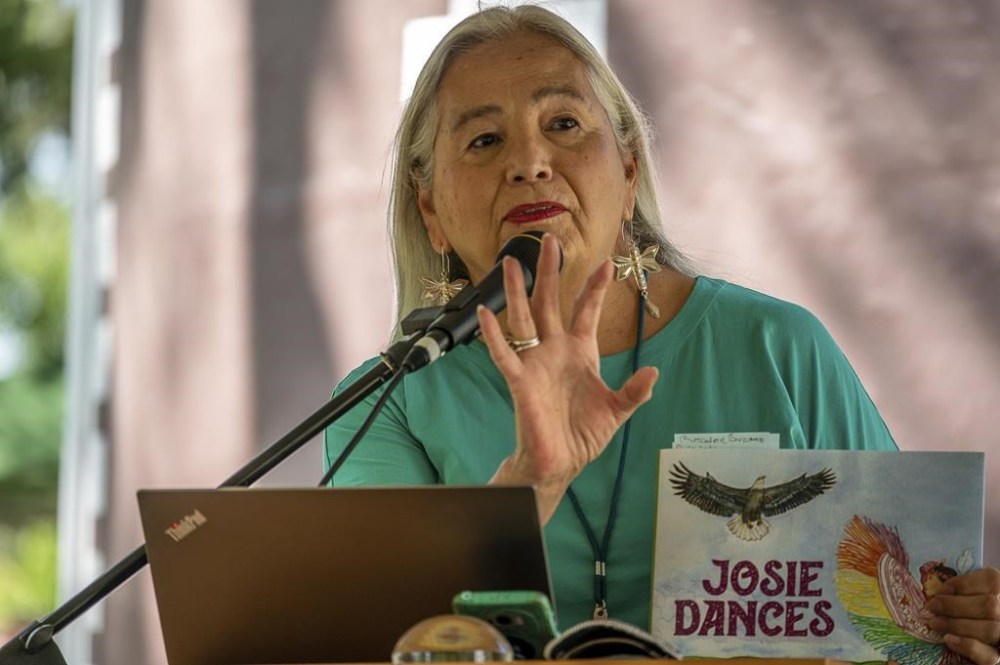
Denise Lajimodiere speaks at the Minnesota Children's Book Festival in Red Wing, Minn., on Sept. 18, 2021. Lajimodiere became North Dakota's first Native American state poet laureate in the state's history on Wednesday, April 5, 2023. (Chap Achen via AP)

Poet laureates represent the state in inaugural speeches, commencements, poetry readings and educational events, said Kim Konikow, executive director of the North Dakota Council on the Arts.

Lajimodiere, an educator who earned her doctorate degree from the University of North Dakota, said she plans to leverage her role as poet laureate to hold workshops with Native students around the state. She wants to develop a new book that focuses on them.

Lajimodiere’s appointment is impactful and inspirational because “representation counts at all levels,” said Nicole Donaghy, executive director of the advocacy group North Dakota Native Vote and a Hunkpapa Lakota from the Standing Rock Nation.

The more Native Americans can see themselves in positions of honor, the better it is for our communities, Donaghy said.

“I’ve grown up knowing how amazing she is,” said Rep. Jayme Davis, a Democrat of Rolette, who is from the same Turtle Mountain Band as Lajimodiere. “In my mind, there’s nobody more deserving.”

By spotlighting personal accounts of what boarding school survivors experienced, Lajimodiere’s book “Stringing Rosaries” sparked discussions on how to address injustices Native people have experienced, Davis said.

From the 18th century and continuing as late as the 1960s, networks of boarding schools institutionalized the legal kidnapping, abuse, and forced cultural assimilation of Indigenous children in North America. Much of Lajimodiere’s work grapples with trauma as it was felt by Native people in the region.

“Sap seeps down a fir tree’s trunk like bitter tears…. I brace against the tree and weep for the children, for the parents left behind, for my father who lived, for those who didn’t,” Lajimodiere wrote in a poem based on interviews with boarding school victims, published in her 2016 book “Bitter Tears.”

Davis, the legislator, said Lajimodiere’s writing informs ongoing work to grapple with the past like returning ancestral remains — including boarding school victims — and protecting tribal cultures going forward by codifying the federal Indian Child Welfare Act into state law.

The law, enacted in 1978, gives tribes power in foster care and adoption proceedings involving Native children. North Dakota and several other states have considered codifying it this year, as the U.S. Supreme Court considers a challenge to the federal law.

The U.S. Department of the Interior released a report last year that identified more than 400 Native American boarding schools that sought to assimilate Native children into white society. The federal study found that more than 500 students died at the boarding schools, but officials expect that figure to grow exponentially as research continues.

___

Trisha Ahmed is a corps member for the Associated Press/Report for America Statehouse News Initiative. Report for America is a nonprofit national service program that places journalists in local newsrooms to report on undercovered issues. Follow Trisha Ahmed on Twitter: @TrishaAhmed15.
Report Error Submit a Tip

More Stories

Business in brief: Kinew, Canadian ambassador to U.S. discuss trade

Free Press staff 2 minute read Yesterday at 2:01 AM CDT

Canada’s ambassador to the United States met Manitoba Premier Wab Kinew and local business leaders during a visit to Winnipeg this week.

Mark Wiseman and Kinew spoke about trade uncertainty with the United States and opportunities for Manitoba businesses, a government news release says.

The provincial U.S. Trade Council, the Business Council of Manitoba and part of the Premier’s Business and Jobs Council spoke to Wiseman about the impacts of trade uncertainty.

Province down 4,400 jobsEmployment dropped 0.6 per cent in Manitoba in September, Statistics Canada reported Friday.

Puzzles Palace

1 minute read Monday, Jul. 27, 2026

To solve our puzzles, please subscribe with this special offer: |

A Life's Story: Writer built bridges with genuine curiosity, compassion for diversity of religious practices

Janine LeGal 6 minute read Preview

A Life's Story: Writer built bridges with genuine curiosity, compassion for diversity of religious practices

Janine LeGal 6 minute read Yesterday at 6:00 AM CDT

Brenda Suderman knew how to make people feel comfortable. For a journalist, that character trait is a real strength, and it made people trust and appreciate her.

Whether covering musicals, worship spaces, the effects of pandemic shutdowns, death rituals and practices of different traditions, the discovery of the burial of 2,284 infants in unmarked graves, or any other of the countless topics she wrote about in her four- decade career, Suderman did it with genuine interest and care.

Born and raised in Winkler, Suderman grew up on a farm. Much of her childhood was spent in gardens and sugar beet fields.

Baptized at 16, she became a member of the Winkler Bergthaler Mennonite Church. The restrictions against women at the time contributed to planting the seeds of Suderman’s feminist perspective.

Read
Yesterday at 6:00 AM CDT

Phoneless concert a beautiful chance to bask in moment

Jen Zoratti 5 minute read Preview

Phoneless concert a beautiful chance to bask in moment

Jen Zoratti 5 minute read Yesterday at 2:01 AM CDT

Outside the Scotiabank Arena in Toronto, digital billboards flashed fans their singular photo op for the night: “I took this photo before I saw Phoebe Bridgers: The Lost Tour 2026.”

It is, as it is for so many other people, my only documentation of a concert by one of my favourite artists. The American singer-songwriter — who I discovered at the Winnipeg Folk Festival in 2018 — has had a meteoric rise in the past few years, winning three Grammys in 2024 as one third of Boygenius, the indie-rock supergroup rounded out by Lucy Dacus and Julien Baker, and opening for Taylor Swift on select dates of her titanic Eras Tour.

Now, Bridgers is touring in support of Lost Weekend, her third album and first since 2020’s Punisher. It’s a feat of a record, a richly textured meditation on loss and grief, written in the aftermath of the death of her dad, with whom she had a complicated relationship.

So she is in a position to not only play multiple sold-out arena shows, but also insist that those shows be phone-free.

Read
Yesterday at 2:01 AM CDT

Is this the season of secession?

David McLaughlin 5 minute read Preview

Is this the season of secession?

David McLaughlin 5 minute read Yesterday at 2:01 AM CDT

Canada has entered its season of secession. Like El Nino, the currents of grievance can blow hot and cold. Today, they are hot. But how hot for how long? The odds of Alberta and now Quebec separating from Canada are not high, but they are never zero.

After a year of waving the flag in a surge of national patriotism to confront Donald Trump’s attacks on Canada — economic and verbal — it is both jarring and frustrating for most Canadians to be reminded of the pervasive and persistent tensions that come with governing our federation.

When we need new national purpose to confront big economic sovereignty and security challenges from outside, that purpose is undermined and diminished by having to confront homegrown grievances.

We’ve seen and seen off two separation referendums in Quebec. Now we have a newly elected separatist party coming to power. In Alberta, voters will soon decide whether the independence road is one they want to travel.

Read
Yesterday at 2:01 AM CDT

Careful work goes into preserving vintage threads at costume museum

AV Kitching 6 minute read Preview

Careful work goes into preserving vintage threads at costume museum

AV Kitching 6 minute read Friday, Oct. 9, 2026

Every Friday morning seven retired women — Diane Zakala, Helen Leeds, Margaret Mills, Melinda Barr, Therese Leneveu, Karen Eastwood and Letizia Sandron — make their way from homes across the city to a nondescript warehouse in downtown Winnipeg.

The group members troop in right at 9 a.m., as they have been doing every week for the last eight years, towards the back of the brightly lit warehouse where the bulk of the collection of the Costume Museum of Canada (410-70 Arthur St.) is stored.

The vintage fashion pieces — some dating back to more than a century — have been carefully packed away in long, flat garment boxes, stacked on rows of shelves.

Some clothes are in mint condition, impeccably taken care of by their owners, while a few show signs of wear and tear and need little bit of care courtesy of expert seamstress Barr, who lovingly restores items which have incurred minimal damage.

Read
Friday, Oct. 9, 2026