Acclaimed composer Kaija Saariaho dies at age 70 of brain tumor
Advertisement
Read this article for free:
or
Already have an account? Log in here »
To continue reading, please subscribe:

Digital Subscription
One year of digital access for only $205*
- Enjoy unlimited reading on winnipegfreepress.com
- Read the E-Edition, our digital replica newspaper
- Access News Break, our award-winning app
- Play interactive puzzles
*First annual payment billed as $205.00 + GST for one year. This annual subscription will automatically renew at $233.00 + GST every 52 weeks (10% off the regular annual price of $259.35). Offer available to new and qualified returning subscribers only. Cancel any time.
To continue reading, please subscribe:
Add Free Press access to your Brandon Sun subscription for only an additional
$1 for the first 4 weeks*
- Enjoy unlimited reading on winnipegfreepress.com
- Read the E-Edition, our digital replica newspaper
- Access News Break, our award-winning app
- Play interactive puzzles
*Your next Brandon Sun subscription payment will increase by $1.00 and you will be charged $17.95 plus GST for four weeks. After four weeks, your payment will increase to $24.95 plus GST every four weeks.
Read unlimited articles for free today:
or
Already have an account? Log in here »
Hey there, time traveller!
This article was published 02/06/2023 (1221 days ago), so information in it may no longer be current.
Kaija Saariaho, who wrote acclaimed works that made her the among the most prominent composers of the 21st century, died Friday. She was 70.
Saariaho died at her apartment in Paris, her family said in a statement posted on her Facebook page. She had been diagnosed in February 2021 with glioblastoma, an aggressive and incurable brain tumor.
“The multiplying tumors did not affect her cognitive facilities until the terminal phase of her illness,” the statement said. Her family said Saariaho had undergone experimental treatment at Pitié-Salpêtrière Hospital in Paris.
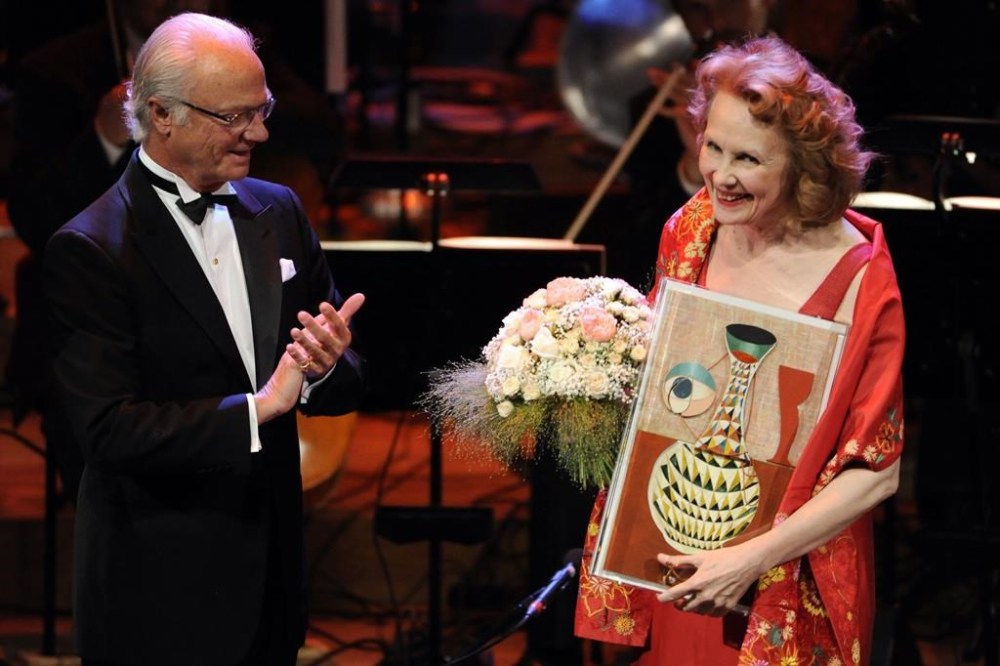
“Kaija’s appearance in a wheelchair or walking with a cane have prompted many questions, to which she answered elusively,” the family said. “Following her physician’s advice, she kept her illness a private matter, in order to maintain a positive mindset and keep the focus of her work.”
Her “L’Amour de Loin (Love from Afar)” premiered at the Salzburg Festival in 2000 and made its U.S. debut at the Santa Fe Opera two years later. In 2016, it became the first staged work by a female composer at the Metropolitan Opera since Ethel M. Smyth’s “Der Wald” in 1903.
“She was one of the most original voices and enjoyed enormous success,” Met general manager Peter Gelb said. “It had impact on one’s intellect as well as one’s emotions. It was music that really moves people’s hearts. She was truly one of the great, great artists.”
Saariaho did not like to be thought of as a female composer, rather a woman who was a composer.
“I would not even like to speak about it,” she said during an interview with The Associated Press after a piano rehearsal at the Met. “It should be a shame.”
Born in Helsinki on Oct. 14, 1952, Saariaho studied at the Sibelius Academy and the Hochschule für Musik Freiburg. She helped found a Finnish group “Korvat auki (Ears Open) in the 1970s.
“The problem in Finland in the 1970s and ’80s was that it was very closed,” she told NPR last year. “My generation felt that there was no place for us and no interest in our music — and more generally, modern music was heard much less.”
Saariaho started work in 1982 at Paris’ Institute for Research and Coordination in Acoustics/Music (IRCAM), a center of contemporary music founded in the 1970s by Pierre Boulez. She incorporated electronics in her composition.
“I am interested in spatialization, but under the condition that it’s not applied gratuitously,” she said in a 2014 conversation posted on her website. “It has to be necessary — in the same way that material and form must be linked together organically.
Inspired by viewing Messiaen’s ″St. Francois d’Assise” at the 1992 Salzburg Festival, she wrote “L’Amour de Loin.” She went on to compose “Adriana Mater,” which premiered at the Opéra Bastille in 2006 and “Émilie,” which debuted at the Lyon Opéra in 2010.
Her latest opera, “Innocence,” was first seen at the 2021 Aix-en-Provence Festival. Putting a spotlight on gun violence, the work was staged in London this spring and is scheduled for the Met’s 2025-26 season.
“This is undoubtedly the work of a mature master, in such full command of her resources that she can focus simply on telling a story and illuminating characters,” Zachary Woolfe wrote in The New York Times.
Saariaho received the University of Louisville’s Grawemeyer Award in 2003 and was selected Musical America’s Musician of the Year in 2008. Kent Nagano’s recording of “L’Amour de Loin” won a 2011 Grammy Award.
Saariaho’s final work, a trumpet concerto titled “HUSH,” is to premiere in Helsinki in Aug. 24 with Susanna Mälkki leading the Finnish Radio Symphony Orchestra.
The announcement of Saariaho’s death was posted by her husband, composer Jean-Baptiste Barrière; son Aleksi Barrière, a writer; and daughter Aliisa Neige Barrière, a conductor and violinist.