Bark beetles are eating through Germany’s Harz forest. Climate change is making matters worse

Advertisement

Advertise with us

CLAUSTHAL-ZELLERFELD, Germany (AP) — Nestled in the spruce trees in the Harz mountains of northern Germany is a bark-eating pest not much bigger than a sesame seed.

Read this article for free:


or

Already have an account? Log in here »

To continue reading, please subscribe:

Subscribe and receive a limited-edition Free Press branded hat or tote.

Digital Subscription

One year of digital access for only $205*

  • Enjoy unlimited reading on winnipegfreepress.com
  • Read the E-Edition, our digital replica newspaper
  • Access News Break, our award-winning app
  • Play interactive puzzles

*First annual payment billed as $205.00 + GST for one year. This annual subscription will automatically renew at $233.00 + GST every 52 weeks (10% off the regular annual price of $259.35). Offer available to new and qualified returning subscribers only. Cancel any time.

To continue reading, please subscribe:

Add Free Press access to your Brandon Sun subscription for only an additional

$1 for the first 4 weeks*

  • Enjoy unlimited reading on winnipegfreepress.com
  • Read the E-Edition, our digital replica newspaper
  • Access News Break, our award-winning app
  • Play interactive puzzles
Start now

*Your next Brandon Sun subscription payment will increase by $1.00 and you will be charged $17.95 plus GST for four weeks. After four weeks, your payment will increase to $24.95 plus GST every four weeks.

Hey there, time traveller!
This article was published 04/08/2023 (1132 days ago), so information in it may no longer be current.

CLAUSTHAL-ZELLERFELD, Germany (AP) — Nestled in the spruce trees in the Harz mountains of northern Germany is a bark-eating pest not much bigger than a sesame seed.

Known as “book printers” for the lines they eat into the bark that fan out from a single spine resembling words on a page, these eight-toothed beetles have always been part of the local forest. Officials expect the bugs to typically kill a few spruces each summer as they find suitable trees to lay their eggs — they burrow into the tree’s cambium, or growing layer, hampering it from getting the nutrients it needs to survive.

But the tiny insects have been causing outsized devastation to the forests in recent years, with officials grappling to get the pests under control before the spruce population is entirely decimated. Two-thirds of the spruce in the region have already been destroyed, said Alexander Ahrenhold from the Lower Saxony state forestry office, and as human-caused climate change makes the region drier and the trees more favorable homes for the beetles’ larvae, forest conservationists are preparing for the worst.
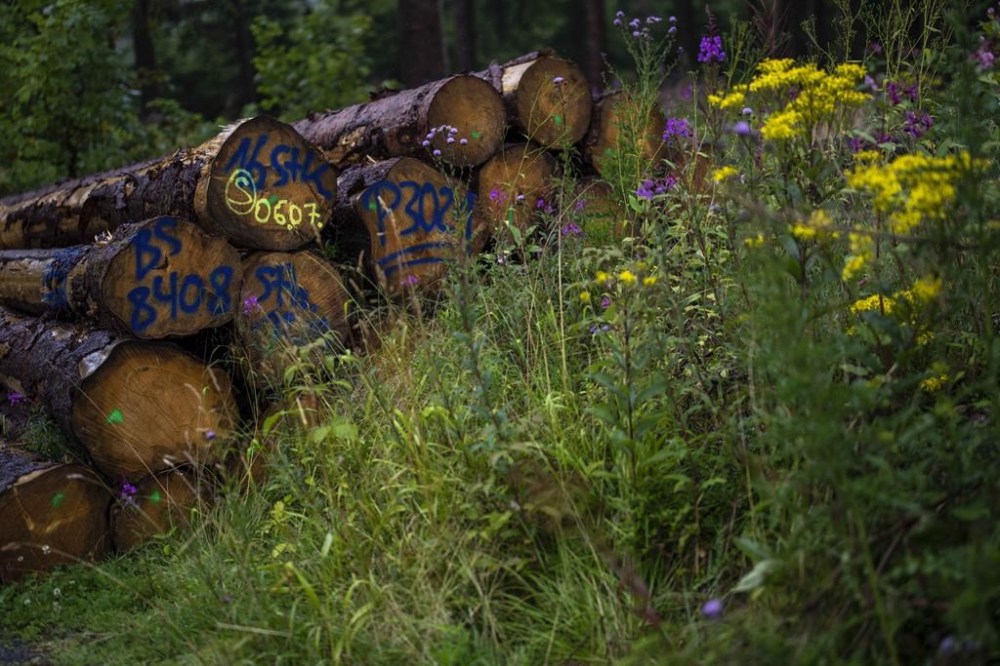
Spruce trees felled due to infestation by spruce bark beetles lie in the Lower-Saxony state forests at the Harz mountains near Clausthal-Zellerfeld, Germany, Thursday, July 27, 2023. The tiny insects have been causing outsized devastation to the forests in recent years, with officials grappling to get the pests under control before the spruce population is entirely decimated. (AP Photo/Matthias Schrader)

“Since 2018, we’ve had extremely dry summers and high temperatures, so almost all trees have had problems,” said Ahrenhold. Spruce trees in particular need a lot of water so having less of it weakens their defenses, and they’re not able to produce their natural tree resin repellent, he said.

As the planet warms, longer droughts are becoming more common around the world, with hotter temperatures also drying up moisture in soil and plants.

And even though the beetles tend to target weakened trees, in dry years the population can reproduce so much “that the beetles were even able to attack healthy spruce in large numbers,” he said. “In some regions there are now no more spruces.”

Experts say there’s no easy solution, but forest managers work to remove trees that might be susceptible to beetles as early as possible and use pesticides where they’re needed.

Michael Müller, the Chair of Forest Protection at the Technical University in Dresden, said there are “very strict requirements for the use of pesticides” which can be very effective in getting rid of the bugs, although the chemicals are sometimes frowned upon for their potentially harmful environmental side effects.

“It’s of course preferable to take the raw wood out of the forest and send it for recycling or to store it in non-endangered areas outside the forest,” he said, but noted that requires a separate logistical operation. On trees that are still standing, he said, it’s not really possible to remove the beetles.

Müller added that forest conservation measures can “sometimes take decades from being implemented to taking effect” and other factors, like storms and drought, and other species, such as game and mice that can also hamper plant growth, are potentially more damaging to the forest in the long run than the bark beetle.

But he said that conservation efforts are limited by external factors, like the changing climate. “After all, we can’t irrigate the forests,” he said.

In the longer term, mixing other tree species into the forest could be a solution, Ahrenhold said. “It makes sense to plant other conifers that can cope better with these conditions, especially on south-facing slopes and on very dry soil,” he said.

Having too many spruce trees in the Harz is a result of centuries of planting big concentrations of the tree, according to Richard Hölzl, an environmental historian at the University of Goettingen and at Five Continents Museum in Munich.
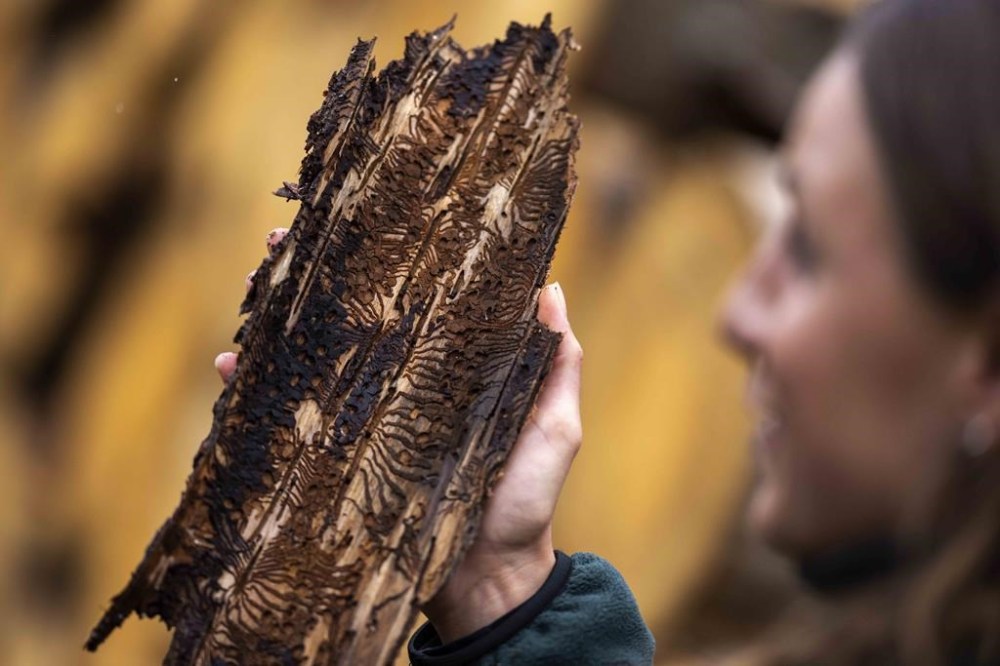
Burrows created by spruce bark beetles course across the inner side of bark pulled from an infested spruce tree in a forest in Lower-Saxony state forests at the Harz mountains near Clausthal-Zellerfeld, Germany, Thursday, July 27, 2023. The beetles are known as “book printers” for the lines they eat into the bark that fan out from a single spine, resembling words on a page. (AP Photo/Matthias Schrader)

“Clausthal-Zellerfeld is one prime example of a mining area in the Harz where they very early on tried to establish artificial reproduction for spruce to have it for mining construction works,” said Hölzl.

Officials realized by the 19th century that planting just one type of tree over and over again wasn’t a good idea ecologically, but “the economy countered that realization because spruce was such an attractive species,” he said. Spruce was the preferred tree for industrial forestry, paper mills and pulp.

Still, without the warmer and drier weather from climate change, the bark beetles wouldn’t be flourishing in all that spruce.

“There is a long, long prehistory, but there’s also the (climatic) change now,” said Hölzl. “We can’t really blame our forefathers for that.”

___

Associated Press climate and environmental coverage receives support from several private foundations. See more about AP’s climate initiative here. The AP is solely responsible for all content.


Report Error Submit a Tip

More Stories

Bark beetles are eating through Germany’s Harz forest. Climate change is making matters worse

Matthias Schrader And Dana Beltaji, The Associated Press 5 minute read Preview

Bark beetles are eating through Germany’s Harz forest. Climate change is making matters worse

Matthias Schrader And Dana Beltaji, The Associated Press 5 minute read Monday, Aug. 7, 2023

CLAUSTHAL-ZELLERFELD, Germany (AP) — Nestled in the spruce trees in the Harz mountains of northern Germany is a bark-eating pest not much bigger than a sesame seed.

Known as “book printers” for the lines they eat into the bark that fan out from a single spine resembling words on a page, these eight-toothed beetles have always been part of the local forest. Officials expect the bugs to typically kill a few spruces each summer as they find suitable trees to lay their eggs — they burrow into the tree’s cambium, or growing layer, hampering it from getting the nutrients it needs to survive.

But the tiny insects have been causing outsized devastation to the forests in recent years, with officials grappling to get the pests under control before the spruce population is entirely decimated. Two-thirds of the spruce in the region have already been destroyed, said Alexander Ahrenhold from the Lower Saxony state forestry office, and as human-caused climate change makes the region drier and the trees more favorable homes for the beetles' larvae, forest conservationists are preparing for the worst.

"Since 2018, we've had extremely dry summers and high temperatures, so almost all trees have had problems," said Ahrenhold. Spruce trees in particular need a lot of water so having less of it weakens their defenses, and they're not able to produce their natural tree resin repellent, he said.

Read
Monday, Aug. 7, 2023

Grieving families, local leaders want review of Interlake intersection after teens die in crash

Chris Kitching 8 minute read Preview

Grieving families, local leaders want review of Interlake intersection after teens die in crash

Chris Kitching 8 minute read Updated: Yesterday at 6:34 PM CDT

A two-vehicle crash that killed four teenage friends in the Interlake Sunday night prompted outpourings of grief in several communities and calls for safety improvements at the intersection, which was also the site of a death in July.

Recent high school graduates Maya Borsa and Chloe Vermette, both 18, were identified by their families as victims of the collision at Highway 8 and Provincial Road 229, just west of Winnipeg Beach.

“(Chloe) was a very bubbly, loving personality. Always giving, always caring. Her friends meant the world to her,” said her mother, Veronique Vermette, who struggled to comprehend the tragedy when she went to the scene Monday. “We sat in the rain for hours, and it blew my mind that four lives were taken.”

The teens’ parents are waiting for RCMP to provide more information about the cause of the crash. Chloe, who graduated from Windsor Park Collegiate in Winnipeg in July, was driving one of the vehicles, her mother said.

Read
Updated: Yesterday at 6:34 PM CDT

Parts of River Heights hammered by storm

Melissa Martin 5 minute read Preview

Parts of River Heights hammered by storm

Melissa Martin 5 minute read Monday, Sep. 7, 2026

A powerful storm cut a swath of destruction through River Heights on Sunday, leaving much of the area without power.

Nobody was hurt in the storm.

By the time it subsided, parts of the quiet neighbourhood, especially Borebank and Lindsay streets between Grant and Taylor, had been ravaged: power lines downed, Manitoba Hydro poles toppled, trees splintered and crashed down on vehicles and homes.

In one case, a vehicle was flipped into a yard and sat under a partially downed tree. Shingles were stripped from roofs. Some residents described looking out during the storm and seeing power lines ablaze and the blue glow of electricity arcing over their backyards.

Read
Monday, Sep. 7, 2026

Bumps in the road as students collect free bus passes

Maggie Macintosh 5 minute read Preview

Bumps in the road as students collect free bus passes

Maggie Macintosh 5 minute read Yesterday at 9:17 PM CDT

Alexis Enns left her guidance counsellor’s office empty-handed, but no less excited about starting Grade 12 — even though she still didn’t know how she would get there or her timetable — on Tuesday.

Read
Yesterday at 9:17 PM CDT

South Winnipeg neighbourhood will be first to go geothermal

Chris Kitching 4 minute read Preview

South Winnipeg neighbourhood will be first to go geothermal

Chris Kitching 4 minute read Updated: 5:07 PM CDT

A new neighbourhood in south Winnipeg will be Manitoba’s first to use a shared, large-scale geothermal system to heat and cool hundreds of homes over coming decades.

The province is giving up to $4 million to the developers of Southwood Circle, just north of the University of Manitoba’s Fort Garry campus, for a district geothermal system as part of the NDP’s goal to reach net-zero greenhouse gas emissions by 2050.

“It means a whole neighbourhood can tap into geothermal, which means low-carbon heating and cooling for at least 1,000 homes,” Premier Wab Kinew said at a news conference Wednesday.

Geothermal systems, equipped with pumps and pipes, use underground temperatures to heat and cool one or more buildings. Proponents point to long-term energy and cost savings compared with conventional heating and cooling systems.

Read
Updated: 5:07 PM CDT

Battling agencies would have far greater impact on homeless crisis by working together

Dan Lett 5 minute read Preview

Battling agencies would have far greater impact on homeless crisis by working together

Dan Lett 5 minute read 3:14 PM CDT

In the midst of one of the most concerted efforts to reduce, if not eliminate, homelessness, why are two of Winnipeg’s more prominent social service agencies fighting each other?

Read
3:14 PM CDT