Borrow a bee colony? West Vancouver library loans out pollinators
Advertisement
Read this article for free:
or
Already have an account? Log in here »
To continue reading, please subscribe:

Digital Subscription
One year of digital access for only $205*
- Enjoy unlimited reading on winnipegfreepress.com
- Read the E-Edition, our digital replica newspaper
- Access News Break, our award-winning app
- Play interactive puzzles
*First annual payment billed as $205.00 + GST for one year. This annual subscription will automatically renew at $233.00 + GST every 52 weeks (10% off the regular annual price of $259.35). Offer available to new and qualified returning subscribers only. Cancel any time.
To continue reading, please subscribe:
Add Free Press access to your Brandon Sun subscription for only an additional
$1 for the first 4 weeks*
- Enjoy unlimited reading on winnipegfreepress.com
- Read the E-Edition, our digital replica newspaper
- Access News Break, our award-winning app
- Play interactive puzzles
*Your next Brandon Sun subscription payment will increase by $1.00 and you will be charged $17.95 plus GST for four weeks. After four weeks, your payment will increase to $24.95 plus GST every four weeks.
Read unlimited articles for free today:
or
Already have an account? Log in here »
Hey there, time traveller!
This article was published 23/03/2024 (921 days ago), so information in it may no longer be current.
VANCOUVER – Patrons at the West Vancouver Memorial Library are abuzz over a loan program of mason bees that come with their own “bungalow.”
The bee program is a bid to educate people about the need for pollinators and how simple it is to raise these easygoing insects, said Taren Urquhart, the library’s arts and special events programmer.
Participants must first take in a 60-minute lecture to learn the basics about the bees’ life cycle and how to take care of their homes, Urquhart said, then they can borrow the home along with the dormant young bees to begin a year of beekeeping.

“They are fascinating. Once you start learning about them, you’ll get hooked,” she said. “They are very gentle and easy to raise in your backyard.”
The bungalow is a circular tube made out of plumbing piping, about 10 centimetres in circumference. Inside are several grass reed tubes that look like thick straws. The bees spend the spring filling the tubes with their eggs, along with nectar and pollen to feed their young, before their lifecycle is complete in June, Urquhart said.
Ten to 15 mason bee cocoons can be borrowed along with the bungalow by anyone who has a West Vancouver Memorial Library card.
The colony can be attached outside a home or even on an apartment patio.
The program started during the pandemic three years ago, and while registration is full this year with 27 bee homes loaned out, Urquhart said she’s happy to add anyone who wants to take part to the list.
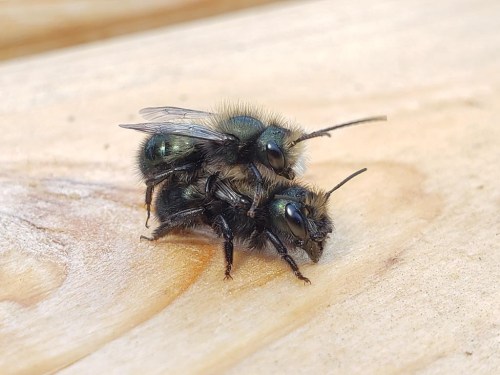
Unlike honeybees, which were brought to North America by European settlers, mason bees are native to B.C. They are solitary pollinators, preferring to work alone but live together in a colony.
The don’t make honey and they aren’t stingers. In the 30 years Urquhart has worked with the insects, she said she’s been stung twice.
There’s no yellow on these bees, and they can be confused for houseflies because their bodies are a shimmering black and blue.
“You’ve probably seen them in your backyard and not known they were a bee,” said Urquhart.
They are hard workers, she said, noting that while honeybees head in when it showers the masons are still moving plant to plant.
“They are very, very effective pollinators. In fact, much better pollinators than the honeybees,” she said.
Lesley Childs, a staff member at the library, said she started mason bee-keeping ten years ago after receiving a bee house made by Urquhart‘s father.
“The first year I put the bees in, I noticed that I had so much more fruit from the plum tree. It was amazing and I found my garden is very productive,” said Childs.
She now has three bee houses and said she enjoys spending her time watching them.
Those who borrowed the bee home are invited back to the library each spring for a cocoon washing party, to ensure the environment is clean so the young have a better chance of survival.
“We open up all the tubes, we washthe cocoons, and we learn from each other,” said Urquhart.
The program has attracted a wide range of beekeepers, from young families with children and seniors who want to get involved with nature, to people who weren’t your typical “bug people,” she said.
“They are like, ‘I don’t know what I’m getting into,’ but once we start handling them … I want them to touch them. I want them to be curious,” she said.
In fact, Urquhart said the project is more than just about bee-keeping, it’s also helping to provide safe, clean habitat for the insects.
“I think as humans, we jump a little too fast. We are like, ‘let’s make houses for bees,’ but we don’t look, are we doing this right? Are we keeping them clean? We are asking them to live in a very small contained area, which isn’t natural.
“So, let’s make sure we are looking after them.”
This report by The Canadian Press was first published Mar. 23, 2024.