Judge in Trump case orders media not to report where potential jurors work

Advertisement

Advertise with us

NEW YORK (AP) — The judge in Donald Trump's hush money trial ordered the media on Thursday not to report on where potential jurors have worked and to be careful about revealing information about those who will sit in judgment of the former president.

Read this article for free:


or

Already have an account? Log in here »

To continue reading, please subscribe:

Subscribe and receive a limited-edition Free Press branded hat or tote.

Digital Subscription

One year of digital access for only $205*

  • Enjoy unlimited reading on winnipegfreepress.com
  • Read the E-Edition, our digital replica newspaper
  • Access News Break, our award-winning app
  • Play interactive puzzles

*First annual payment billed as $205.00 + GST for one year. This annual subscription will automatically renew at $233.00 + GST every 52 weeks (10% off the regular annual price of $259.35). Offer available to new and qualified returning subscribers only. Cancel any time.

To continue reading, please subscribe:

Add Free Press access to your Brandon Sun subscription for only an additional

$1 for the first 4 weeks*

  • Enjoy unlimited reading on winnipegfreepress.com
  • Read the E-Edition, our digital replica newspaper
  • Access News Break, our award-winning app
  • Play interactive puzzles
Start now

*Your next Brandon Sun subscription payment will increase by $1.00 and you will be charged $17.95 plus GST for four weeks. After four weeks, your payment will increase to $24.95 plus GST every four weeks.

Hey there, time traveller!
This article was published 18/04/2024 (899 days ago), so information in it may no longer be current.

NEW YORK (AP) — The judge in Donald Trump’s hush money trial ordered the media on Thursday not to report on where potential jurors have worked and to be careful about revealing information about those who will sit in judgment of the former president.

Judge Juan Merchan acted after one juror was dismissed when she expressed concerns about participating in the trial after details about her became publicly known.

The names of the jurors are supposed to be a secret, but the dismissed juror told Merchan she had friends, colleagues and family members contacting her to ask whether she was on the case. “I don’t believe at this point I can be fair and unbiased and let the outside influences not affect my decision-making in the courtroom,” she said.
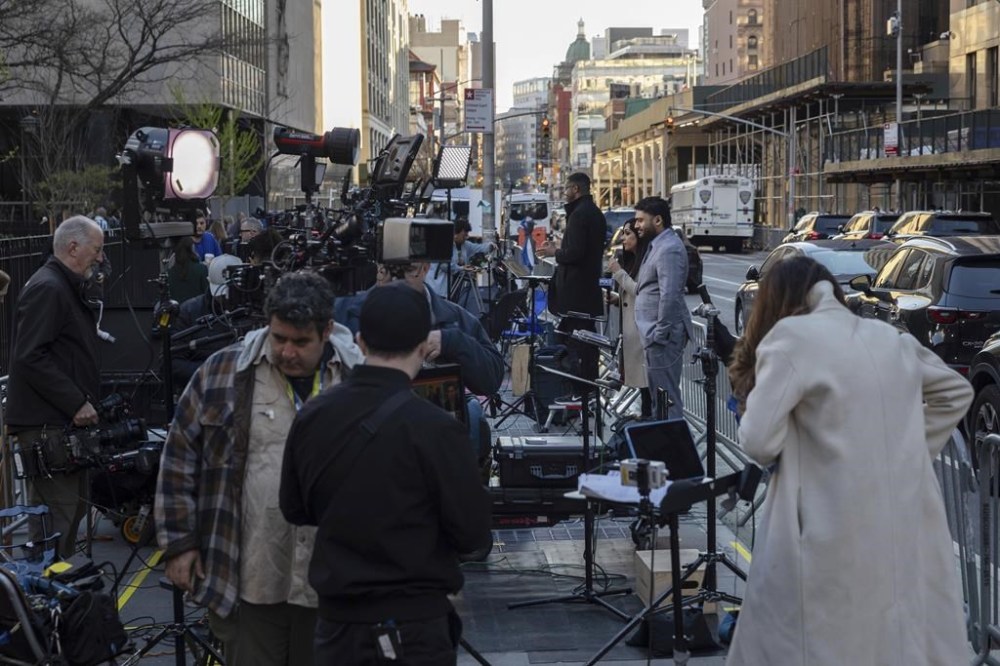
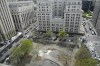
Members of the media gather outside Manhattan Criminal Court, Tuesday, April 16, 2024, in New York. Former President Donald Trump will return to court as a judge works to find a panel of jurors who will decide whether the former president is guilty of criminal charges alleging he falsified business records to cover up a sex scandal during the 2016 campaign. (AP Photo/Yuki Iwamura)

Merchan then directed journalists present in the courthouse not to report it when potential jurors told the court their specific workplaces, past or present. That put journalists in the difficult position of not reporting something they heard in open court.

Some media organizations were considering whether to protest having that onus placed on them. Generally, the First Amendment of the U.S. Constitution bars judges from ordering journalists not to disclose what they hear and see in courtrooms open to the public, though there are exceptions, such as when military security is at stake.

New York criminal defense lawyer Ron Kuby said that while judges typically can’t control what the media reports, other options are available to protect juror anonymity, including restricting what reporters see and hear in the courtroom.

“There are actions the judge could take,” he said. “Courts have extraordinary powers to protect jurors from tampering and intimidation. It is really where a court’s power is at its peak.”

The court action underscored the difficulty of trying to maintain anonymity for jurors in a case that has sparked wide interest and heated opinions, while lawyers need to sift through as much information as possible in a public courtroom to determine who to choose.

Despite the setback, 12 jurors were seated by the end of Thursday for the historic trial. Trump is charged with falsifying his company’s business records to cover up an effort during the 2016 presidential election campaign to squash negative publicity about alleged marital infidelity. Part of the case involves a $130,000 payment made to porn actor Stormy Daniels to prevent her from making public her claims of a sexual meeting with Trump years earlier. Trump has denied the encounter.

New York state law requires trial attorneys to get the names of jurors, but the judge has ordered the lawyers in Trump’s case not to disclose those names publicly. The jurors’ names haven’t been mentioned in court during three days of jury selection.

Still, enough personal information about the jurors was revealed in court that people might be able to identify them anyway.

Some news organizations described details including what Manhattan neighborhoods potential jurors lived in, what they did for a living, what academic degrees they had earned, how many children they had, what countries they grew up in and what their spouses did for a living.

On Fox News Channel Wednesday night, host Jesse Watters did a segment with a jury consultant, revealing details about people who had been seated on the jury and questioning whether some were “stealth liberals” who would be out to convict Trump.

Besides his order about employment history, Merchan said he was asking the media to “simply apply common sense and refrain from writing about anything that has to do, for example, with physical descriptions.”

He said “there was really no need” for the media to mention one widely-reported tidbit that a juror speaks with an Irish accent.

Anonymous juries have long existed, particularly in terrorism and mob-related cases or when there is a history of jury tampering. They have been ordered more frequently in the last two decades with the rising influence of social media and the anonymous hate speech that is sometimes associated with it. Usually courtroom artists are told they aren’t permitted to draw the face of any juror in their sketches; New York courts do not permit video coverage of trials.
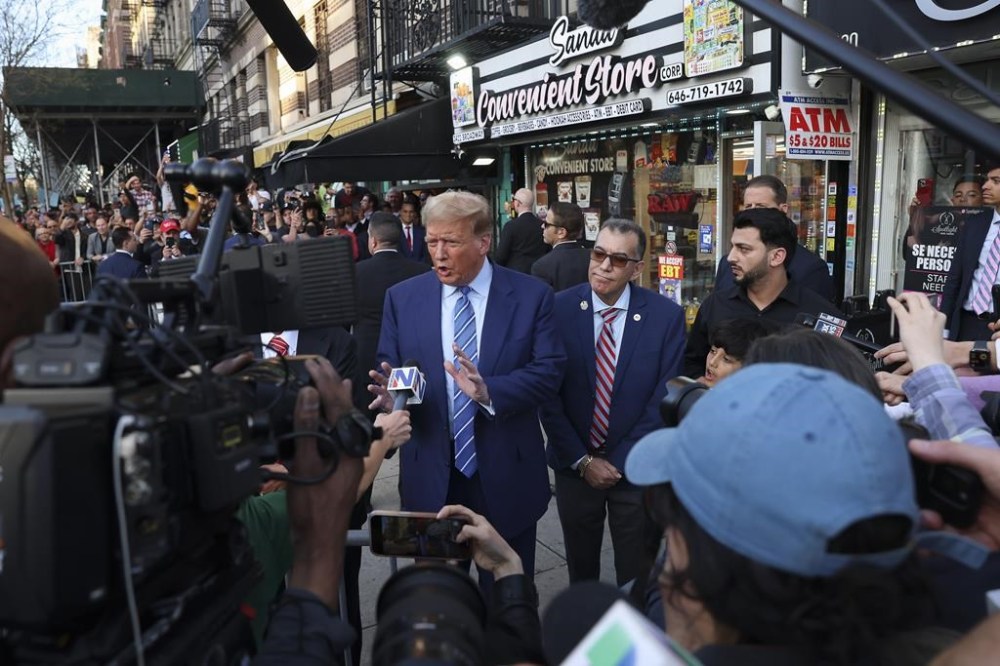
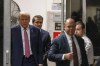
Former president Donald Trump, talks to members of the media while visiting a bodega, Tuesday, April 16, 2024, who's owner was attacked last year in New York. Fresh from a Manhattan courtroom, Donald Trump visited a New York bodega where a man was stabbed to death, a stark pivot for the former president as he juggles being a criminal defendant and the Republican challenger intent on blaming President Joe Biden for crime. Alba's attorney, Rich Cardinale, second from left, and Fransisco Marte, president of the Bodega Association, looked on. (AP Photo/Yuki Iwamura)

During the Trump defamation trial in Manhattan federal court earlier this year, jurors had heightened protection of their identities by a security-conscious judge who routinely did not allow anyone in his courtroom to have a cellphone, even if it was shut off. Jurors were driven to and from the courthouse by the U.S. Marshals Service and were sequestered from the public during trial breaks.

When asked general questions about themselves during jury selection in that case, prospective jurors often gave vague answers that would have made it nearly impossible to determine much about them.

After the ruling in that case, Judge Lewis A. Kaplan ordered the anonymous jury not to disclose the identities of any of the people they served with, and advised jurors not to disclose their service. So far, none have come forward publicly.

Kuby said the ability of lawyers at Trump’s trial to research the backgrounds of jurors was important.

“Both sides have interest in preventing sleeper jurors who have their own agenda from serving on the jury,” he said.

Neama Rahmani, a former federal prosecutor who is president of the West Coast Trial Lawyers, said the difficulty at the Trump trial is weeding out people with extreme viewpoints.

“Everyone in the entire country knows who Donald Trump is,” Rahmani said. “Some think he’s a criminal traitor and insurrectionist. Others think he’s a hero. You don’t have a lot of people in the middle.”

___

Associated Press writers Michael R. Sisak and Jake Offenhartz contributed to this report.

Report Error Submit a Tip

More Stories

Moving drama at MTYP gives voice to boy who changed law

Holly Harris 5 minute read Preview

Moving drama at MTYP gives voice to boy who changed law

Holly Harris 5 minute read Yesterday at 2:37 PM CDT

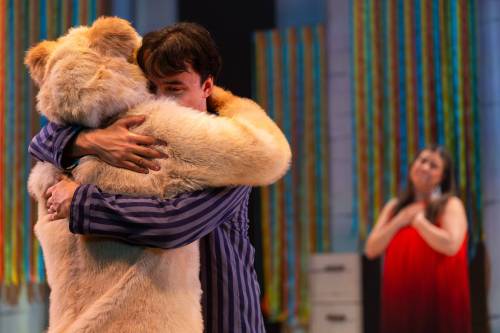
The heroic true tale of Norway House Cree Nation-born Jordan River Anderson came home Friday night, as Manitoba Theatre for Young People presented Yvette Nolan’s Jordan.

The touring production, a collaboration with Geordie Theatre, runs weekends through Oct. 11, with additional stops in Toronto, Vancouver and Ottawa’s National Arts Centre.

Having several of Anderson’s family members witness the local première underscored the evening with poignancy. Elder and Pine Creek First Nation member Barbara Nepinak added her own dignified presence and prayers following MTYP artistic director Pablo Felices-Luna’s welcoming remarks.

The season-opener also marks the Winnipeg-raised playwright’s homecoming; the Algonquin playwright, director, dramaturg, actor and educator was a fixture in our local theatre community for many years before going on to serve as artistic director for Native Earth Performing Arts from 2003 to ‘11, among other contributions.

Read
Yesterday at 2:37 PM CDT

Manitoba’s own Summer Howell takes on biggest role yet as Stephen King’s telekinetic teen Carrie

Randall King 7 minute read Preview

Manitoba’s own Summer Howell takes on biggest role yet as Stephen King’s telekinetic teen Carrie

Randall King 7 minute read Friday, Oct. 2, 2026

From the tender age of eight, actress Summer Howell has made her presence known in a series of horror films shot in her home province of Manitoba.

Her first film was Curse of Chucky (2013), director Don Mancini’s continuation of the venerable killer doll series he started (as a screenwriter) in 1988 with Child’s Play.

“Even then, it was obvious she was very talented, intelligent and delightful,” Mancini said of Howell.

Though she has worked in other genres, Howell gravitated to horror repeatedly, with credits in Shawn Linden’s harrowing Hunter Hunter (2020) and the 2023 possession thriller All Fun and Games. Earlier this year, she shot the horror film Sundown in Winnipeg with director Rebekah McKendry, which premièred last week at Beyond Fest in Los Angeles and is headed for a streaming berth on Shudder.

Read
Friday, Oct. 2, 2026

May be whiff of truth to ex’s odour ardour

Maureen Scurfield 5 minute read Yesterday at 2:01 AM CDT

DEAR MISS LONELYHEARTS: I ran into an old boyfriend I used to curl on a team with, and we went for drinks. We’ve been almost eight years apart, and I couldn’t remember why we broke up, as we always had such a great time together.

It wasn’t until the second date — this time on a weekend — that it came back to me, with a jolt. Pee-yew! I remembered he doesn’t use deodorant on weekends. Why? He enjoys his own body odour. I recalled that a bit too late, and it was just as awful as ever! I went home early.

Tonight, he called and I refused him another date. I said, “Think back. You remember why we broke up?” Then he said, “Oh yeah, you hated my no-deodorant weekend policy. Well, guess what? Some women don’t mind!” I said I really doubted that, and that ended the conversation. Miss L., wouldn’t any women find stinky underarms offensive?

— Sensitive Nose, Fort Richmond

Bombers get ‘whooped’ in Montreal

Taylor Allen 5 minute read Preview

Bombers get ‘whooped’ in Montreal

Taylor Allen 5 minute read Yesterday at 11:32 PM CDT

MONTREAL — It’s hard to fathom that the Winnipeg Blue Bombers smacked these Montreal Alouettes five weeks ago.

The team that pulled off that 44-28 upset at Princess Auto Stadium was nowhere to be found in La Belle Province on Saturday night.

You can, however, now find them in the basement of the West Division at 7-8 after getting completely outmatched and outclassed by the Als in a 37-10 beatdown.

“This was bad,” left tackle Stanley Bryant told the Free Press postgame. “They basically had their way all around. They whooped our ass.”

Read
Yesterday at 11:32 PM CDT

Puzzles Palace

1 minute read Monday, Jul. 27, 2026

To solve our puzzles, please subscribe with this special offer: |

Letters, Oct. 3

7 minute read Yesterday at 2:01 AM CDT

A morning in the life …

My very first lesson does not start when I walk into that lecture hall, oh no — it starts long before. It begins when I walk to my car, check the estimated arrival time to the University of Manitoba and hope that Winnipeg traffic agrees with it.

A drive that appears completely manageable changes almost immediately when I’m greeted by a tsunami of orange pylons and a line of cars that appears to go on forever. Traffic moves by the inch, lanes magically disappear and the detour I took yesterday now has a detour of its own. These factors make me do a calculation that I have become all too familiar with. How late can I arrive and still find parking, run to my class across campus and get to class with enough time left to make it worth it?

I have grown used to people saying, “Why not just leave earlier?” I do. But when I’m already leaving for my 8:30 a.m. class at 7 a.m., there’s only so much I can do. This drive that some would think is relaxing is one that feels like an assignment that I didn’t know I had to complete and is due at 8:30 a.m.