With help from AI, Randy Travis got his voice back. Here’s how his first song post-stroke came to be

Advertisement

Advertise with us

With some help from artificial intelligence, country music star Randy Travis, celebrated for his timeless hits like “Forever and Ever, Amen” and “I Told You So," has his voice back.

Read this article for free:


or

Already have an account? Log in here »

To continue reading, please subscribe:

Subscribe and receive a limited-edition Free Press branded hat or tote.

Digital Subscription

One year of digital access for only $205*

  • Enjoy unlimited reading on winnipegfreepress.com
  • Read the E-Edition, our digital replica newspaper
  • Access News Break, our award-winning app
  • Play interactive puzzles

*First annual payment billed as $205.00 + GST for one year. This annual subscription will automatically renew at $233.00 + GST every 52 weeks (10% off the regular annual price of $259.35). Offer available to new and qualified returning subscribers only. Cancel any time.

To continue reading, please subscribe:

Add Free Press access to your Brandon Sun subscription for only an additional

$1 for the first 4 weeks*

  • Enjoy unlimited reading on winnipegfreepress.com
  • Read the E-Edition, our digital replica newspaper
  • Access News Break, our award-winning app
  • Play interactive puzzles
Start now

*Your next Brandon Sun subscription payment will increase by $1.00 and you will be charged $17.95 plus GST for four weeks. After four weeks, your payment will increase to $24.95 plus GST every four weeks.

Hey there, time traveller!
This article was published 06/05/2024 (887 days ago), so information in it may no longer be current.

With some help from artificial intelligence, country music star Randy Travis, celebrated for his timeless hits like “Forever and Ever, Amen” and “I Told You So,” has his voice back.

In July 2013, Travis was hospitalized with viral cardiomyopathy, a virus that attacks the heart, and later suffered a stroke. The Country Music Hall of Famer had to relearn how to walk, spell and read in the years that followed. A condition called aphasia limits his ability to speak — it’s why his wife Mary Travis assists him in interviews. It’s also why he hasn’t released new music in over a decade, until now.

“Where That Came From,” which released Friday, is a rich acoustic ballad amplified by Travis’ immediately recognizable, soulful vocal tone.
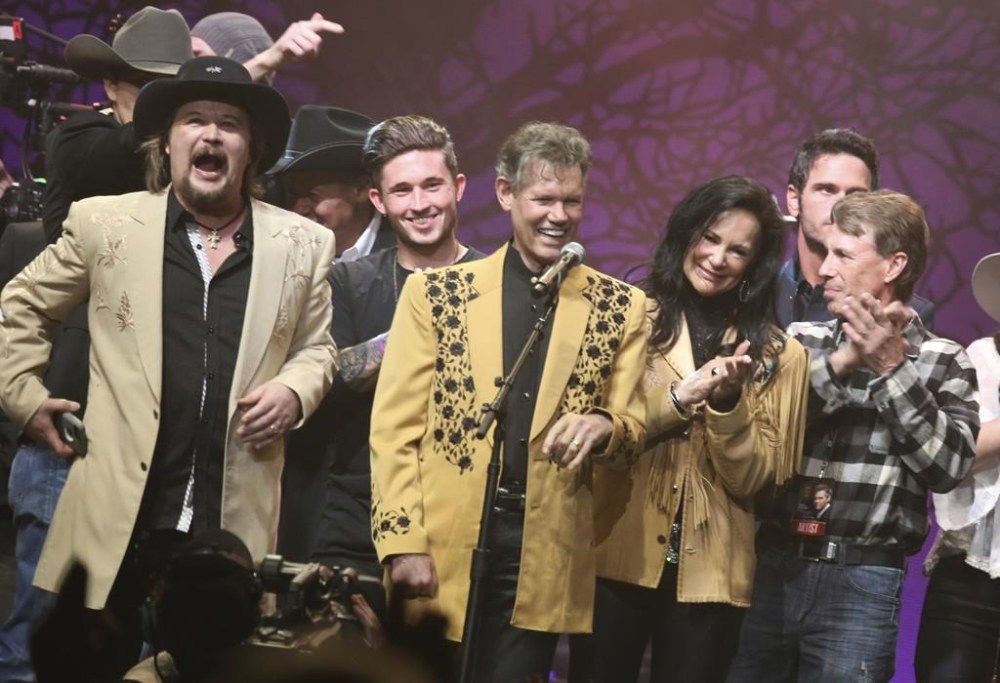
FILE - Travis Tritt, left, Randy Travis, center left, Mary Travis, center right, and Ricky Traywick, right, appear on stage at the
FILE - Travis Tritt, left, Randy Travis, center left, Mary Travis, center right, and Ricky Traywick, right, appear on stage at the "1 Night. 1 Place. 1 Time.: A Heroes and Friends Tribute to Randy Travis" on Feb. 8, 2017 in Nashville, Tenn. (Photo by Laura Roberts/Invision/AP, File)

Cris Lacy, Warner Music Nashville co-president, approached Randy and Mary Travis and asked: “’What if we could take Randy’s voice and recreate it using AI?,'” Mary Travis told The Associated Press over Zoom last week, Randy smiling in agreement right next to her. “Well, we were all over that, so we were so excited.”

“All I ever wanted since the day of a stroke was to hear that voice again.”

Lacy tapped developers in London to create a proprietary AI model to begin the process. The result was two models: One with 12 vocal stems (or song samples), and another with 42 stems collected across Travis’ career — from 1985 to 2013, says Kyle Lehning, Travis’ longtime producer. Lacy and Lehning chose to use “Where That Came From,” a song written by Scotty Emerick and John Scott Sherrill that Lehning co-produced and held on to for years. He believed it could best articulate the humanity of Travis’ idiosyncratic vocal style.

“I never even thought about another song,” Lehning said.

Once he input the demo vocal (sung by James Dupree) into the AI models, “it took about five minutes to analyze,” says Lehning. “I really wish somebody had been here with a camera because I was the first person to hear it. And it was stunning, to me, how good it was sort of right off the bat. It’s hard to put an equation around it, but it was probably 70, 75% what you hear now.”

“There were certain aspects of it that were not authentic to Randy’s performance,” he said, so he began to edit and build on the recording with engineer Casey Wood, who also worked closely with Travis over a few decades.

The pair cherrypicked from the two models, and made alterations to things like vibrato speed, or slowing and relaxing phrases. “Randy is a laid-back singer,” Lehning says. “Randy, in my opinion, had an old soul quality to his voice. That’s one of the things that made him unique, but also, somehow familiar.”

His vocal performance on “Where That Came From” had to reflect that fact.

“We were able to just improve on it,” Lehning says of the AI recording. “It was emotional, and it’s still emotional.”

Mary Travis says the “human element,” and “the people that are involved” in this project, separate it from more nefarious uses of AI in music.

“Randy, I remember watching him when he first heard the song after it was completed. It was beautiful because at first, he was surprised, and then he was very pensive, and he was listening and studying,” she said. “And then he put his head down and his eyes were a little watery. I think he went through every emotion there was, in those three minutes of just hearing his voice again.”

Lacy agrees. “The beauty of this is, you know, we’re doing it with a voice that the world knows and has heard and has been comforted by,” she says.

“But I think, just on human terms, it’s a very real need. And it’s a big loss when you lose the voice of someone that you were connected to, and the ability to have it back is a beautiful gift.”

They also hope that this song will work to educate people on the good that AI can do — not the fraudulent activities that so frequently make headlines. “We’re hoping that maybe we can set a standard,” Mary Travis says, where credit is given where credit is due — and artists have control over their voice and work.

Last month, over 200 artists signed an open letter submitted by the Artist Rights Alliance non-profit, calling on artificial intelligence tech companies, developers, platforms, digital music services and platforms to stop using AI “to infringe upon and devalue the rights of human artists.” Artists who co-signed included Stevie Wonder, Miranda Lambert, Billie Eilish, Nicki Minaj, Peter Frampton, Katy Perry, Smokey Robinson and J Balvin.

So, now that “Where That Came From” is here, will there be more original Randy Travis songs in the future?

“There may be others,” says Mary Travis. “We’ll see where this goes. This is such a foreign territory. There’s likely more on the horizon.”

“We do have other tracks,” says Lacy, but Warner Music is being as selective. “This isn’t a stunt, and it’s not a parlor trick,” she added. “It was important to have a song worthy of him.”

___

This story has been updated to correct one instance of the song title “Where That Came From,” instead of “What That Came From.”

Report Error Submit a Tip

More Stories

Phoneless concert a beautiful chance to bask in moment

Jen Zoratti 5 minute read Preview

Phoneless concert a beautiful chance to bask in moment

Jen Zoratti 5 minute read 2:01 AM CDT

Outside the Scotiabank Arena in Toronto, digital billboards flashed fans their singular photo op for the night: “I took this photo before I saw Phoebe Bridgers: The Lost Tour 2026.”

It is, as it is for so many other people, my only documentation of a concert by one of my favourite artists. The American singer-songwriter — who I discovered at the Winnipeg Folk Festival in 2018 — has had a meteoric rise in the past few years, winning three Grammys in 2024 as one third of Boygenius, the indie-rock supergroup rounded out by Lucy Dacus and Julien Baker, and opening for Taylor Swift on select dates of her titanic Eras Tour.

Now, Bridgers is touring in support of Lost Weekend, her third album and first since 2020’s Punisher. It’s a feat of a record, a richly textured meditation on loss and grief, written in the aftermath of the death of her dad, with whom she had a complicated relationship.

So she is in a position to not only play multiple sold-out arena shows, but also insist that those shows be phone-free.

Read
2:01 AM CDT

Jets’ game flies south against Ducks

Mike McIntyre 7 minute read Preview

Jets’ game flies south against Ducks

Mike McIntyre 7 minute read Yesterday at 10:38 PM CDT

The Winnipeg Jets sure looked like a team that was running on fumes Friday night.

Playing for the fifth time in eight days, the club suffered its first regulation loss of the young season — a lacklustre 5-1 showing against the Anaheim Ducks at Canada Life Centre.

While we won’t question the effort, the execution was a different story. Sloppy plays, missed passes, porous defensive-zone coverage and iffy goaltending made this a tough watch for the 13,693 fans in attendance.

“Just some mental things that happened. Obviously some physical things as well,” said head coach Scott Arniel.

Read
Yesterday at 10:38 PM CDT

Nurses disciplined for botched IV infusion

Nicole Buffie 4 minute read Preview

Nurses disciplined for botched IV infusion

Nicole Buffie 4 minute read Thursday, Oct. 8, 2026

Two nurses working at the Grace Hospital have been reprimanded and fined $2,500 each for an IV infusion gone bad and an attempted coverup.

The incident happened on November 23, 2023 when a nurse asked a colleague to set up an IV infusion on him in an unused operating room.

During the attempted IV start, the nurse lost consciousness. The nurse who attempted the IV drip and another who was in the room called for help and several staff responded.

The nurse regained consciousness and vomited, but recovered and continued to work his shift, a March 18 decision by the College of Registered Nurses of Manitoba says.

Read
Thursday, Oct. 8, 2026

Puppies, stocks — ‘zoomies’ abound

Andrew Froese 4 minute read 2:01 AM CDT

This spring, I adopted a three-month-old rescued German Shepherd mix. To say she is easily excitable is an understatement.

It is not really her fault. A puppy’s frontal cortex, the part of the brain that helps with decision-making and impulse control, is still developing. When an older dog, or a human, gets tired, we generally understand we should rest. Puppies have not quite figured that out. They often interpret tiredness as a signal something is wrong, which makes them more alert, more reactive and harder to settle.

That creates a feedback loop. The puppy gets tired, which makes her frantic, which makes her more tired, which makes her even more frantic. Eventually, this becomes what people call the “zoomies”: frantic sprinting, biting, jumping and general chaos.

From the outside, it looks like the puppy has too much energy. In reality, the opposite is true. The zoomies are not a sign of excess energy. They are a sign the puppy is overtired and does not know it yet.

With help from AI, Randy Travis got his voice back. Here’s how his first song post-stroke came to be

Maria Sherman, The Associated Press 5 minute read Preview

With help from AI, Randy Travis got his voice back. Here’s how his first song post-stroke came to be

Maria Sherman, The Associated Press 5 minute read Tuesday, May. 7, 2024

With some help from artificial intelligence, country music star Randy Travis, celebrated for his timeless hits like “Forever and Ever, Amen” and “I Told You So,” has his voice back. In July 2013, Travis was hospitalized with viral cardiomyopathy, a virus that attacks the heart, and later suffered a stroke. The Country Music Hall of Famer had to relearn how to walk, spell and read in the years that followed. A condition called aphasia limits his ability to speak — it’s why his wife Mary Travis assists him in interviews. It’s also why he hasn’t released new music in over […]

Read
Tuesday, May. 7, 2024

Musk’s meddlesome trolling

Editorial 4 minute read Preview

Musk’s meddlesome trolling

Editorial 4 minute read 2:01 AM CDT

It seems obvious the world’s first trillionaire thought he was helping separatists within the Canadian federation when he encouraged three provinces — Alberta, Saskatchewan and Quebec — to leave Canada.

Unfortunately for Elon Musk, a man suffering from a profound deficit of self-awareness, his comments may only help those who want to keep the country together.

Musk entered the national unity debate on Wednesday, two days after the pro-independence Parti Quebecois was returned to power in Quebec with a minority mandate. The PQ has promised to hold a third referendum on separation at some point in its current term.

Musk — who has a Canadian mother and attended university in Ontario — took to X, the social media platform formerly known as Twitter (which he owns) and encouraged Quebec to forge ahead with plans to separate. He said Alberta — which will hold a vote this fall on whether to hold a binding referendum on separation — and Saskatchewan should follow suit.

Read
2:01 AM CDT