Small Nashville museum wants you to know why it is returning artifacts to Mexico

Advertisement

Advertise with us

NASHVILLE, Tenn. (AP) — When Bonnie Seymour took a job as assistant curator of Nashville's Parthenon museum, one of the first things she did was to look through the collections. Among paintings by American artists and memorabilia from Tennessee’s 1897 Centennial Exposition — the event for which the Parthenon was built — she found a random assortment of pre-Columbian pottery from Mexico.

Read this article for free:


or

Already have an account? Log in here »

To continue reading, please subscribe:

Subscribe and receive a limited-edition Free Press branded hat or tote.

Digital Subscription

One year of digital access for only $205*

  • Enjoy unlimited reading on winnipegfreepress.com
  • Read the E-Edition, our digital replica newspaper
  • Access News Break, our award-winning app
  • Play interactive puzzles

*First annual payment billed as $205.00 + GST for one year. This annual subscription will automatically renew at $233.00 + GST every 52 weeks (10% off the regular annual price of $259.35). Offer available to new and qualified returning subscribers only. Cancel any time.

To continue reading, please subscribe:

Add Free Press access to your Brandon Sun subscription for only an additional

$1 for the first 4 weeks*

  • Enjoy unlimited reading on winnipegfreepress.com
  • Read the E-Edition, our digital replica newspaper
  • Access News Break, our award-winning app
  • Play interactive puzzles
Start now

*Your next Brandon Sun subscription payment will increase by $1.00 and you will be charged $17.95 plus GST for four weeks. After four weeks, your payment will increase to $24.95 plus GST every four weeks.

Hey there, time traveller!
This article was published 12/07/2024 (812 days ago), so information in it may no longer be current.

NASHVILLE, Tenn. (AP) — When Bonnie Seymour took a job as assistant curator of Nashville’s Parthenon museum, one of the first things she did was to look through the collections. Among paintings by American artists and memorabilia from Tennessee’s 1897 Centennial Exposition — the event for which the Parthenon was built — she found a random assortment of pre-Columbian pottery from Mexico.

The artifacts had almost no identifying information, and Seymour knew next to nothing about them. But she knew they did not belong in a Nashville storage room.

“My first thought was, well, it’s going to get repatriated. It’s got to go home,” she said during a recent interview.
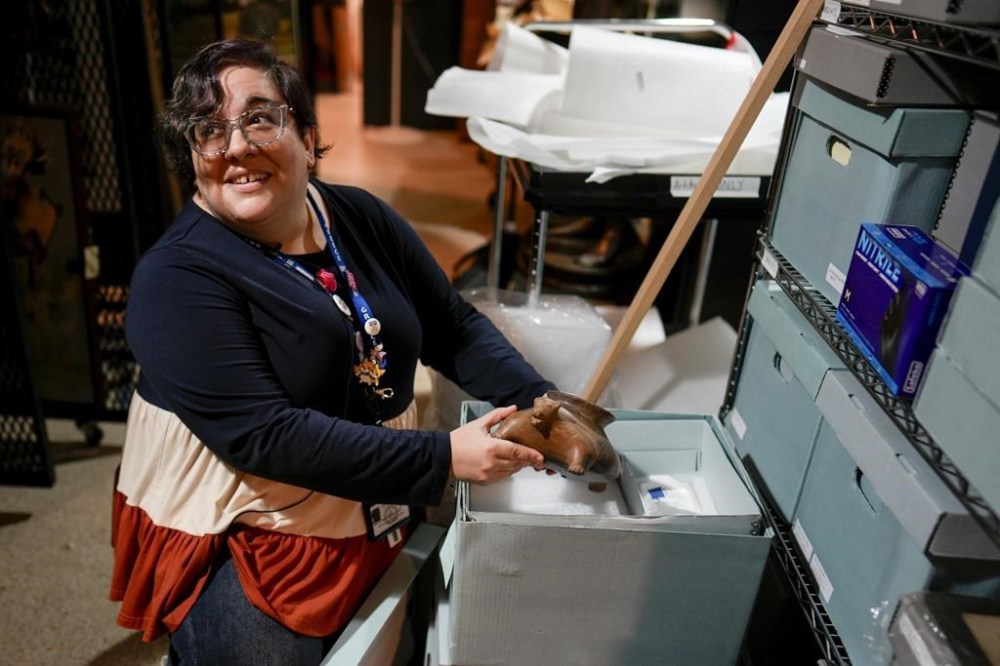
The Parthenon's Registrar and Assistant Curator Bonnie Seymour packs pre-Columbian artifacts from Mexico into boxes Tuesday, July 2, 2024, in Nashville, Tenn. The museum is working to repatriate the items back to Mexico. (AP Photo/George Walker IV)

That goal led to an exhibit, “ Repatriation and Its Impact,” along with the discovery of the collection’s strange origins, and even a quest to change the city’s charter. It all started with a tax deduction.

Colima dogs

It was the 1960s and Rich Montgomery says his father, an Oregon doctor, and some friends were looking for ways to lower their income taxes. Somehow they came upon the idea of using museum donations for deductions. In order to acquire objects to donate, they sent a college-aged Rich and his brother to Mexico in a Chevy Suburban they had tricked out for extra storage.

Rich had spent a year of high school in Mazatlan and was familiar with artifacts called Colima dogs — pottery representations of small, chubby hairless dogs that were often placed in tombs. As the name implies, they are associated with the Colima region. That gave the Montgomery brothers a place to start.

“So we we headed straight into Colima and we started asking about these items,” he said. “You’d get on these dirt roads and wander up into the hills, and down into the valleys, and along the rivers, and come to these little pueblos and just ask around for this stuff. People would come up with it, and we would buy them.”

The pieces they bought included figurines and ocarinas. They had little apparent value to the local farmers — Montgomery said the people considered them junk and were happy to sell them for a few pesos each. He also emphasizes that they did not try to smuggle them out.

“At no point did we ever think or feel that we’re doing anything illegal,” he said. “We would show this stuff to the Mexican authorities as we left the country, and those guys could care less about it. And when we came into the US, we would show it to the customs people here on this side. And the rules back then were very clear. If it’s an antique, it’s over 100 years old, there was no duty on it. Off we’d go.”

Repatriation

Mexico had laws, even back then, to prevent artifacts from leaving the country, but they were not evenly enforced, said Javier Diaz de Leon, the Mexican consul general in Atlanta who has been working with Seymour on the repatriation. In recent years, people have become more aware of the ethical issues around keeping artifacts that were taken from other countries without proper authorization, Diaz de Leon said.

“It’s a greater conscience,” he said. “People come to us, are coming to us, all over the world, voluntarily saying, ‘I got this. It came to our hands. But we don’t think we should have it. We think we belongs to the Mexican people.’ And that is the sort of transition that we are very happy about.”

The consul general has nothing but praise for Seymour.

When she began this effort two years ago, the Parthenon had no policy for deaccession — removing an item from a collection. Meanwhile, Nashville’s charter required the artifacts to be treated as surplus property, which is normally either redistributed within Metro government or sold at auction. Seymour worked with council members on an ordinance to allow their return to Mexico. It was approved in May, but it was a one-time fix. Her next step is to revise the charter.
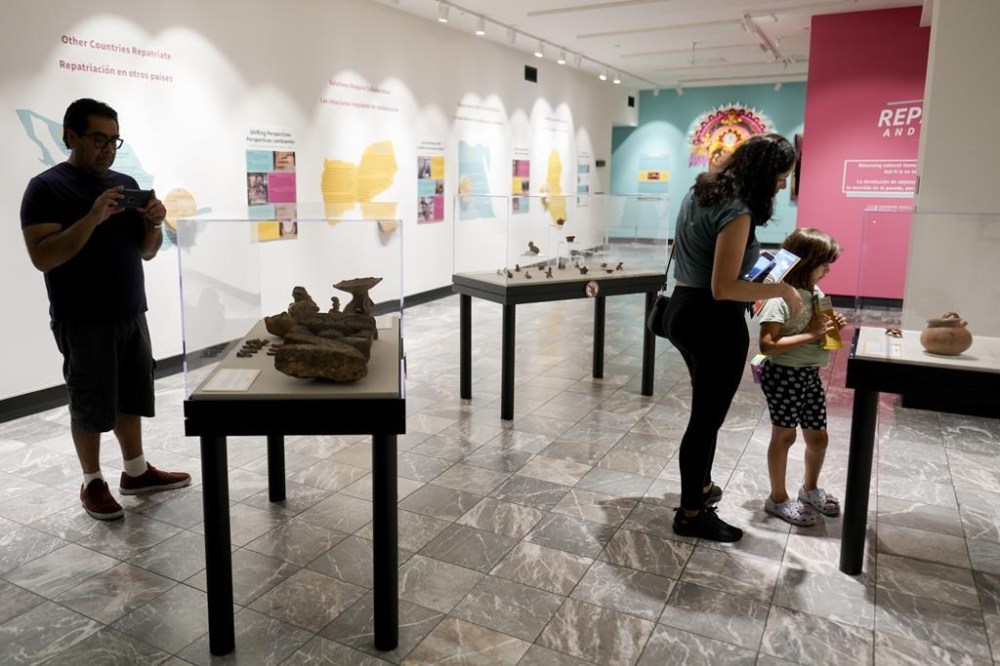
Guests visit the exhibit 'Repatriation and its Impact' at The Parthenon, Tuesday, July 2, 2024, in Nashville, Tenn. The museum is working to repatriate pre-Columbian artifacts back to Mexico. (AP Photo/George Walker IV)

Meanwhile, she hopes the collection will find a more appropriate home at the National Institute of Anthropology and History in Mexico City where it will fit into the institution’s mission.

“Hopefully, they’re going to research them and put them on display,” she said.

While she is sad to see the collection go, Seymour has commissioned a 3-D printed model of a Colima dog they can use to continue to tell the story. Ultimately, she said repatriation is simply the right thing to do. At the Parthenon “it’s not being utilized. It’s a waste.”

“Outside the Parthenon’s mission”

Montgomery has no idea how his father got connected with the city’s Parthenon, which operates a small museum inside a full-scale replica of the ancient Greek temple in Nashville’s Centennial Park. However it happened, the museum now has 255 pre-Columbian pieces donated by Montgomery and someone named Edgar York, whom Seymour knows even less about.

That lack of information is part of the point in the exhibit, which displays a selection of the collection’s small adornments, zoomorphic images, ceramic pots, musical instruments and hand tools with only generic labels, their exact provenance unknown. It notes that research by Vanderbilt University students in the 1990s raised questions about the authenticity of some pieces. A 2014 review determined they were “outside the Parthenon’s mission.”

Some people can have a finders-keepers attitude toward repatriation efforts, while others blame museums for holding onto artifacts looted from other countries, so Seymour wanted to be very transparent.

“Museums aren’t evil institutions trying to keep people’s stuff away from them. We are actually trying to figure out what to do,” she said.

Report Error Submit a Tip

More Stories

Ferraro gets call-up to the Jets

Mike McIntyre 6 minute read Preview

Ferraro gets call-up to the Jets

Mike McIntyre 6 minute read Wednesday, Sep. 30, 2026

Landon Ferraro vividly recalls the moment his NHL career came to an extremely painful end — Oct. 20, 2017, in downtown Winnipeg.

“My last play was a breakaway on Connor Hellebuyck,” Ferraro told the Free Press this week.

“I tried to poke the puck past the first D. It was me and (Dustin) Byfuglien chasing it down. I thought he was going to throw me across the ice, so I tried to cut in on him, and he moved. I overextended, and I literally ripped my abductor off the bone and gave myself a hernia.”

Ferraro — at the time playing forward for the visiting Minnesota Wild — said he managed to get off a weak shot that hit the Jets goaltender square in the chest. But his 77th appearance in the big leagues would be his last following previous stops with Detroit (which drafted him 32nd overall in 2009) and Boston.

Read
Wednesday, Sep. 30, 2026

Woman took ‘meaningful’ responsibility after disposing of body: lawyer

Dean Pritchard 5 minute read Preview

Woman took ‘meaningful’ responsibility after disposing of body: lawyer

Dean Pritchard 5 minute read Wednesday, Sep. 30, 2026

A woman who was threatened with death if she didn’t help dispose the body of a Mexican man murdered in the basement of a North End home should serve no more jail time, a judge has been told.

Devlin Langlois, 25, has pleaded guilty to accessory after the fact to murder in the March 2025 killing of 28-year-old Diego Moscoza.

“By pleading guilty, Ms. Langlois has already taken meaningful accountability for her actions,” defence lawyer Joshua Rogala told King’s Bench Justice Candace Grammond at a sentencing hearing Monday.

He urged the judge to sentence Langlois to the equivalent of 14 months already served, plus two years supervised probation.

Read
Wednesday, Sep. 30, 2026

Confidence vote was gamble for MLA, Tories: political expert

Alex Lambert 5 minute read Preview

Confidence vote was gamble for MLA, Tories: political expert

Alex Lambert 5 minute read Yesterday at 7:30 PM CDT

BRANDON — A Progressive Conservative MLA’s decision to put forward a confidence motion against the party’s former leader carries a lot of risk for her and the Tories, a political science expert says.

Obby Khan resigned as leader of the PCs on Monday after Jodie Byram (Agassiz) initiated a confidence vote against him the previous week.

The majority of the PC caucus voted in favour of Khan, but he resigned a few days later, citing continued efforts to undermine him by a minority of MLAs.

Brandon University political science Prof. Kelly Saunders said while she doesn’t know what Byram’s motivations were for triggering the vote, such a move carries a lot of risk.

Read
Yesterday at 7:30 PM CDT

Health minister warns $1.2 billion in annual federal funding set to expire in March

Scott Billeck 4 minute read Preview

Health minister warns $1.2 billion in annual federal funding set to expire in March

Scott Billeck 4 minute read Yesterday at 6:58 PM CDT

Manitoba’s health minister is warning of possible cuts to health care with $1.2 billion in annual funding from Ottawa set to expire next year.

“We’re very concerned that what would be the largest cut to health care in a generation is right in front of us,” Health Minister Uzoma Asagwara said Thursday at the Manitoba legislature. “It means that services that Manitobans depend on will be in jeopardy and be at risk.

“Any reductions, any cuts from Canada, will have direct impacts on the health outcomes of Manitobans.”

Asagwara, who serves as the provincial and territorial health minister lead, chaired a virtual meeting Tuesday with provincial and territorial health ministers to discuss federal funding for health care, mental health care and substance use services, which is scheduled to expire March 31, 2027.

Read
Yesterday at 6:58 PM CDT

A day on the campaign trail: Winnipeg's mayor, seeking a second term, does double duty

Malak Abas 12 minute read Preview

A day on the campaign trail: Winnipeg's mayor, seeking a second term, does double duty

Malak Abas 12 minute read Updated: 5:56 PM CDT

In the weeks leading up to the civic election, Scott Gillingham has been performing a juggling act: he’s running to be Winnipeg’s 45th mayor, while still serving as its 44th.

“If someone asks me about the campaign, I’m going to answer them. But I think for most people, I’m the mayor of Winnipeg, even if I’m showing up as a candidate,” Gillingham, 58, says. “I try to do all I can to maintain that distinction.”

The Free Press joined Gillingham on a recent rainy September Saturday on the campaign trail, where he served in both roles during an event-laden day. City council’s final meeting before the Oct. 28 election was days earlier.

In Winnipeg, it’s rare for an incumbent to be defeated. But Gillingham knows his win in 2022 wasn’t exactly a landslide — he won with 27.5 per cent of the vote — and he’s been thinking about his second term ever since.

Read
Updated: 5:56 PM CDT

Fewer health system critical incidents reported in 2025 than in previous two years, data shows

Chris Kitching 5 minute read Preview

Fewer health system critical incidents reported in 2025 than in previous two years, data shows

Chris Kitching 5 minute read 5:48 PM CDT

The number of critical incidents reported within Manitoba’s health-care system declined again in 2025, with delays, gaps and “missed opportunities” among the most common circumstances of deaths or injuries.

Quarterly reports from Manitoba Health listed 121 critical incidents, including 32 deaths, in hospitals, personal-care homes and other settings, down from 134 incidents in 2024, when 32 deaths were also reported, and 166 incidents (42 deaths) in 2023.

“We’d obviously like to see those at zero,” said Jason Linklater, president of the Manitoba Association of Health Care Professionals, which represents more than 7,700 allied health workers.

“It’s good that they’ve come down. What we really want to see is those numbers drastically reduced overall, and I just fear that’s not going to happen until staffing is dealt with.”

Read
5:48 PM CDT