

As tensions spike between journalists and the president, here’s a look at ‘viewpoint discrimination’
Advertisement
Read this article for free:
or
Already have an account? Log in here »
To continue reading, please subscribe:
Monthly Digital Subscription
$1 per week for 24 weeks*
- Enjoy unlimited reading on winnipegfreepress.com
- Read the E-Edition, our digital replica newspaper
- Access News Break, our award-winning app
- Play interactive puzzles
*Billed as $4.00 plus GST every four weeks. After 24 weeks, price increases to the regular rate of $19.95 plus GST every four weeks. Offer available to new and qualified returning subscribers only. Cancel any time.
Monthly Digital Subscription
$4.99/week*
- Enjoy unlimited reading on winnipegfreepress.com
- Read the E-Edition, our digital replica newspaper
- Access News Break, our award-winning app
- Play interactive puzzles
*Billed as $19.95 plus GST every four weeks. Cancel any time.
To continue reading, please subscribe:
Add Free Press access to your Brandon Sun subscription for only an additional
$1 for the first 4 weeks*
*Your next subscription payment will increase by $1.00 and you will be charged $16.99 plus GST for four weeks. After four weeks, your payment will increase to $23.99 plus GST every four weeks.
Read unlimited articles for free today:
or
Already have an account? Log in here »
Hey there, time traveller!
This article was published 28/02/2025 (392 days ago), so information in it may no longer be current.
NEW YORK (AP) — President Donald Trump’s executive order was clear: The Gulf of Mexico was out after hundreds of years. The Gulf of America was its name now.
But The Associated Press decided to keep the original name for its style and also note that Trump changed it. Trump limited the global news outlet’s access to some presidential events. The AP sued.
A federal judge hearing the case this week observed that it seemed an obvious constitutional problem, calling Trump’s actions “pretty clearly viewpoint discrimination.”

What is viewpoint discrimination?
Viewpoint discrimination is when the government treats speech differently based on the words used or the viewpoint expressed. It’s often an important concept in trademark law and free speech disputes because it can violate the First Amendment’s protections.
Observers said the judge, a Trump appointee and former law enforcement officer, left the impression that he saw it as a weak spot in Trump’s case. Discriminating against someone for the content of their speech, or writing, is one of the highest hurdles in constitutional law.
Allowing government to favor one type of speech has a much higher bar than controlling speech for other reasons, like public safety, said Professor Joseph A. Tomain of the Indiana University school of law.
“The judge definitely indicated that he had concerns that this might violate the First Amendment.” said Kevin Goldberg, a vice president at Freedom Forum. “The government can’t choose which side it prefers to favor or disfavor.”
That’s why viewpoint discrimination is one of the rarest types of case to actually go to court.
A rare convergence of developments
Now, Trump is being accused of it as he challenges a century of press tradition.
Since the early 20th century, an independent pool of news organizations documented the president in small public spaces such as the Oval Office and Air Force One. Trump’s administration said Tuesday that, from now on, the White House will determine the pool’s makeup.
Speaking Tuesday, the day after the federal court hearing, White House press secretary Karoline Leavitt said the administration “will determine who gets to enjoy the very privileged and limited access” to the president and would add new voices and reporters into it while rotating out “traditional” media like wire services and major newspapers. That was seen as a sign that it is trying to avert accusations of viewpoint discrimination.
Lawyers see a fight looming over the question of journalists’ access to the president.
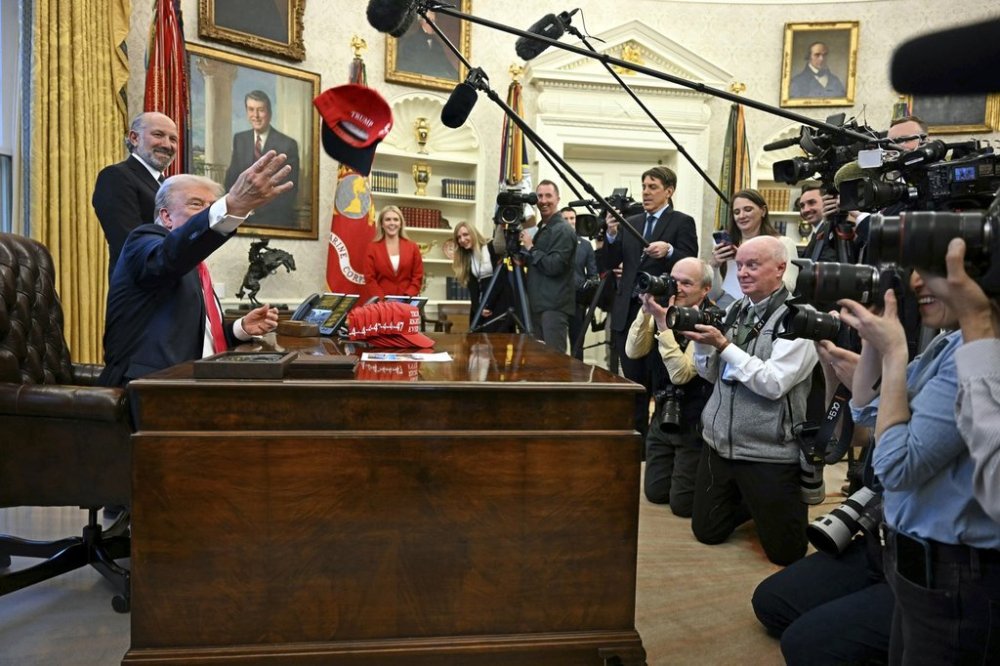
‘You’ve never had the Supreme Court deciding a case about journalist access to the White House or even to the president,” Goldberg said. “This is sort of new ground.”
Reshaped territory
The possibility of access being remade by a conservative president comfortable with modern media technology was prompting strong reactions this week from media groups that tried to show a unified face to the administration.

“Conditioning pool access to White House events on the editorial decisions of any news organization violates First Amendment principles,” the Reporters Committee for Freedom of the Press wrote Friday. “All news organizations covering the White House are negatively affected when one peer outlet is singled out.”
However, settings limited by space — like Air Force One and the Oval Office — give the president more discretion.
“It’s not an open-and-shut question,” said Eugene Volokh, a senior fellow at Stanford University and a law professor at UCLA. ”That’s the argument that the Trump administration makes and I think it’s a plausible one. He’s entitled to say, ‘I just don’t want to talk to you.’”
___
Laurie Kellman in London and Matt Sedensky in New York contributed.