

Artists in this former pasta factory are preserving Italian opera traditions
Advertisement
Read this article for free:
or
Already have an account? Log in here »
To continue reading, please subscribe:
Monthly Digital Subscription
$1 per week for 24 weeks*
- Enjoy unlimited reading on winnipegfreepress.com
- Read the E-Edition, our digital replica newspaper
- Access News Break, our award-winning app
- Play interactive puzzles
*Billed as $4.00 plus GST every four weeks. After 24 weeks, price increases to the regular rate of $19.95 plus GST every four weeks. Offer available to new and qualified returning subscribers only. Cancel any time.
Monthly Digital Subscription
$4.99/week*
- Enjoy unlimited reading on winnipegfreepress.com
- Read the E-Edition, our digital replica newspaper
- Access News Break, our award-winning app
- Play interactive puzzles
*Billed as $19.95 plus GST every four weeks. Cancel any time.
To continue reading, please subscribe:
Add Free Press access to your Brandon Sun subscription for only an additional
$1 for the first 4 weeks*
*Your next subscription payment will increase by $1.00 and you will be charged $16.99 plus GST for four weeks. After four weeks, your payment will increase to $23.99 plus GST every four weeks.
Read unlimited articles for free today:
or
Already have an account? Log in here »
Hey there, time traveller!
This article was published 01/05/2025 (330 days ago), so information in it may no longer be current.
ROME (AP) — Behind a rusty gate near Rome’s Circus Maximus is a building passed daily by hordes of tourists. They’re oblivious to the fact that behind its faded, flaking paint is a hive of activity sustaining one of Italy’s grandest cultural institutions.
It was a pasta factory until almost a century ago, when the Rome Opera House transformed the four-story building into a sprawling warehouse and workshop. It is home to a trove of scenic backdrops and 70,000 costumes from over a century of performances. Even more are being created — the traditional way.
For this year, the opera house’s costume designers, tailors and seamstresses have been scouring archives and working to reconstruct the original outfits of Giacomo Puccini’s Opera “Tosca.” It is a tale of passion, cruelty and deception set in Rome in the 1800s, featuring a dark-haired beauty forced to commit murder to protect her dignity and the man she loves. This year marks the 125th anniversary of its first-ever performance.
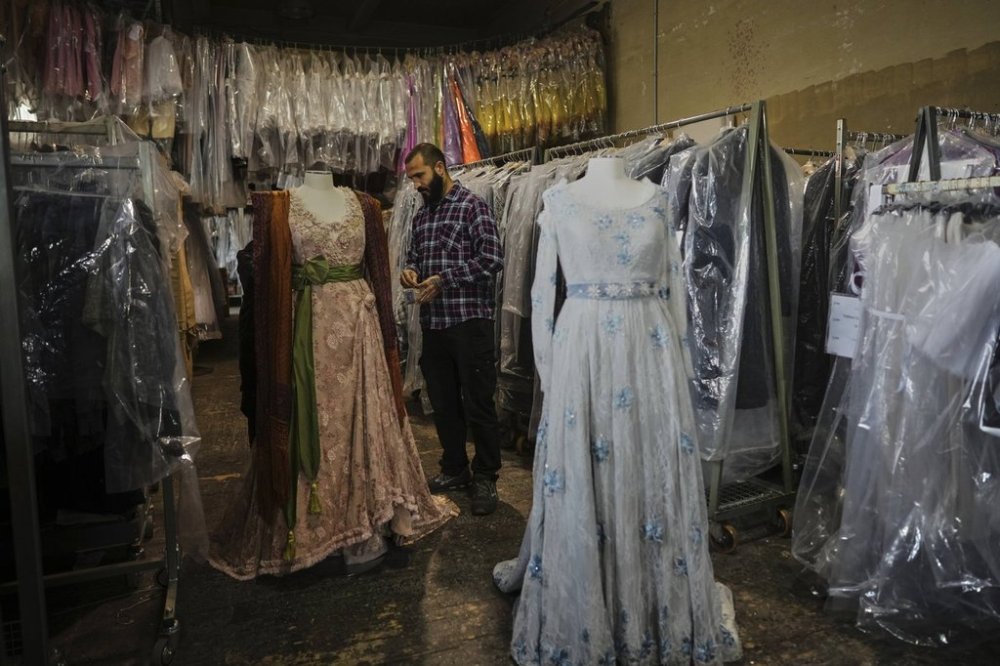
“Fortunately, all the sketches for each costume exist and are very detailed and we have reconstructed them, respecting as much as possible the taste of the time from the point of view of the fabrics, the shapes and all the materials used,” Anna Biagiotti, the opera house’s costume director, said in an interview inside the warehouse.
Behind each sketch Biagotti found detailed notes. She compiled a binder her team refers to as “the bible,” filled with copies of the originals. To help her roughly 30 tailors, Biagotti painstakingly transcribed the tightly scrawled cursive notes of then-lead costume designer Adolph Hohenstein into legible, capital letters.
They work in a cramped space above the opera house — sewing, pinning, stitching, cutting, ironing. Each year, they churn out some 700 costumes for opera and ballet performances, which are later stored in the warehouse, hanging inside plastic dry cleaning covers. There is no digitalized system to track them once there; they can only be located by the designers and tailors who have spent their lives in the trade.
And on the warehouse’s top floor, set designers in a giant loft space walk atop a canvas, dragging grey wagons loaded with buckets of paint. On April 10, they used brushes with handles so long they looked like brooms to paint ancient doors, archways, statues and frescoes to conjure a three-dimensional Roman palazzo upon the flat surface. An overhead walkway provided a view to ensure the optical illusion was coming out just right.
It’s a dying craft, said Danilo Mancini, director of set production. In other places, painted sets have been replaced by LED walls, projections and back-lit screens — but not at the Rome Opera House. For Tosca, set designers also worked off Hohenstein’s sketches for the original show.
Both Mancini and music director Michele Mariotti credit Puccini for keeping their passions alive.
“Puccini was a genius, not only in terms of the beauty of the music, but precisely because of the theatrical and cinematographic flair he gives to his works,” said Mariotti. “If we are all here, we must be grateful to him, not so much for the rebirth of the work, but for its survival. Because he understood that if it was not regenerated in some way, opera would have disappeared.”