

Movie Review: The sweep of history courses through Jia Zhangke’s ‘Caught By the Tides’
Advertisement
Read this article for free:
or
Already have an account? Log in here »
To continue reading, please subscribe:
Monthly Digital Subscription
$1 per week for 24 weeks*
- Enjoy unlimited reading on winnipegfreepress.com
- Read the E-Edition, our digital replica newspaper
- Access News Break, our award-winning app
- Play interactive puzzles
*Billed as $4.00 plus GST every four weeks. After 24 weeks, price increases to the regular rate of $19.95 plus GST every four weeks. Offer available to new and qualified returning subscribers only. Cancel any time.
Monthly Digital Subscription
$4.99/week*
- Enjoy unlimited reading on winnipegfreepress.com
- Read the E-Edition, our digital replica newspaper
- Access News Break, our award-winning app
- Play interactive puzzles
*Billed as $19.95 plus GST every four weeks. Cancel any time.
To continue reading, please subscribe:
Add Free Press access to your Brandon Sun subscription for only an additional
$1 for the first 4 weeks*
*Your next subscription payment will increase by $1.00 and you will be charged $16.99 plus GST for four weeks. After four weeks, your payment will increase to $23.99 plus GST every four weeks.
Read unlimited articles for free today:
or
Already have an account? Log in here »
Hey there, time traveller!
This article was published 07/05/2025 (323 days ago), so information in it may no longer be current.
Jia Zhangke’s “Caught by the Tides” is less than two hours long and yet contains nearly a quarter-century of time’s relentless march forward.
Few films course with history the way it does in the Chinese master’s latest, an epic collage that spans 21 years. Jia undertook the film during the pandemic, assembling a mix of fiction and documentary, including images from his earlier films as well as newly shot scenes.
That might sound like a mishmash kind of moviemaking. But for Jia, the preeminent cinematic chronicler of 21st century China, it’s a remarkably cohesive, even profound vessel for capturing what has most interested him as a filmmaker: the tidal wave-sized currents of technological progress and social transmutation that wash over a lifetime.
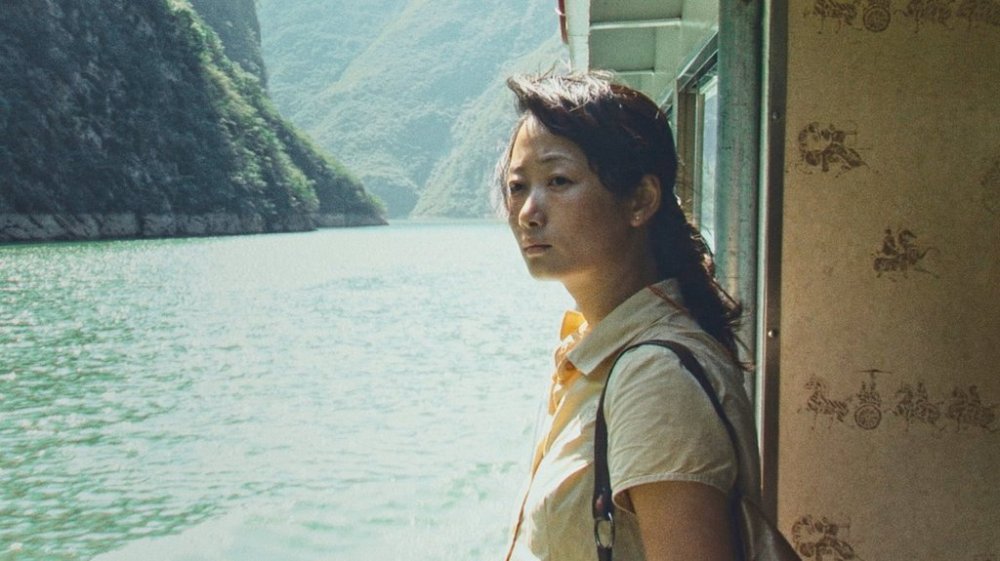
The high-speed upheavals of modern China are, of course, a fitting setting for such interests. Jia’s films are often most expressed in their surroundings — in vistas of infrastructure that dwarf his protagonists. Fans of Jia will recognize some from his previous films. For me, there’s never been a more moving backdrop from him than the rubble and mass displacement of the Three Gorges Dam project (seen here, as in his 2008 film “Still Life”).
“Caught by the Tides” is ostensibly about Qiaoqiao (Zhao Tao, Jia’s wife and muse) and her lover Bin (Li Zhubin), whom she searches for years after a row sent them in different directions. But in “Caught by the Tides,” these characters are more like life rafts bobbing in expansive waters, making their way aimlessly.
The poetry of “Caught by the Tides” comes from a grander arc. In one of the film’s opening scenes, shot on grainy digital film, women in a Datong city room laugh together, singing old, half-remembered songs. The film’s final scenes, set more than two decades later in the southern city of Zhuhai, are more crisply photographed and depict a more impersonal world of smartphones, robots and QR codes. For a moment, Jia even adopts the perspective of a surveillance camera.
Another moment: a shot, from pre-digital times, drifting down a street with men looking back at us, smoking and mildly curious. Cut then to what might be the same street years later, where a woman parades as a model in front of a sprawling shopping mall.

In “Caught by the Tides,” these changes go unexplained and unspoken. But the evolutions they chart are deeply familiar to anyone who has lived through even some of these years, in China or elsewhere. We see how people once moved differently, spoke differently and sang differently. Progress and loss exist together as one. Zhao and Li age through the film, leaving them weathered, too, by time. A song late in the film goes: “I can’t grasp the warmth we once shared.”
“Caught by the Tides,” a Sideshow and Janus Films release, is unrated by the Motion Picture Association. In Mandarin. Running time: 116 minutes. Three and a half stars out of four.