

Strauss’ ‘Blue Danube’ waltz is launching into space to mark his 200th birthday
Advertisement
Read this article for free:
or
Already have an account? Log in here »
To continue reading, please subscribe:
Monthly Digital Subscription
$0 for the first 4 weeks*
- Enjoy unlimited reading on winnipegfreepress.com
- Read the E-Edition, our digital replica newspaper
- Access News Break, our award-winning app
- Play interactive puzzles
*No charge for 4 weeks then price increases to the regular rate of $19.95 plus GST every four weeks. Offer available to new and qualified returning subscribers only. Cancel any time.
Monthly Digital Subscription
$4.99/week*
- Enjoy unlimited reading on winnipegfreepress.com
- Read the E-Edition, our digital replica newspaper
- Access News Break, our award-winning app
- Play interactive puzzles
*Billed as $19.95 plus GST every four weeks. Cancel any time.
To continue reading, please subscribe:
Add Free Press access to your Brandon Sun subscription for only an additional
$1 for the first 4 weeks*
*Your next subscription payment will increase by $1.00 and you will be charged $16.99 plus GST for four weeks. After four weeks, your payment will increase to $23.99 plus GST every four weeks.
Read unlimited articles for free today:
or
Already have an account? Log in here »
Hey there, time traveller!
This article was published 25/05/2025 (223 days ago), so information in it may no longer be current.
CAPE CANAVERAL, Fla. (AP) — Strauss’ “Blue Danube” is heading into space this month to mark the 200th anniversary of the waltz king’s birth.
The classical piece will be beamed into the cosmos as it’s performed by the Vienna Symphony Orchestra. The celestial send-off on May 31 — livestreamed with free public screenings in Vienna, Madrid and New York — also will celebrate the European Space Agency’s founding 50 years ago.
Although the music could be converted into radio signals in real time, according to officials, ESA will relay a pre-recorded version from the orchestra’s rehearsal the day before to avoid any technical issues. The live performance will provide the accompaniment.
The radio signals will hurtle away at the speed of light, or a mind-blowing 670 million mph (more than 1 billion kph).
That will put the music past the moon in 1 1/2 seconds, past Mars in 4 1/2 minutes, past Jupiter in 37 minutes and past Neptune in four hours. Within 23 hours, the signals will be as far from Earth as NASA’s Voyager 1, the world’s most distant spacecraft at more than 15 billion miles (24 billion kilometers) in interstellar space.
NASA also celebrated its 50th anniversary in 2008 by transmitting a song directly into deep space: the Beatles’ “Across the Universe.” And last year, NASA beamed up Missy Elliott’s “The Rain (Supa Dupa Fly)” toward Venus.
Music has even flowed from another planet to Earth — courtesy of a NASA Mars rover. Flight controllers at California’s Jet Propulsion Laboratory sent a recording of will.i.am’s “Reach for the Stars” to Curiosity in 2012 and the rover relayed it back.
These are all deep-space transmissions as opposed to the melodies streaming between NASA’s Mission Control and orbiting crews since the mid-1960s.
Now it’s Strauss’ turn, after getting passed over for the Voyager Golden Records nearly a half-century ago.
Launched in 1977, NASA’s twin Voyagers 1 and 2 each carry a gold-plated copper phonograph record, along with a stylus and playing instructions for anyone or anything out there.
The records contain sounds and images of Earth as well as 90 minutes of music. The late astronomer Carl Sagan led the committee that chose Bach, Beethoven, Mozart and Stravinsky pieces, along with modern and Indigenous selections.
Among those skipped was Johann Strauss II, whose “Blue Danube” graced Stanley Kubrick’s 1968 sci-fi opus “2001: A Space Odyssey.”
The tourist board in Vienna, where Strauss was born on Oct. 25, 1825, said it aims to correct this “cosmic mistake” by sending the “the most famous of all waltzes” to its destined home among the stars.
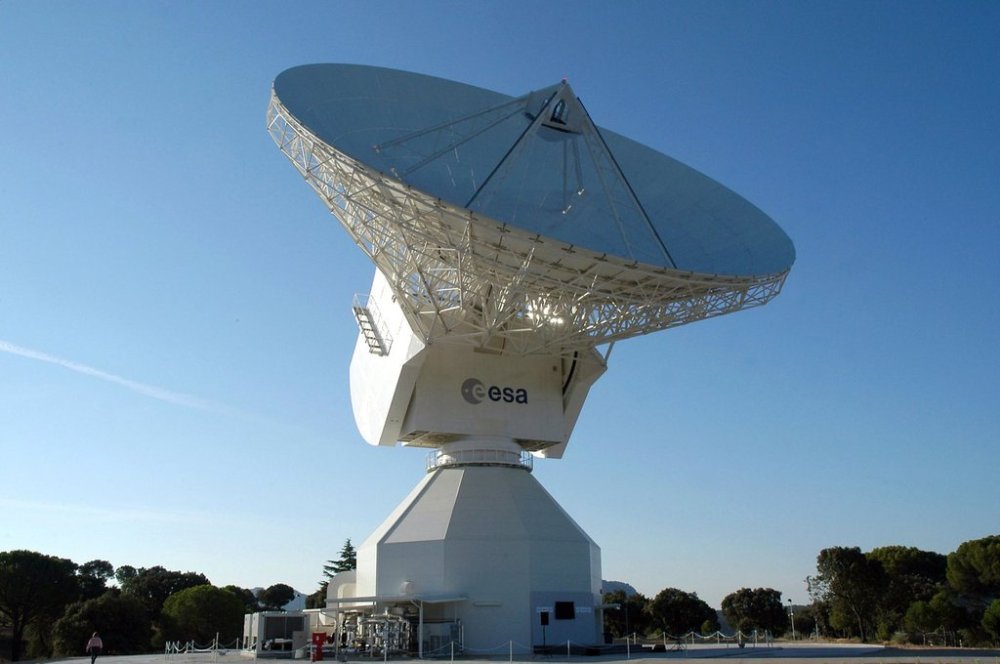
ESA’s big radio antenna in Spain, part of the space agency’s deep-space network, will do the honors. The dish will be pointed in the direction of Voyager 1 so the “Blue Danube” heads that way.
“Music connects us all through time and space in a very particular way,” ESA’s director general Josef Aschbacher said in a statement. “The European Space Agency is pleased to share the stage with Johann Strauss II and open the imaginations of future space scientists and explorers who may one day journey to the anthem of space.”
___
The Associated Press Health and Science Department receives support from the Howard Hughes Medical Institute’s Science and Educational Media Group and the Robert Wood Johnson Foundation. The AP is solely responsible for all content.