Drones blasting AC/DC and Scarlett Johansson are helping biologists protect cattle from wolves

Advertisement

Advertise with us

For millennia humans have tried to scare wolves away from their livestock. Most of them didn’t have drones.

Read this article for free:


or

Already have an account? Log in here »

To continue reading, please subscribe:

Subscribe and receive a limited-edition Free Press branded hat or tote.

Digital Subscription

One year of digital access for only $205*

  • Enjoy unlimited reading on winnipegfreepress.com
  • Read the E-Edition, our digital replica newspaper
  • Access News Break, our award-winning app
  • Play interactive puzzles

*First annual payment billed as $205.00 + GST for one year. This annual subscription will automatically renew at $233.00 + GST every 52 weeks (10% off the regular annual price of $259.35). Offer available to new and qualified returning subscribers only. Cancel any time.

To continue reading, please subscribe:

Add Free Press access to your Brandon Sun subscription for only an additional

$1 for the first 4 weeks*

  • Enjoy unlimited reading on winnipegfreepress.com
  • Read the E-Edition, our digital replica newspaper
  • Access News Break, our award-winning app
  • Play interactive puzzles
Start now

*Your next Brandon Sun subscription payment will increase by $1.00 and you will be charged $17.95 plus GST for four weeks. After four weeks, your payment will increase to $24.95 plus GST every four weeks.

Hey there, time traveller!
This article was published 30/08/2025 (379 days ago), so information in it may no longer be current.

For millennia humans have tried to scare wolves away from their livestock. Most of them didn’t have drones.

But a team of biologists working near the California-Oregon border do, and they’re using them to blast AC/DC’s “Thunderstruck,” movie clips and live human voices at the apex predators to shoo them away from cattle in an ongoing experiment.

“I am not putting up with this anymore!” actor Scarlett Johansson yells in one clip, from the 2019 film “ Marriage Story.”
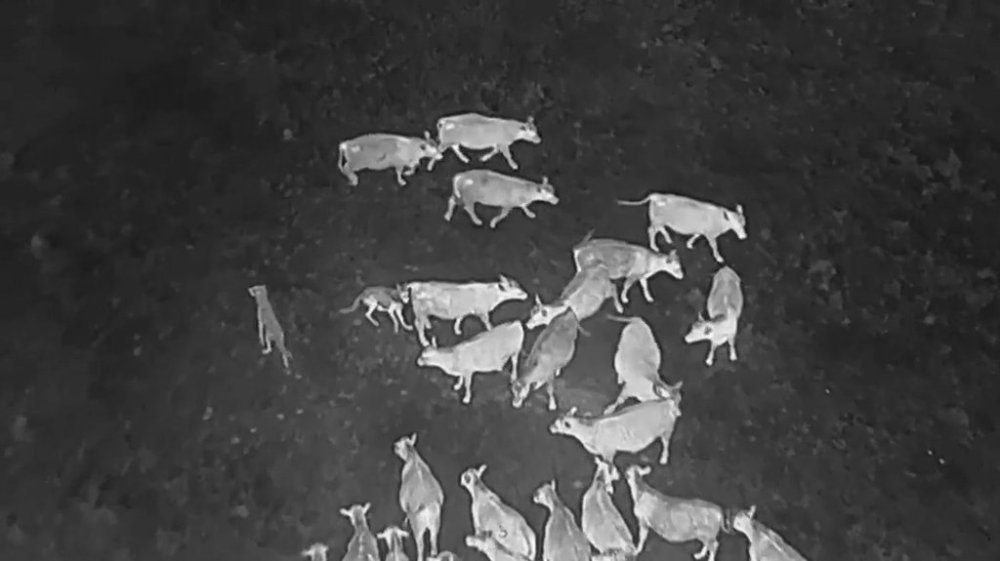
In this image taken from video released by the USDA, Gray wolves halt an attack on a cow at an undisclosed location along the Oregon/California border after a drone emits noises at them as part of efforts by the USDA to monitor predators at night and repel them from livestock by non-lethal means. (USDA via AP)

“With what? I can’t talk to people?” co-star Adam Driver shouts back.

Gray wolves were hunted nearly to extinction throughout the U.S. West by the first half of the 20th century. Since their reintroduction in Idaho and at Yellowstone National Park in the mid-1990s, they’ve proliferated to the point that a population in the Northern Rockies has been removed from the endangered species list.

There are now hundreds of wolves in Washington and Oregon, dozens more in northern California, and thousands roaming near the Great Lakes.

The recovering population has meant increasing conflict with ranchers — and increasingly creative efforts by the latter to protect livestock. They’ve turned to electrified fencing, wolf alarms, guard dogs, horseback patrols, trapping and relocating, and now drones. In some areas where nonlethal efforts have failed, officials routinely approve killing wolves, including last week in Washington state.

Gray wolves killed some 800 domesticated animals across 10 states in 2022, a previous Associated Press review of data from state and federal agencies found.

Scientists with the USDA Animal and Plant Health Inspection Service developed the techniques for hazing wolves by drone while monitoring them using thermal imaging cameras at night, when the predators are most active. A preliminary study released in 2022 demonstrated that adding human voices through a loudspeaker rigged onto a drone can freak them out.

The team documented successful interruptions of wolf hunts. When Dustin Ranglack, the USDA’s lead researcher on the project, saw one for the first time, he smiled from ear to ear.

“If we could reduce those negative impacts of wolves, that is going to be more likely to lead to a situation where we have coexistence,” Ranglack said.

The preloaded clips include recordings of music, gunshots, fireworks and voices. A drone pilot starts by playing three clips chosen at random, such as the “Marriage Story” scene or “Thunderstruck,” with its screams and hair-raising electric guitar licks.

If those don’t work, the operator can improvise by yelling through a microphone or playing a different clip that’s not among the randomized presets. One favorite is the heavy metal band Five Finger Death Punch ‘s cover of “Blue on Black,” which might blast the lyric “You turned and you ran” as the wolves flee.

USDA drone pilots have continued cattle protection patrols this summer while researching wolf responses at ranches with high conflict levels along the Oregon-California border. Patrols extended south to the Sierra Valley in August for the first time, according to the California Department of Fish and Wildlife.

It’s unclear whether the wolves might become accustomed to the drones. Herders and wolf hunters in Europe have long deterred them with long lines hung with flapping cloth, but the wolves can eventually learn that the flags are not a threat.

Environmental advocates are optimistic about drones, though, because they allow for scaring wolves in different ways, in different places.

“Wolves are frightened of novel things,” said Amaroq Weiss, a wolf advocate with the Center for Biological Diversity. “I know that in the human imagination, people think of wolves as big, scary critters that are scared of nothing.”

There are also drawbacks to the technology. A drone with night vision and a loudspeaker costs around $20,000, requires professional training and doesn’t work well in wooded areas, making it impractical for many ranchers.

Ranchers in Northern California who have hosted USDA drone patrols agree that they have reduced livestock deaths so far.

“I’m very appreciative of what they did. But I don’t think it’s a long-term solution,” said Mary Rickert, the owner of a cattle ranch north of Mount Shasta. “What I’m afraid of is that after some period of time, that all of a sudden they go, ‘Wow, this isn’t going to hurt me. It just makes a lot of noise.’”

Ranchers are compensated if they can prove that a wolf killed their livestock. But there are uncompensated costs of having stressed-out cows, such as lower birth rates and tougher meat.

Rickert said if the drones don’t work over the long term, she might have to close the business, which she’s been involved in since at least the 1980s. She wants permission to shoot wolves if they’re attacking her animals or if they come onto her property after a certain number of attacks.

If the technology proves effective and costs come down, someday ranchers might merely have to ask the wolves to go away.

Oregon-based Paul Wolf — yes, Wolf — is the USDA’s southwest district supervisor and the main Five Finger Death Punch fan among the drone pilots. He recalled an early encounter during which a wolf at first merely seemed curious at the sight of a drone, until the pilot talked to it through the speaker.

“He said, ‘Hey wolf — get out of here,’” Wolf said. “The wolf immediately lets go of the cattle and runs away.”


Report Error Submit a Tip

More Stories

Sunday-night auto aficionados work to steer away from unwelcome elements they say aren’t a part of their tradition

Zoe Pierce 12 minute read Preview

Sunday-night auto aficionados work to steer away from unwelcome elements they say aren’t a part of their tradition

Zoe Pierce 12 minute read Friday, Sep. 11, 2026

The red 1969 Dodge Coronet Super Bee out for a cruise on Portage Avenue draws admiring eyes from onlookers on a recent Sunday night, many of them seeing a specimen of the now-rare muscle car for the first time on a Winnipeg street. Or any other street, for that matter.

Longtime car enthusiast Bob Sudoma was behind the wheel, participating in the decades-old show-offy summer tradition.

The Sunday night cruise is built around a simple idea: proud car owners take their beloved vehicles for a spin to meet up with others of the same autophile ilk.

Less-fortunate appreciators, or just curious folks, also gather along the route to watch the highly-polished parade. Portage Avenue is one of cruise night’s best-known stretches.

Read
Friday, Sep. 11, 2026

Downtown no place to be after dark, huge majority of Winnipeggers say in survey

Joyanne Pursaga 8 minute read Preview

Downtown no place to be after dark, huge majority of Winnipeggers say in survey

Joyanne Pursaga 8 minute read Friday, Sep. 11, 2026

Most Winnipeggers are afraid to walk alone downtown and believe the city needs more police officers, a new survey finds.

Winnipeg Police Service released its 2026 citizen survey Friday.

Downtown safety appears to remain a major concern, with just 44 per cent saying they feel very or reasonably safe walking alone in the area during the day. The number plummets to eight per cent overall at night, down from nine per cent in 2024, the last time the survey was conducted.

This year, 14 per cent of men felt very or reasonably safe walking alone downtown at night, compared to just three per cent of women.

Read
Friday, Sep. 11, 2026

Drones blasting AC/DC and Scarlett Johansson are helping biologists protect cattle from wolves

Cedar Attanasio, The Associated Press 5 minute read Preview

Drones blasting AC/DC and Scarlett Johansson are helping biologists protect cattle from wolves

Cedar Attanasio, The Associated Press 5 minute read Saturday, Aug. 30, 2025

For millennia humans have tried to scare wolves away from their livestock. Most of them didn’t have drones.

But a team of biologists working near the California-Oregon border do, and they're using them to blast AC/DC’s “Thunderstruck,” movie clips and live human voices at the apex predators to shoo them away from cattle in an ongoing experiment.

“I am not putting up with this anymore!” actor Scarlett Johansson yells in one clip, from the 2019 film “ Marriage Story.”

“With what? I can't talk to people?” co-star Adam Driver shouts back.

Read
Saturday, Aug. 30, 2025

Highway-safety upgrades in progress after tragic Interlake crash

Chris Kitching 5 minute read Preview

Highway-safety upgrades in progress after tragic Interlake crash

Chris Kitching 5 minute read Friday, Sep. 11, 2026

Provincial workers have started to update or install safety measures at a rural Interlake intersection where four teenage friends died in a crash on Labour Day weekend.

Pavement markings were repainted at Highway 8 and Provincial Road 229, just west of Winnipeg Beach, ahead of work to refresh worn-down rumble strips, starting Monday, and install flashing lights atop two stop signs, following an assessment earlier this week.

“They will also need to incorporate any information from the RCMP report that might be helpful if we were to consider any additional safety measures at this intersection,” Transportation and Infrastructure Minister Lisa Naylor said of department staff.

“The most important thing is safety, and any kinds of changes we make at any intersection actually have to make it safer.”

Read
Friday, Sep. 11, 2026

The port of Churchill — but done right

Editorial 4 minute read Preview

The port of Churchill — but done right

Editorial 4 minute read Yesterday at 2:00 AM CDT

The seagoing grain carrier wasn’t christened with a champagne bottle. There was no confetti or streamers. Nevertheless, the Aug. 31 event marking the first shipment of grain to be loaded at the Port of Churchill since 2020 was celebrated like the launch of a brand new vessel.

The presence of the federal minister of northern and arctic affairs, provincial cabinet ministers and leaders and elders from several northern First Nations signalled that the fast-tracked process of refurbishing and buffing up Manitoba’s deep-water seaport gem is gaining momentum.

For OneNorth, the partnership of 29 First Nations and 12 northern communities which owns the Port of Churchill and the Hudson Bay Railway (both operated by the Arctic Gateway Group) the event heralded a new beginning. It’s been eight years since OneNorth purchased the port and railroad, and six years since grain was moved by rail through Manitoba and then by ship to European markets. Two more grain shipments, plus shipments of potash and critical minerals, will continue through the fall.

When Prime Minister Mark Carney solicited the premiers to suggest “nation-building” projects following his election in 2025, Premier Wab Kinew pitched a Manitoba trade corridor that would move wheat, critical minerals, potash and energy (oil or liquid natural gas) through the Port of Churchill.

Read
Yesterday at 2:00 AM CDT

A life's story: ‘Ivor the Driver’ found his calling in the ranching life

Aaron Epp 7 minute read Preview

A life's story: ‘Ivor the Driver’ found his calling in the ranching life

Aaron Epp 7 minute read Updated: Yesterday at 9:59 AM CDT

Ivor Asham’s family couldn’t have picked a better image to accompany his obituary. There he is, riding Flash, his beloved brown and white quarter horse, a black cowboy hat on his head and a drink in his hand.

Asham owned and operated Birds Hill Park Ranch for nearly 35 years, where he shared his lifelong passion for horses with thousands of visitors. He moved hay, harnessed horses and drove the wagons, introducing himself as “Ivor the Driver.”

Over the years, Asham built a reputation as the quintessential cowboy.

There’s a restaurant at the ranch filled with memorabilia that he collected over the years. Calgary Stampede posters, cowboy boot-shaped shot glasses, a child’s rocking horse, a wagon wheel and numerous photos of legendary actor John Wayne are just some of the items that line the walls.

Read
Updated: Yesterday at 9:59 AM CDT