Quebec has turned down funds aimed at addressing systemic racism in the courts
Advertisement
Read this article for free:
or
Already have an account? Log in here »
To continue reading, please subscribe:
Digital Subscription
One year of digital access for only $1.44 a week*
- Enjoy unlimited reading on winnipegfreepress.com
- Read the E-Edition, our digital replica newspaper
- Access News Break, our award-winning app
- Play interactive puzzles
*Billed as $5.77 plus GST every four weeks. After 52 weeks, price increases to the regular rate of $19.95 plus GST every four weeks. Offer available to new and qualified returning subscribers only. Cancel any time.
To continue reading, please subscribe:
Add Free Press access to your Brandon Sun subscription for only an additional
$1 for the first 4 weeks*
- Enjoy unlimited reading on winnipegfreepress.com
- Read the E-Edition, our digital replica newspaper
- Access News Break, our award-winning app
- Play interactive puzzles
*Your next Brandon Sun subscription payment will increase by $1.00 and you will be charged $17.95 plus GST for four weeks. After four weeks, your payment will increase to $24.95 plus GST every four weeks.
Read unlimited articles for free today:
or
Already have an account? Log in here »
Hey there, time traveller!
This article was published 02/09/2025 (414 days ago), so information in it may no longer be current.
MONTREAL – The Quebec government has turned down federal funding aimed at combating systemic racism in the criminal justice system, saying it doesn’t agree with the program’s approach.
The federal government first offered $6.64 million in funding to provinces and territories in 2021 to improve fairness in the courts. Spread out over five years, the money was aimed at addressing the overrepresentation of Black people in the criminal justice system by promoting the use of race and cultural assessments before sentencing.
These assessments — known as Impact of Race and Culture Assessments, or IRCAs — analyze how a convicted person’s experience of systemic racism contributed to their criminal charges.
While most provinces have accepted the federal funding aimed at supporting defendants or to cover the costs of assessments through their legal aid programs, Quebec has been opposed to providing this type of support.
“We are not party to any funding agreement involving Impact of Race and Culture Assessments, as Quebec doesn’t subscribe to the approach on which the funding program is based, namely systemic racism,” Marie-Hélène Mercier, a spokesperson for Quebec’s Justice Department, told The Canadian Press in an email.
The assessments have been used in Canadian courtrooms for more than a decade by defence lawyers seeking fair sentences. Up until recently, Quebec has been an outlier.
David Nyarko, a board member at the Montreal-based Viola Desmond Justice Institute, an organization that advocates against anti-Black racism in the criminal justice system, says the government’s position leaves criminal defendants at a disadvantage.
The institute wants the assessments to become routine in the province’s criminal proceedings, but Nyarko says a lack of legal aid funding from Quebec is making that mission difficult. As a result, he said their team is largely working pro-bono.
“The majority of our work is done without any sort of compensation,” he said.
He believes one day the province will acknowledge the existence of systemic racism. Meantime, he said his organization has no plans to slow down its work.
“We believe that systemic racism is alive and exists in Quebec,” Nyarko said. “Regardless of their position, we’re going to continue to do the work that we do, and make the best of what we can — with or without their support.”
The institute, named after a Black Nova Scotian civil rights activist convicted in the 1940s for challenging racial segregation in a New Glasgow, N.S., theatre, played a key role in producing the first ever race and culture assessment to be presented to a Quebec judge, before a sentencing decision in July.
The assessment relayed the life story of Frank Paris, 52, a man who pleaded guilty on counts of trafficking cannabis and hashish. It also described how his crimes were linked to racism and poverty he faced as an intergenerational survivor of slavery.
Judge Magali Lepage gave him a reduced sentence of 24 months, down from the 36-month sentence recommended by the Crown, his lawyer Andrew Galliano said. Because he got credit for time served, Paris was released from custody, Galliano added.
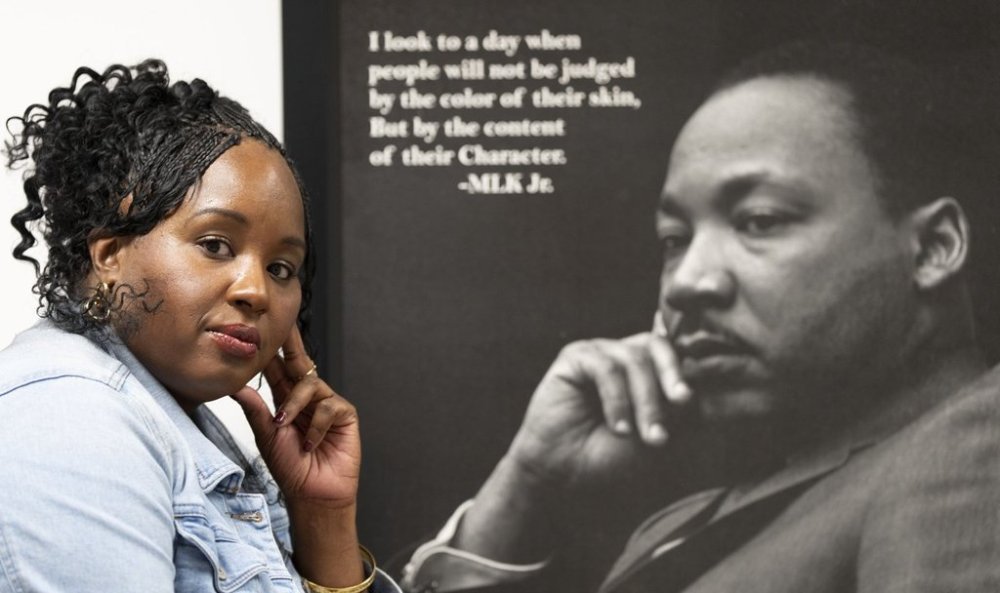
Nicole Mitchell, one of the co-authors of his assessment, said Quebec should seize the opportunity to access the federal funds.
The province’s current approach is blocking Black and other racialized people from having access to vital justice-informed and culturally grounded legal aid services, she said.
Federal statistics published in a Canadian Justice Department report in 2022 showed that Black people were found to be 24 per cent more likely to serve time following arrest or sentencing, and 36 per cent more likely to be sentenced two years or more compared to white offenders.
In 2021, the rate of Black people accused of homicide was almost six times higher than the one for non-racialized people, the department also noted.
“The main reason that I got involved in all of this is because I wanted to make a positive difference in the Black community,” said Mitchell, also a PhD student in social work at McGill University. “I don’t want to see Black people overrepresented in the criminal justice system.”
Canada recently expanded its legal aid program aimed at addressing the disparities reflected in federal statistics, announcing in 2024 it was increasing funding to $16 million over five years to address the issue.
In addition to funding civil rights organizations that produce the assessments, provincial and territorial legal aid clinics also received funding. The program has additionally supported national training efforts and awareness campaigns.
It’s always been up to individual provinces and territories however to decide if and how they want to use the money.
The federal government says there aren’t any active funding agreements in Prince Edward Island, Saskatchewan and Alberta. There also aren’t any in Nunavut or the Northwest Territories.
“Canada remains ready to work with Quebec, and other interested provinces and territories, to support the implementation of IRCAs in their respective jurisdictions,” said Kwame Bonsu, a spokesperson for the federal Justice Department.
The department said it previously had an agreement with Alberta that was suspended in December 2024.
A spokesperson for Alberta’s justice minister did not directly respond to a question about why the province had suspended the agreement.
“We continue to support programs that address the needs of justice system participants that include specialized court programs, including drug treatment, Indigenous, and mental health courts,” spokesperson Heather Jenkins wrote.
A spokesperson for Prince Edward Island’s justice minister said while it has yet to receive this funding, stakeholders including its anti-racism office are committed to “exploring” the use of the assessments.
Saskatchewan’s legal aid service meanwhile says it’s in discussions with the federal government in hopes of establishing a funding agreement, but has struggled due to a lack of qualified professionals in the province.
The Justice Department for the Northwest Territories told The Canadian Press that defence lawyers are welcome to reach their legal aid office with a request for reimbursement.
Nunavut’s Justice Department meanwhile said it couldn’t immediately respond to the question.
This report by The Canadian Press was first published Sept. 2, 2025.