Sergi López on ‘Sirāt’: A journey that makes you look inward
Advertisement
Read this article for free:
or
Already have an account? Log in here »
To continue reading, please subscribe:

Digital Subscription
One year of digital access for only $205*
- Enjoy unlimited reading on winnipegfreepress.com
- Read the E-Edition, our digital replica newspaper
- Access News Break, our award-winning app
- Play interactive puzzles
*First annual payment billed as $205.00 + GST for one year. This annual subscription will automatically renew at $233.00 + GST every 52 weeks (10% off the regular annual price of $259.35). Offer available to new and qualified returning subscribers only. Cancel any time.
To continue reading, please subscribe:
Add Free Press access to your Brandon Sun subscription for only an additional
$1 for the first 4 weeks*
- Enjoy unlimited reading on winnipegfreepress.com
- Read the E-Edition, our digital replica newspaper
- Access News Break, our award-winning app
- Play interactive puzzles
*Your next Brandon Sun subscription payment will increase by $1.00 and you will be charged $17.95 plus GST for four weeks. After four weeks, your payment will increase to $24.95 plus GST every four weeks.
Read unlimited articles for free today:
or
Already have an account? Log in here »
Hey there, time traveller!
This article was published 28/01/2026 (253 days ago), so information in it may no longer be current.
MEXICO CITY (AP) — “Sirāt,” Spain’s latest Oscar contender, follows Luis as he treks through the North African desert with his 12-year-old son and his dog to find his missing daughter.
Blending the grit of “Mad Max” with the underground rave culture of the 1990s, the film is set against the backdrop of a hypothetical World War III. It follows nomadic youths with hippie-punk aesthetics who carry their passion for electronic music into North Africa — a journey that becomes existential amid the desert dust.
“Drums of war, rumors of borders closing or armies moving,” the film’s star, Sergi López, said in a video interview with The Associated Press. “We feel that we are not doing science fiction; we are talking about how you move forward with the pain that you have to live in this world.”

Although it is set in that future, Oliver Laxe’s “Sirāt” carries irremediable echoes of the present. Luis is a searching father, an unfortunately familiar figure in Mexico, where parents must often hunt for their missing children alone, without the help of the authorities and under the threat of pervasive violence.
“Disappearance is worse than death. It’s an eternal death,” said López. “Searching without finding is surely the hardest thing.”
Since its premiere at the 78th edition of the Cannes Film Festival, “Sirāt” has caused a stir, taking the Jury Prize, the Best Original Score Award and the Palm Dog Jury Prize, for its dogs Lupita and Pipa.
Last week, it was nominated for Oscars in the best international feature film and best sound categories. The Academy Awards will be presented on March 15 in Los Angeles.
“Oliver’s vision has a deeply spiritual quality to it,” López said about Laxe, the 41-year-old French-born Galician director. “He said that this film (‘Sirāt’), forces the viewer — or rather what he proposes the viewer to do — is to look inward.”
‘A brutal social conscience’

López, whose credits include “Pan’s Labyrinth,” “With a Friend Like Harry…,” and “Dirty Pretty Things,” said that “Sirāt” allowed him to immerse himself in the raver community or “ravero collective,” as he calls it. He said he was surprised to find that, although their parties can last for days, interactions are usually peaceful among revelers and respectful with the environment.
“I used to view them as a collective of immature people who took drugs, danced and did nothing else,” said the actor. “Instead, I found a group with a brutal social conscience… Women feel safe, people accompany each other, people are aware of everyone else. When they dismantle the party, there is not a piece of paper left on the floor. I was very surprised.”
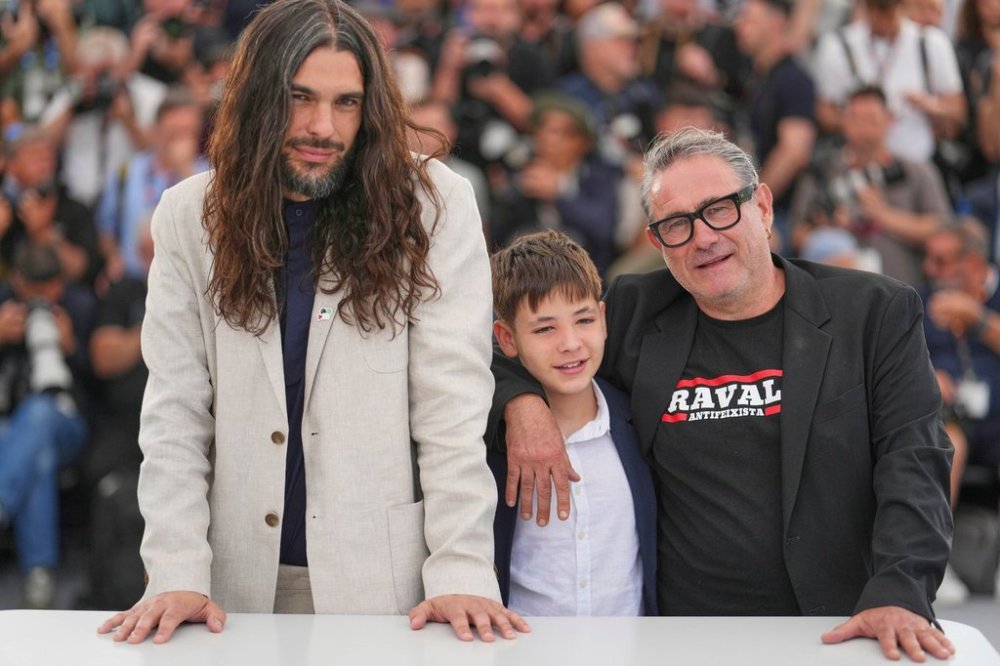
Esteban, the son who accompanies Luis on his journey, is played movingly by Bruno Núñez Arjona.
“I did tests with different children, but we connected with him right away,” said López about Núñez Arjona. His parents, watching from the sidelines, smiled at the “odd couple.”
“Bruno and I walking around the set. I think he had a blast. Especially during the scenes where there are cars moving and falling — it was like he was in an amusement park.”
Shot across the Moroccan desert and Teruel, Spain, “Sirāt” incorporates a real three-day rave, capturing shots of the partygoers. The film’s title, “Sirāt,” is Arabic for “way” or “path” — a poignant name for a story set in a dystopian future where there is no law, there are weapons of war, water is scarce and driving on the roads is a lethal risk for those daring enough to travel them.
Ultimately, López believes the film is a testament to human resilience.
“That’s what life is about, trying to move forward with whatever you get,” López said. “And if it’s painful, then how do we do it? Surely by being accompanied by a family — even if it’s a family of punks you don’t know.”