Valentino opens post-Garavani couture with somber note, then high drama
Advertisement
Read this article for free:
or
Already have an account? Log in here »
To continue reading, please subscribe:

Digital Subscription
One year of digital access for only $205*
- Enjoy unlimited reading on winnipegfreepress.com
- Read the E-Edition, our digital replica newspaper
- Access News Break, our award-winning app
- Play interactive puzzles
*First annual payment billed as $205.00 + GST for one year. This annual subscription will automatically renew at $233.00 + GST every 52 weeks (10% off the regular annual price of $259.35). Offer available to new and qualified returning subscribers only. Cancel any time.
To continue reading, please subscribe:
Add Free Press access to your Brandon Sun subscription for only an additional
$1 for the first 4 weeks*
- Enjoy unlimited reading on winnipegfreepress.com
- Read the E-Edition, our digital replica newspaper
- Access News Break, our award-winning app
- Play interactive puzzles
*Your next Brandon Sun subscription payment will increase by $1.00 and you will be charged $17.95 plus GST for four weeks. After four weeks, your payment will increase to $24.95 plus GST every four weeks.
Read unlimited articles for free today:
or
Already have an account? Log in here »
Hey there, time traveller!
This article was published 28/01/2026 (246 days ago), so information in it may no longer be current.
PARIS (AP) — Valentino’s first couture show since house founder Valentino Garavani’s funeral in Rome opened under a somber shadow, with many guests fresh from the ceremony — then snapped it off with a jolt of pure theater.
VIP guests, including Sir Elton John and Kirsten Dunst, were guided through near-darkness to their “seats”: simple stools set against circular pods, each punctured by a small kinky-feeling viewing window.
When the show began, the blinds lifted; the classical music soundtrack cut by the sharp punctuation of barking dogs.
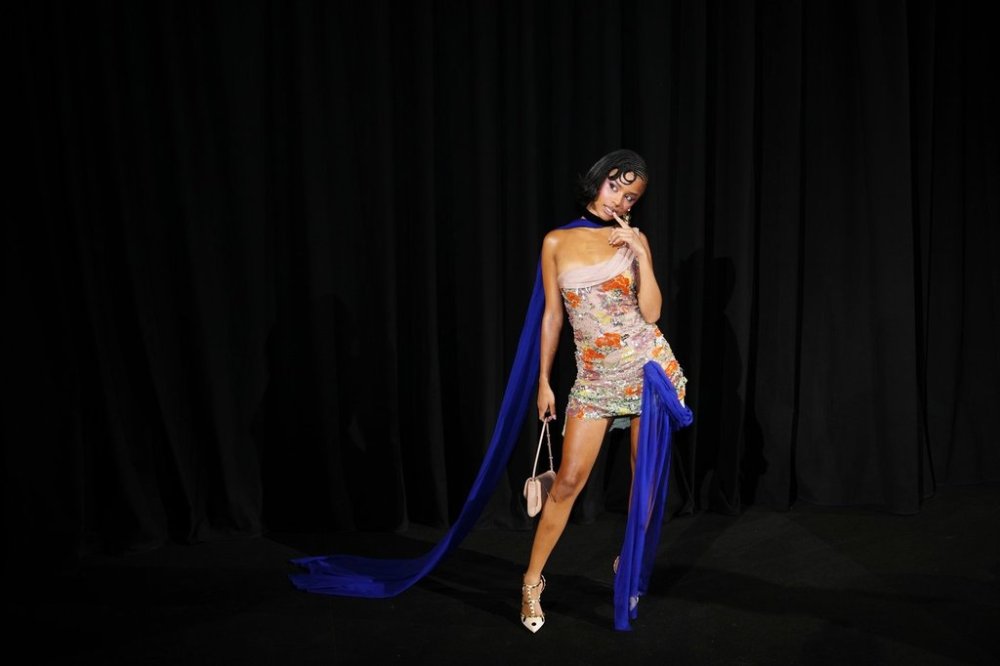
Inside the hubs, models appeared like mannequins behind glass — private viewing holes turned into a couture peep show.
Couture as show
The white, sterile-lit staging leaned into the idea of a curated gaze.
Each guest saw a slice, not always the whole: a face, a shoulder, a shimmer of fabric, then the next.
The set read like a sterilized, futuristic cell — clean, white, clinical — made more unsettling by the soundscape, which kept slipping from elegance into angry animal sounds.
It was a clever piece of showcraft: creative director Alessandro Michele, a maximalist by instinct, using restriction as a hook.
He didn’t flood the room with spectacle; he rationed it.
Spectacular set, restrained clothes
The often dazzling clothes, however, didn’t always match the set’s ambition.
Michele delivered disco sheen — sparkle, gems, bedazzled headwear and layered gold collars with a faint circus edge — but the couture itself felt comparatively restrained, even cautious.
There were strong flashes: bold sleeves that swelled toward leg-of-mutton proportions; sequined surfaces that caught the light with that Valentino polish; and occasional provocation in the way the body was framed.
The skirts of giant billowing dresses nicely overwhelmed the human form.
But for a designer known for excess, the collection often played it safe.
Stars and strobe stripes
Front row heat underlined the stakes.
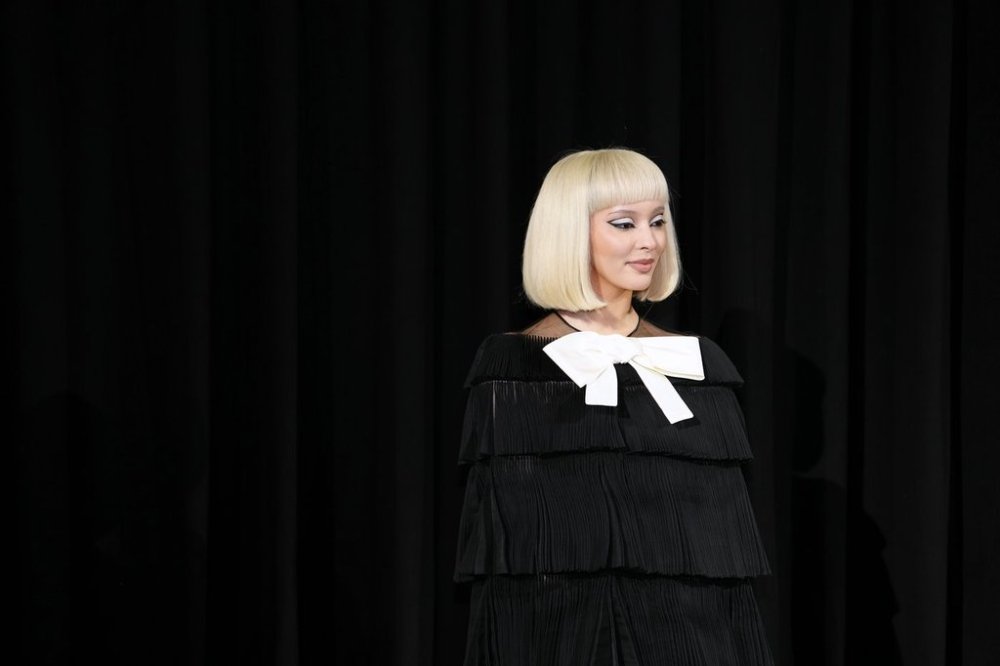
The room pulled in a heavy mix of celebrity and brand power, from Dakota Johnson to Lily Allen and Tyla, plus global ambassadors and high-wattage fashion regulars.
The atmosphere said “event.”
The collection said “reset”: a designer calibrating his volume, testing how far he can bend Valentino’s couture codes without breaking them.
Michele can stage a show — that much is settled.
Fashion insiders remember Garavani
For Suzy Menkes, the emotion around this Valentino couture show was immediate.
Coming straight from Garavani’s funeral in Rome to Paris couture week, the fashion industry doyenne and former International Herald Tribune fashion critic said “people do feel emotional” because “it is an end of an era.”
She described a wider pattern, too: “one designer or elderly designer after another” has “gently disappeared.” But this, she suggested, felt like “a special one” — not only inside the industry, but beyond it.
Menkes said Valentino was “a designer that everybody could understand,” with “so many clients and famous people” that it wasn’t just “those who were contracted to fashion who knew of him.”
Asked about her own history with Valentino, she traced it back “about 45 years ago,” when she was a junior journalist — “he didn’t pay much attention” to her, she recalled, though he was “always polite,” surrounded by “an enormous number of people” from fashion and “social society.”
She acknowledged that “we’ve got some really good designers who are taking over and doing a terrific job,” but insisted the transition doesn’t feel identical: “it’s not the same character… it doesn’t seem to be the same person who was there before.”