Buzz of the Olympics: How drone cams deliver high-pace visuals and add a new dynamic for TV viewers

Advertisement

Advertise with us

CORTINA D’AMPEZZO, Italy (AP) — Standing on a tower overlooking the cliffs of the Cortina downhill course, there is someone who is just as involved in the biggest skiing races of the Winter Olympics as Mikaela Shiffrin and Breezy Johnson.

Read this article for free:


or

Already have an account? Log in here »

To continue reading, please subscribe:

Subscribe and receive a limited-edition Free Press branded hat or tote.

Digital Subscription

One year of digital access for only $205*

  • Enjoy unlimited reading on winnipegfreepress.com
  • Read the E-Edition, our digital replica newspaper
  • Access News Break, our award-winning app
  • Play interactive puzzles

*First annual payment billed as $205.00 + GST for one year. This annual subscription will automatically renew at $233.00 + GST every 52 weeks (10% off the regular annual price of $259.35). Offer available to new and qualified returning subscribers only. Cancel any time.

To continue reading, please subscribe:

Add Free Press access to your Brandon Sun subscription for only an additional

$1 for the first 4 weeks*

  • Enjoy unlimited reading on winnipegfreepress.com
  • Read the E-Edition, our digital replica newspaper
  • Access News Break, our award-winning app
  • Play interactive puzzles
Start now

*Your next Brandon Sun subscription payment will increase by $1.00 and you will be charged $17.95 plus GST for four weeks. After four weeks, your payment will increase to $24.95 plus GST every four weeks.

Hey there, time traveller!
This article was published 13/02/2026 (235 days ago), so information in it may no longer be current.

CORTINA D’AMPEZZO, Italy (AP) — Standing on a tower overlooking the cliffs of the Cortina downhill course, there is someone who is just as involved in the biggest skiing races of the Winter Olympics as Mikaela Shiffrin and Breezy Johnson.

Martin Bochatay is the drone cam pilot for the money shots inside the iconic Tofana schuss, the narrow chute between two walls of Dolomite rock.

He is part of a team in control of the buzzing machines that are flying right behind Olympians as they go for gold at the Milan Cortina Games, offering stunning and high-pace visuals to TV viewers back home.
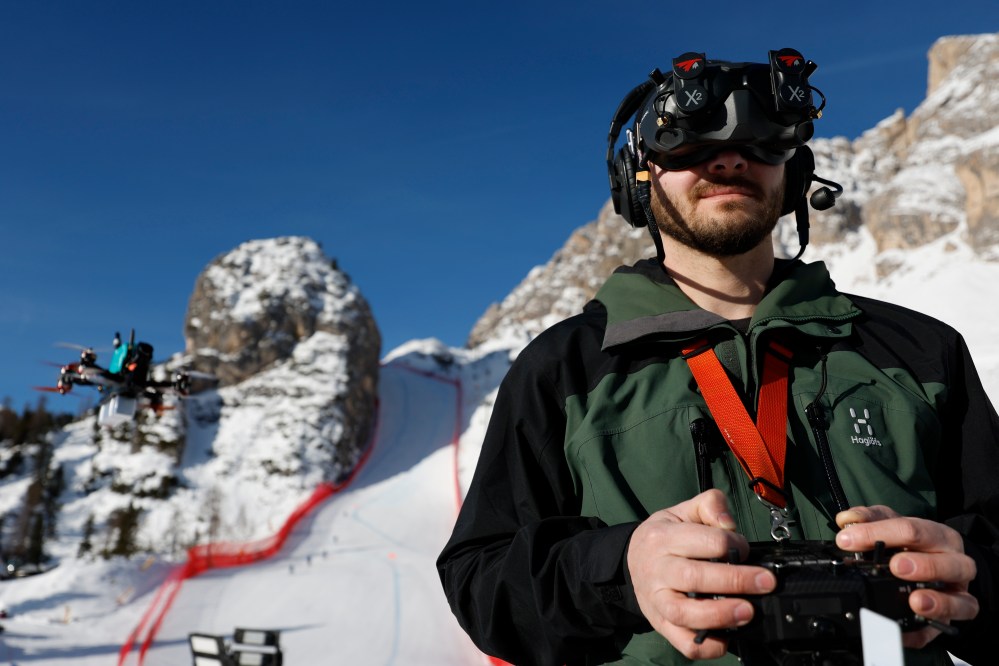
Drone pilot Martin Bochatay controls a drone, left, in front of the Olympia delle Tofane course, ahead of an alpine ski, women's World Cup downhill race, in Cortina d'Ampezzo, Italy, Friday, Jan. 26, 2024. (AP Photo/Alessandro Trovati)

“In my mind, I’m not flying a drone. I’m flying with the skiers,” Bochatay told The Associated Press before the Olympics. “It’s an immersive thing. … The skiers don’t see us. But I’m right there with them. You become the drone.”

Drone cams have become ubiquitous in showcasing the speeds and angles of skiers, lugers, snowboarders, ski jumpers and other Winter Olympians at these Games.

“The skill of those drone pilots is just phenomenal,” U.S. bobsledder and flag bearer Frank Del Duca said. “It gets a really unique perspective.”

Viewers have noted the humming noise coming from the machines, sparking the question: Is it putting off the Olympians in the biggest moment of their lives? Norwegian downhiller Kajsa Vickhoff Lie says that’s not an issue.

“No, you just maybe hear them on the start, but you don’t hear them when you ski,” she said.

The drones are tiny and zoom beyond 100 mph
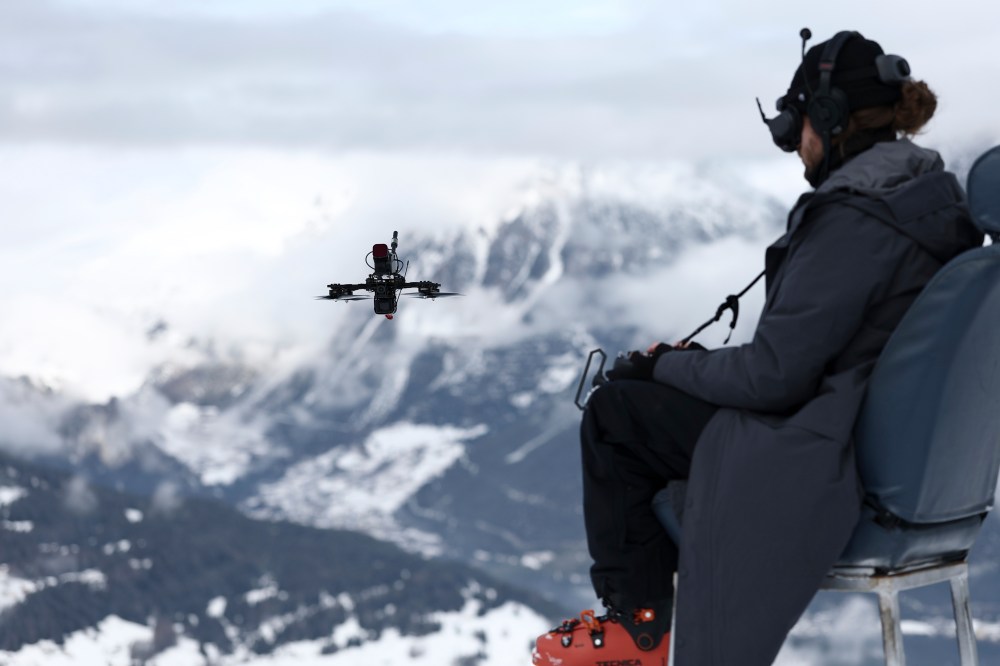
A drone operator captures video ahead of an alpine ski, men's super-G race, at the 2026 Winter Olympics, in Bormio, Italy, Wednesday, Feb. 11, 2026. (AP Photo/Gabriele Facciotti)

Drone cams made in inauspicious impact on Alpine skiing 11 years ago when a primitive, massive machine came crashing down from the sky and nearly smashed into Austrian great Marcel Hirscher during a slalom race.

These days, the drones are agile, tiny — they weigh around half a pound (250 grams) — and can easily accelerate to speeds beyond 100 mph (more than 170 kph).

In all the sports, there are rules preventing the drones from overtaking the athletes, and they must keep a safe distance behind the competitors.

Pitch, roll and yaw: how to fly a drone

The drones actually contain two cameras. There’s a high-quality camera for broadcast purposes that is actually controlled by the TV production unit in a truck below the course.

“They can adjust whether it’s too bright, the balance, without us doing anything,” Bochatay said.
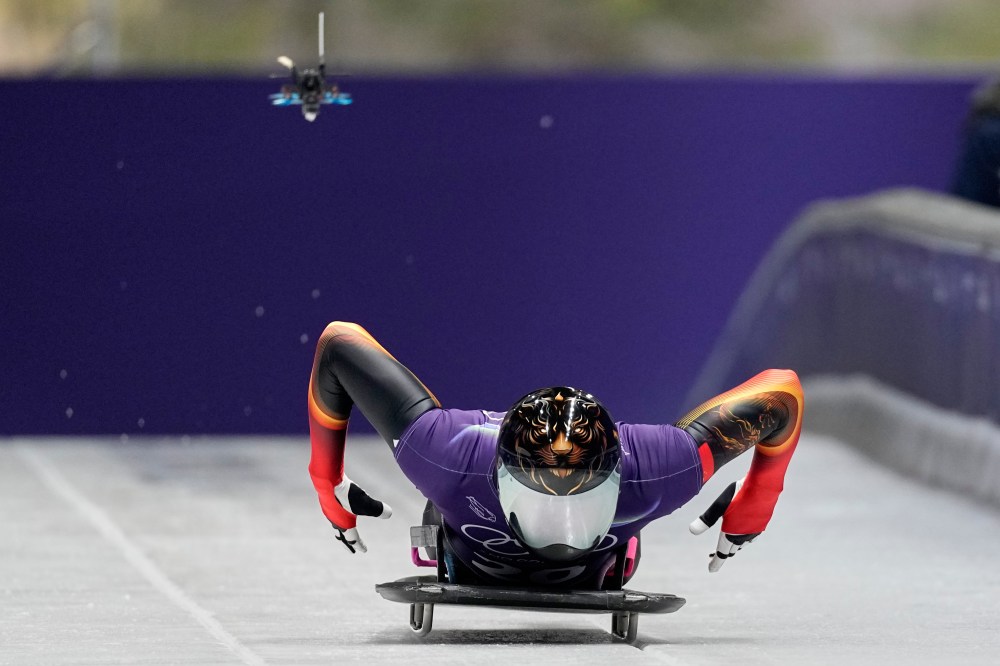
A drone follows China's Lin Qinwei as he starts for a men's skeleton training session at the 2026 Winter Olympics, in Cortina d'Ampezzo, Italy, Tuesday, Feb. 10, 2026. (AP Photo/Aijaz Rahi)

Then there’s a lower-quality camera that the pilots use to see where they are going. Those are the images that the pilots see in the goggles they wear to fly the drones.

The pilots have a remote control that requires two hands to hold, and contains two main switches to input the flying commands of pitch (front-to-back), roll (side-to-side) and yaw (vertical axis); plus throttle (up/down or altitude control).

“There’s always these four,” Bochatay said. “It’s not like you move one then the other. It’s everything at the same time.”

There’s also a low-tech issue: the batteries for the drones need to be changed constantly — and kept in warming cases due to the cold temperatures — requiring a “pit stop crew” to quickly sub in new batteries between runs.

Flying footage can be ‘nauseating’ but beautiful

Two things were important to Olympic broadcasting officials: Showing off both the beauty of the venues and the point of view of the athlete.
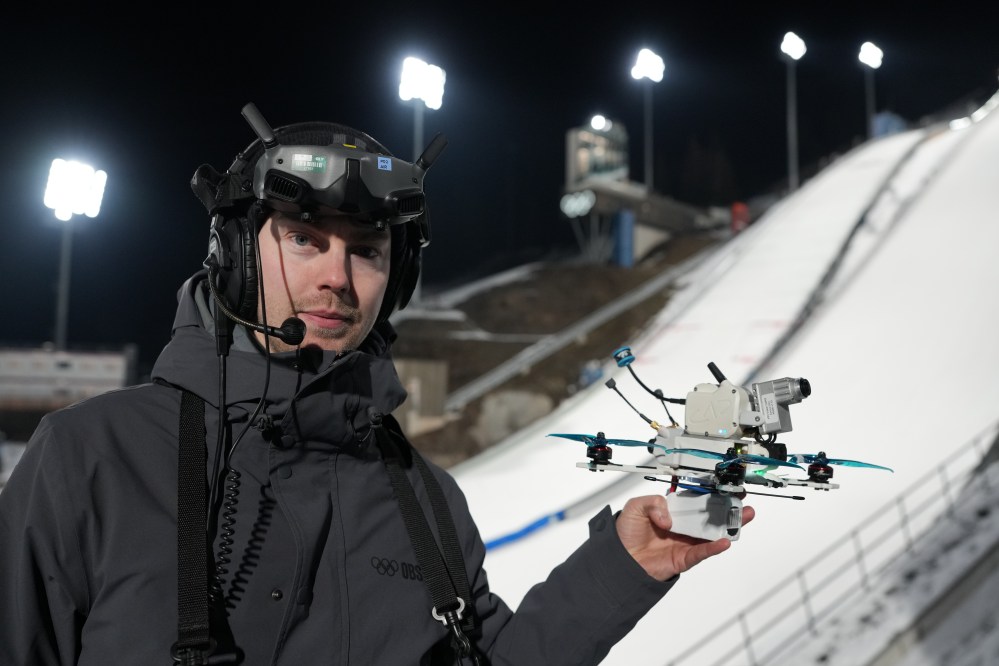
Drone pilot Jonas Sundal, from Canada, holds one of the drones being flown at the ski jumping venue during the 2026 Winter Olympics, in Predazzo, Italy, Tuesday, Feb. 10, 2026. (AP Photo/Evgeniy Maloletka)

And the International Olympic Committee is delighted with the results as they look to bring viewers closer to the action. Maybe too close.

“Looking at the screen in the downhill, I almost feel motion sickness,” said Pierre Ducrey, the IOC’s sports director. “That’s how much we are able to project ourselves thanks to this new way of broadcasting the sport.”

U.S. bobsledder Elana Meyers Taylor agreed.

“I’m not concerned about the drone or anything like that,” she said, “but I will say I was watching the luge footage the other day and I was like, ‘This is slightly nauseating.’ I don’t know if I could watch this all the way down the run.”

Lie, the Norwegian skier, likes how the drones showcase a key aspect of skiing: It’s cool to see the speed a little bit more for the spectators.”

___
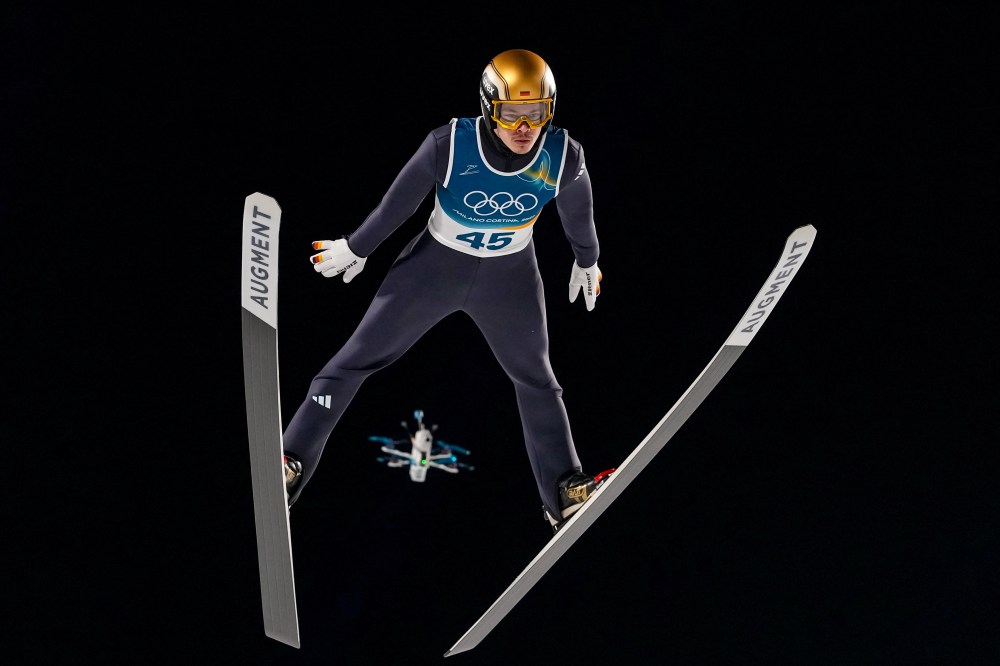
A drone follows Philipp Raimund, of Germany, as he soars through the air during his first round jump of the ski jumping men's normal hill individual at the 2026 Winter Olympics, in Predazzo, Italy, Monday, Feb. 9, 2026. (AP Photo/Kirsty Wigglesworth)

AP Sports Writer Tim Reynolds contributed to this report.

___

AP Olympics: https://apnews.com/hub/milan-cortina-2026-winter-olympics

Report Error Submit a Tip

More Stories

Seven Wilsons, one regional spirit

Hersh Seth 5 minute read Preview

Seven Wilsons, one regional spirit

Hersh Seth 5 minute read 2:00 AM CDT

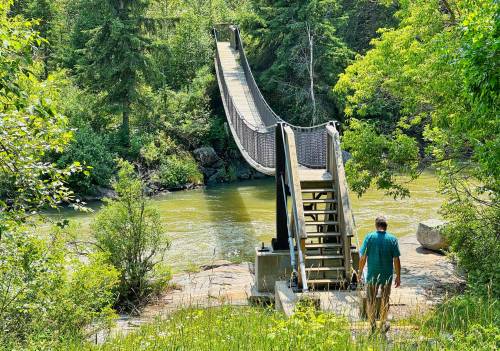
In Dryden, Ont., a 34-metre suspension bridge crosses the Wabigoon River rapids. It is named after a man who paid for a quarter of the bridge himself. A plaque recognizes Roy Wilson’s “many contributions to City Revitalization” and mentions his 40 years in the Rotary Club, whose motto is “service above self”.

My father sold business machines from the 1970s through the ’90s, during the shift from carbon copy machines and typewriters to photocopiers, fax machines, and early office computers and printers. His sales territory — which he covered mostly by car but also by propeller plane — was Saskatchewan, the Northwest Territories, Manitoba, and northwestern Ontario, though much of it really belonged to the Wilsons.

In business machines, selling the machine was only half the job — the other half was ensuring a technician would fix it in January. Wilson’s set the standard for dealers across most of my dad’s regions. My father worked with Roy’s son Greg (who would later go on to become mayor of Dryden) but really respected Roy for teaching Greg to run the company with the towns they served as the priority.

Wilson’s service routes went beyond where roads stopped. Even if customers lived north of the highway system, Wilson’s still found a way to help, using three company planes based at the Dryden airport. As a result, a stationery shop from a paper mill town served all of northwestern Ontario and later northern Manitoba. Imagine a photocopier strapped into a small plane, a technician beside it, and a gravel runway waiting at the other end.

Read
2:00 AM CDT

Morning-show veteran swaps microphone for macchiatos at new Corydon café

David Sanderson 9 minute read Preview

Morning-show veteran swaps microphone for macchiatos at new Corydon café

David Sanderson 9 minute read Saturday, Oct. 3, 2026

Good news if you were used to having your morning coffee with Terri Gale, who earlier this summer signed off from CTV Your Morning, after 15 years on the job.

Gale, the three-hour program’s longtime weather expert, and her husband Rob Gale, the ex-head soccer coach of Valour FC and co-founder of the Northern Super League’s new Winnipeg franchise, are the owners of Golden Hour Café and Bar at 775 Corydon Ave.

Gale (formerly Apostle) nods when she is asked who would know more about caffeinated beverages than a person who, for the last decade and a half, set her alarm to go off in the wee small hours.

“I do love coffee and take mine black. Except because I hate burning my tongue — not a good thing when you speak for a living — I got into the habit of throwing a couple of ice cubes in my cup, to be on the safe side,” Gale says, seated on the second level of their attractive, 2,100-square-foot premises, which officially opened in mid-September.

Read
Saturday, Oct. 3, 2026

Botched execution revives death penalty debate

Arthur Chapman 5 minute read 2:00 AM CDT

The United States of America’s seemingly endless, often futile, search for the painless, bloodless method of executing prisoners continues. The latest horrifying chapter occurred in Tennessee on Sept. 30, when the state tried to kill convicted murderer Christa Pike by lethal injection.

It didn’t work. Pike survived two dosages of pentobarbital. She was rushed to a hospital where, according to her lawyer, she was receiving “lifesaving care”.

Tennessee governor Bill Lee has cancelled upcoming executions, but he isn’t moving away from capital punishment.

Lee said, as quoted in the New York Times: “The people of Tennessee have determined that capital punishment is the appropriate sentence for the most heinous of crimes. The people of Tennessee expect those sentences to be carried out in a manner that’s not only legal and constitutional but effective, and that didn’t happen.”

Essential workers ruling raises questions

Editorial 4 minute read Preview

Essential workers ruling raises questions

Editorial 4 minute read 2:00 AM CDT

Ever been to a Dynacare clinic? Most of us have been. It’s an amazing demographic and ethnic slice of the city we’ve become. Old patients. Young patients. New arrivals. Long-time Canadians. People who know the ropes — others who are startled by the crowds and the noise and the lockstep forward motion of professionals doing what they have been trained to do. It seems, all at the same time, both chaotic and diagnostic, as names of patients are steadily called out and thousands of tests are performed.

But Dynacare is at the centre of a new kind of test and this time, we’re all in the test tube together.

It’s the first real test for new labour law put in place by the government of Premier Wab Kinew in 2024 — a law that redefined what essential services are for provincially-regulated workplaces. Under this law, companies and their employee and unions must have an agreement of which employees are essential — which ones must stay on the job during a legal strike for the protection of the health and safety of the public.

Dynacare had that kind of essential employee agreement with its staff and union — the company and the union had agreed the employees were not essential.

Read
2:00 AM CDT

Pimp sentenced to 11 years in prison

Erik Pindera 5 minute read Preview

Pimp sentenced to 11 years in prison

Erik Pindera 5 minute read 2:00 AM CDT

A man who picked up a vulnerable 17-year-old child-welfare ward on the streets of Winnipeg and coerced her into providing sexual services for several months has been sent to prison for more than a decade.

After a trial, Hassan Kargbo, who’s in his early 30s, was found guilty of sexual exploitation, making child sexual abuse and exploitation material, receiving a material benefit from sexual services provided by a person under 18, procuring a person under 18 and advertising sexual services.

Provincial court Judge Julie Frederickson sentenced him to 11 years behind bars late last month.

“Mr. Kargbo picked up a young Indigenous girl walking over the Osborne Street bridge and quickly got her involved in drug use and escorting,” Frederickson said in a written decision.

Read
2:00 AM CDT

MPI lowers speed limit on tech upgrade with ‘IT roadmap’ following Project Nova debacle

Carol Sanders 5 minute read Preview

MPI lowers speed limit on tech upgrade with ‘IT roadmap’ following Project Nova debacle

Carol Sanders 5 minute read Updated: Yesterday at 9:44 PM CDT

Manitoba Public Insurance is now using an “IT road map” and phasing in new technology and systems after pulling the plug last year on its failed $164-million overhaul known as Project Nova, its annual report says.

Read
Updated: Yesterday at 9:44 PM CDT