It’s International Fact-Checking Day. Refresh your AI identification skills

Advertisement

Advertise with us

Artificial intelligence-generated content is everywhere these days, making it increasingly difficult to separate fact from fiction, particularly when it comes to breaking news.

Read this article for free:


or

Already have an account? Log in here »

To continue reading, please subscribe:

Subscribe and receive a limited-edition Free Press branded hat or tote.

Digital Subscription

One year of digital access for only $205*

  • Enjoy unlimited reading on winnipegfreepress.com
  • Read the E-Edition, our digital replica newspaper
  • Access News Break, our award-winning app
  • Play interactive puzzles

*First annual payment billed as $205.00 + GST for one year. This annual subscription will automatically renew at $233.00 + GST every 52 weeks (10% off the regular annual price of $259.35). Offer available to new and qualified returning subscribers only. Cancel any time.

To continue reading, please subscribe:

Add Free Press access to your Brandon Sun subscription for only an additional

$1 for the first 4 weeks*

  • Enjoy unlimited reading on winnipegfreepress.com
  • Read the E-Edition, our digital replica newspaper
  • Access News Break, our award-winning app
  • Play interactive puzzles
Start now

*Your next Brandon Sun subscription payment will increase by $1.00 and you will be charged $17.95 plus GST for four weeks. After four weeks, your payment will increase to $24.95 plus GST every four weeks.

Artificial intelligence-generated content is everywhere these days, making it increasingly difficult to separate fact from fiction, particularly when it comes to breaking news.

Look no further than the Iran war. Since the U.S. and Israel attacked Iran on Feb. 28, researchers have identified an unprecedented number of false and misleading images that were generated using artificial intelligence and have reached countless people around the world. Among them, fake footage of bombings that never happened, images of soldiers who were supposedly captured and propaganda videos created by Iran that depict President Donald Trump and others as blocky, Lego-like miniatures.

Thursday, the 10th annual International Fact-Checking Day, provides a good opportunity to look at these evolving challenges.
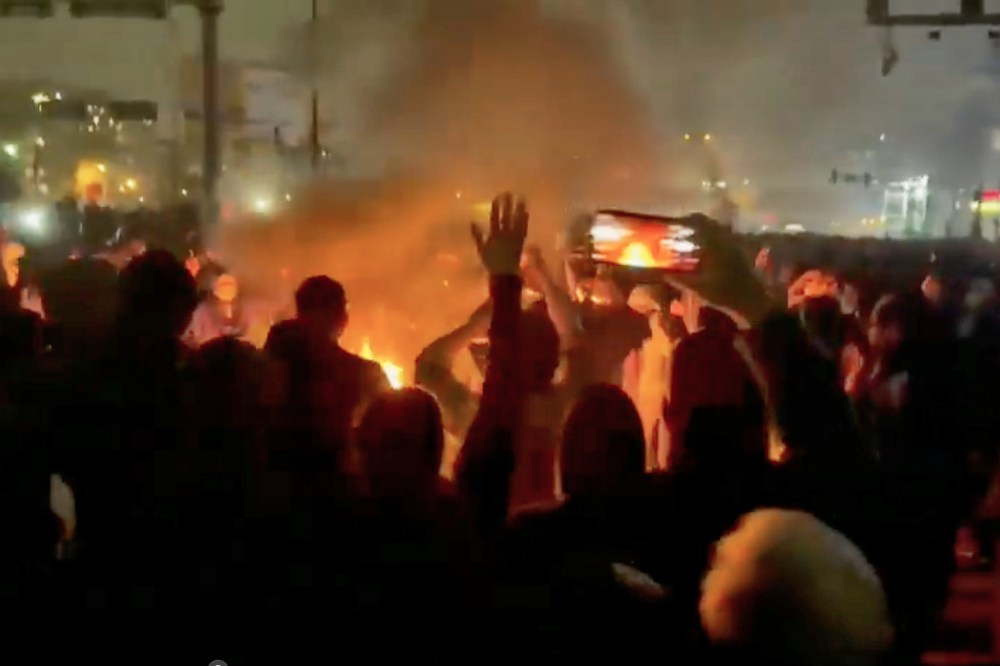
FILE - In this image from video circulating on social media, protesters dance and cheer around a bonfire as they take to the streets of Tehran, Iran, on Jan. 9, 2026. (UGC via AP, File)

Misinformation created with AI is being shared with unprecedented speed from an endless number of sources. From the outset of the Iran war, accounts from all sides of the conflict promoted such content.

The Institute for Strategic Dialogue, which tracks disinformation and online extremism, has been examining social media posts around the Iran war. Among their findings was a group of X accounts that regularly post AI-generated content and collectively gained more than 1 billion views since the conflict began. This was done by roughly two dozen accounts, many of which had blue check verification.

Here are some tips for distinguishing AI-generated content from reality in an online world where that continues to get harder.

Look for visual cues

When AI-generated images first began spreading widely online, there were often obvious tells that could identify them as fabricated. Perhaps a person had too few — or too many — fingers or their voice was out of sync with their mouth. Text may have been nonsensical. Objects were frequently distorted or missing key components. As the technology continues to evolve, these clues aren’t as common as they once were, but it’s still worth looking for them. Watch for inconsistencies such as a car that is in a video one moment and gone the next or actions that aren’t possible according to the laws of physics. Some images may also be overly polished or have an unnatural sheen.

Seek out a source

AI-generated images get shared over and over again. One way to determine their authenticity (or lack thereof) is to hunt for their origin. Using a reverse image search is a simple way to do this. If you’re looking at a video, take a screenshot first. This can lead to a social media account that specifically generates AI content, an older image that is being misrepresented, or something entirely unexpected.

Listen to the experts

Look for multiple verified sources that can help authenticate the image. For example, that can mean a fact-check from a reputable media outlet, a statement from a public figure, or a social media post from a misinformation expert. These sources may have more advanced techniques for identifying AI-generated content or access to information about the image that is not accessible by the general public.

Make use of technology

There are many AI detection tools that can be a helpful place to start. But be wary, as they are not always correct in their assessments. Images that have been generated or altered with AI using Google’s Gemini app include an invisible digital watermarking tool called SynthID, which the app can detect. Other AI creation tools have added visible watermarks to content they generate. They are often easy to remove though, meaning the absence of such a watermark is not proof that an image is genuine.

Slow down

Sometimes it’s just about going back to basics. Stop, take a breath and don’t immediately share something you don’t know is real. Bad actors are often counting on the fact that people let their emotions and existing viewpoints guide their reactions to content. Looking at the comments may provide clues about whether the image you’re looking at is real or not. Another user might have noticed something you didn’t or been able to find the original source. Ultimately though, it’s not always possible to determine with 100% accuracy whether an image is AI-generated so remain alert to the possibility it might not be real.

See something that looks false or misleading? Email us at FactCheck@ap.org.

___

Find AP Fact Checks here: https://apnews.com/APFactCheck.

Report Error Submit a Tip

More Stories

‘Buy Canadian’ takes on new meaning

Gabrielle Piché 6 minute read Preview

‘Buy Canadian’ takes on new meaning

Gabrielle Piché 6 minute read Yesterday at 6:30 PM CDT

The “Buy Canadian” push has re-emerged as the federal government rolls out tariffs on $27.6 billion worth of imports from the United States.

Premier Wab Kinew led the Manitoba charge Tuesday, hours after the federal government announced the retaliatory levies that will take effect Sept. 8.

“Whether you look at it as an affordability initiative, or you look at it as a way to support our economy here, buying local always makes sense,” Kinew said at an unrelated press conference. “It makes even more sense right now.”

Mark Carney’s government has responded to new 50 per cent tariffs imposed by the United States on $27.6 billion worth of Canadian products. Trade talks between the countries broke down late Friday.

Read
Yesterday at 6:30 PM CDT

Inflation-battered U.S. voters could prove to be key Canadian ally in fight against Trump’s trade tyranny

Dan Lett 5 minute read Preview

Inflation-battered U.S. voters could prove to be key Canadian ally in fight against Trump’s trade tyranny

Dan Lett 5 minute read Monday, Aug. 24, 2026

Increasingly, it appears that if U.S. President Donald Trump is going to back away from punitive tariffs against Canada, it will be because of mounting pressure from within the United States and not because of tough talk and countermeasures from this side of the border.

Read
Monday, Aug. 24, 2026

Security guard, 22, stabbed by shoplifter at Dollarama store

Malak Abas 4 minute read Preview

Security guard, 22, stabbed by shoplifter at Dollarama store

Malak Abas 4 minute read 2:44 PM CDT

A security guard was stabbed as he tried to stop a shoplifter at a Dollarama store in Winnipeg Tuesday, the latest in a string of violent incidents at the discount chain.

Winnipeg police were called to the outlet in the Courts of St. James, at 2727 Portage Ave., around 4 p.m.

Police said the guard, who is employed by Impact Security, had confronted a man suspected of shoplifting and directed him to leave the store. The suspect pulled out a sharp-edged weapon and stabbed the guard in the upper body before fleeing with stolen merchandise.

The guard, 22, was seriously injured and was taken to hospital in unstable condition. He was later upgraded to stable condition.

Read
2:44 PM CDT

Police make two arrests in June theft of cross-country fundraising cyclists’ bikes

Zoe Pierce 4 minute read Preview

Police make two arrests in June theft of cross-country fundraising cyclists’ bikes

Zoe Pierce 4 minute read 4:53 PM CDT

On June 22, Thomas Clark and Valentin Duquenne set out to cycle across Canada to raise money for men’s mental health. Along the way, they lost four bikes to thieves in two cities — first in Winnipeg, then in Calgary.

Just over a month after their first bikes were stolen in Winnipeg, police have arrested two men for the theft.

The bicycles, valued at about $15,000, were stolen July 24 from a vehicle parked in the 400 block of Portage Avenue while Clark and Duquenne were inside CBC Manitoba for a media interview.

The Winnipeg Police Service said one of the bikes was recovered Aug. 7 after officers spotted a 60-year-old man riding it in the 1800 block of Bannatyne Avenue West. He was arrested and charged with possession of property obtained by crime over $5,000 before being released on an appearance notice. The bicycle was returned to its owner.

Read
4:53 PM CDT

Police chief pulls plug on security shifts at supermarkets, stores

Chris Kitching 8 minute read Preview

Police chief pulls plug on security shifts at supermarkets, stores

Chris Kitching 8 minute read 5:51 PM CDT

The Winnipeg Police Service is ending its years-long practice of allowing officers to pick up overtime shifts to provide additional security in supermarkets and other stores at retailers’ expense.

Read
5:51 PM CDT

CMHR trustees should stay in their mandated lane, Palestinian organization president says after report reveals divide over exhibition content

Scott Billeck 6 minute read Preview

CMHR trustees should stay in their mandated lane, Palestinian organization president says after report reveals divide over exhibition content

Scott Billeck 6 minute read 4:22 PM CDT

The head of the Canadian Palestinian Association of Manitoba says Canadian Museum for Human Rights trustees should stay out of exhibition decisions, after a report revealed concerns over a contentious display.

Ramsey Zeid, a Winnipeg businessman and president of the association, said Wednesday that board trustees are responsible for ensuring the museum follows its mandate — not deciding what belongs on its walls.

“It’s not really their job to approve or disapprove exhibits,” Zeid said. “Their job is to make sure that the museum is operating and following their mandate, properly and legally, which the museum absolutely is. That’s the job of the board of trustees, not to approve or disapprove exhibits.”

His comments followed a Globe and Mail report Wednesday revealing that several CMHR trustees raised concerns about the museum’s Palestine Uprooted: Nakba Past and Present exhibit months before it opened in June, with some unsuccessfully pushing for it to be delayed or reworked.

Read
4:22 PM CDT