‘Into the Wild’ bus on display during preservation work

Advertisement

Advertise with us

FAIRBANKS, Alaska (AP) — A bus that people sometimes embarked on deadly pilgrimages to Alaska’s backcountry to visit can now safely be viewed at the University of Alaska Fairbanks while it undergoes preservation work.

Read this article for free:


or

Already have an account? Log in here »

To continue reading, please subscribe:

Subscribe and receive a limited-edition Free Press branded hat or tote.

Digital Subscription

One year of digital access for only $205*

  • Enjoy unlimited reading on winnipegfreepress.com
  • Read the E-Edition, our digital replica newspaper
  • Access News Break, our award-winning app
  • Play interactive puzzles

*First annual payment billed as $205.00 + GST for one year. This annual subscription will automatically renew at $233.00 + GST every 52 weeks (10% off the regular annual price of $259.35). Offer available to new and qualified returning subscribers only. Cancel any time.

To continue reading, please subscribe:

Add Free Press access to your Brandon Sun subscription for only an additional

$1 for the first 4 weeks*

  • Enjoy unlimited reading on winnipegfreepress.com
  • Read the E-Edition, our digital replica newspaper
  • Access News Break, our award-winning app
  • Play interactive puzzles
Start now

*Your next Brandon Sun subscription payment will increase by $1.00 and you will be charged $17.95 plus GST for four weeks. After four weeks, your payment will increase to $24.95 plus GST every four weeks.

Hey there, time traveller!
This article was published 12/10/2021 (1801 days ago), so information in it may no longer be current.

FAIRBANKS, Alaska (AP) — A bus that people sometimes embarked on deadly pilgrimages to Alaska’s backcountry to visit can now safely be viewed at the University of Alaska Fairbanks while it undergoes preservation work.

The bus was moved to the university’s engineering facility last week while it’s being prepared for outdoor display at the Museum of the North, Fairbanks television station KTVF reported.

The abandoned Fairbanks city bus became a shelter for hunters and others using the backcountry near Denali National Park and Preserve, but it became a beacon for those wishing to retrace the steps of Christopher McCandless, who hiked to the bus in 1992.
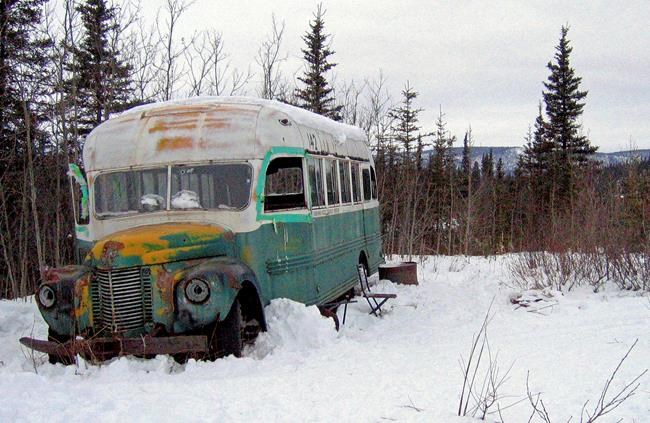
FILE - In this March 21, 2006, file photo, is the abandoned bus where Christopher McCandless starved to death in 1992 near Healy, Alaska. The bus that people sometimes embarked on deadly pilgrimages to Alaska’s backcountry to visit can now safely be viewed at the University of Alaska Fairbanks while it undergoes preservation work. The bus was moved to the university's engineering facility in early Oct. 2021, while it's being prepared for outdoor display at the Museum of the North, Fairbanks television station KTVF reported. (AP Photo/Jillian Rogers, File )

The 24-year-old Virginia man died from starvation when he couldn’t hike back out because of the swollen Teklanika River. He kept a journal during his last days, which was discovered when his body was found.

McCandless’ ordeal was chronicled in Jon Krakauer’s 1996 book “Into the Wild,” followed later by director Sean Penn’s movie of the same name. People from all over the world made the bus a focal point and tried to retrace his steps.

The state of Alaska removed the bus located about 25 miles (40 kilometers) from the town of Healy after two women — one from Switzerland and the other from Belarus — drowned on homages to the bus. There were 15 other search-and-rescue missions since 2009, the state Department of Natural Resources said in August 2020 when the bus was flown out of the wilderness.

Many people have a personal connection to the bus, said Angela Linn, senior collections manager of ethnology and history at the museum.

“It’s OK that people have this huge range of feeling about the bus,” Linn said. “That means they’re thinking about it. They have opinions about it, and that means they’re engaged with history, which is a really important thing for those of us who are in the business of preserving history.”

The bus is being preserved in a heated, secure space that has environmental controls. It also has an elevated observation space that allows anyone to view the bus for free on weekdays. The bus is expected to remain there through the end of the academic year.

Preparing the bus for outdoor is an extensive process, Linn said.

“One of the very first things we’re going to do is to document, really systematically, all the graffiti that you can see on the inside and the outside of the bus. This is a really important part of the last 30 years of the bus,” she said.

Holes cut in the roof and floor of the bus to allow a helicopter to ferry it out of the woods must be repaired, Linn said, and the bus is riddled with bullet holes.

“Some of them are kind of dangerous. The shots that come from inside leave these jagged holes, so we don’t want anybody to be injured when this does eventually go on exhibit,” she said.

The 1940s-era bus, sometimes called “Bus 142” or “The Magic Bus,” was used to house employees by the Yutan Construction Co. when it built an access road about 25 miles west of the Parks Highway, the main thoroughfare between Anchorage and Fairbanks.

The bus was abandoned in 1961 and had become an emergency shelter for those using the backcountry to recreate or hunt.

Telling the other history of the bus will be part of the permanent display.

“That’s one of the things that we want to explain to people and show people, that there is a lot more to the history of the bus and the story of the bus than just those 114 days that McCandless is associated with it,” Linn said.


Report Error Submit a Tip

More Stories

Food literacy curriculum on the menu

Maggie Macintosh 5 minute read Preview

Food literacy curriculum on the menu

Maggie Macintosh 5 minute read Yesterday at 2:01 AM CDT

Manitoba has a new recipe for health class and “food literacy” is a key ingredient.

The in-class portion of phys-ed has historically involved lessons about puberty, the risks of consuming drugs and dissecting Canada’s food guide.

A new pilot program asks teachers to expand their nutrition units and include in-depth discussions about how everything from diet culture to food insecurity affects eating habits.

“This is really moving beyond a conception of food as only fuel, where you just boil down food to its calories, its vitamins,” said Sarah Elvins, a food historian at the University of Manitoba who researches popular culture and marketing.

Read
Yesterday at 2:01 AM CDT

Letters, Sept. 17

7 minute read 2:00 AM CDT

It’s done here, too

The GLITTER program in Portland was held up last week as a glowing example of progressive, community-minded litter removal that Winnipeg and its downtown agencies should aspire to replicate.

Well, the grass may seem greener, and the encampments a little cleaner, but ask around and you may learn that Winnipeg already has community-led programs doing this work and doing it well.

I can’t fault anyone for raising the merits of a made-in-Portland program for the sake of discussion. After all, it is a timeless Winnipeg pastime to ask why our city lags behind others on any number of trends, programs, or amenities. But the suggestion that “some version” of GLITTER should be considered here falls short when it fails to acknowledge the parallel efforts already delivering results here.

Suspension on the horizon for Hellebuyck as pre-season set to start

Ken Wiebe 7 minute read Preview

Suspension on the horizon for Hellebuyck as pre-season set to start

Ken Wiebe 7 minute read Tuesday, Sep. 15, 2026

In this high stakes game of chicken, Kevin Cheveldayoff, Connor Hellebuyck or any of the potential suitors for the Winnipeg Jets franchise netminder appear ready to blink.

Read
Tuesday, Sep. 15, 2026

Wind and batteries the best bet

James Wilt 5 minute read Preview

Wind and batteries the best bet

James Wilt 5 minute read Yesterday at 2:01 AM CDT

For years, Manitoba Hydro has claimed that we can’t rely on wind turbines during multi-day or even multi-week cold snaps.

Read
Yesterday at 2:01 AM CDT

Online fundraiser for ‘polite, modest farmer’ facing firearms charges sending message, neighbour says

Nicole Buffie 4 minute read Preview

Online fundraiser for ‘polite, modest farmer’ facing firearms charges sending message, neighbour says

Nicole Buffie 4 minute read Yesterday at 5:45 PM CDT

Thousands of dollars have been raised to help cover the legal fees of a Manitoba man charged after he allegedly fired a gun at thieves during a theft on his farm in August.

Read
Yesterday at 5:45 PM CDT

A community brought the Trident Press home

Stephen Borys 6 minute read Preview

A community brought the Trident Press home

Stephen Borys 6 minute read 2:00 AM CDT

A truck pulled up outside Oseredok a few weeks ago carrying more than an exhibition.

Inside were the panels of Ukrainian Voice: A Legacy Mosaic, a monumental artwork built from the printing blocks once used to reproduce the photographs and illustrations in one of Canada’s longest-running Ukrainian newspapers.

A dozen people gathered to unload it. Some were longtime members of Winnipeg’s Ukrainian community; others were newcomers who had arrived since Russia’s full-scale invasion of Ukraine. Together, they lifted, unpacked and carried the panels through Oseredok’s doors.

It was an ordinary act of volunteer labour, but also a fitting final stage in an extraordinary journey. More than a century ago, Ukrainian newcomers created the newspaper whose printing blocks form the mosaic. Now another generation of newcomers was helping bring that history home.

Read
2:00 AM CDT