‘This is too much’: Art shows children’s struggles during pandemic, says researcher
Advertisement
Read this article for free:
or
Already have an account? Log in here »
To continue reading, please subscribe:
Digital Subscription
One year of digital access for only $1.44 a week*
- Enjoy unlimited reading on winnipegfreepress.com
- Read the E-Edition, our digital replica newspaper
- Access News Break, our award-winning app
- Play interactive puzzles
*Billed as $5.77 plus GST every four weeks. After 52 weeks, price increases to the regular rate of $19.95 plus GST every four weeks. Offer available to new and qualified returning subscribers only. Cancel any time.
To continue reading, please subscribe:
Add Free Press access to your Brandon Sun subscription for only an additional
$1 for the first 4 weeks*
- Enjoy unlimited reading on winnipegfreepress.com
- Read the E-Edition, our digital replica newspaper
- Access News Break, our award-winning app
- Play interactive puzzles
*Your next Brandon Sun subscription payment will increase by $1.00 and you will be charged $17.95 plus GST for four weeks. After four weeks, your payment will increase to $24.95 plus GST every four weeks.
Read unlimited articles for free today:
or
Already have an account? Log in here »
Hey there, time traveller!
This article was published 15/01/2021 (2107 days ago), so information in it may no longer be current.
A collection of children’s drawings made during the pandemic illustrates the mental toll the crisis is taking on Canadian youth, says the researcher behind a project analyzing their artwork.
Many of the submissions by kids and teenagers on childart.ca depict people alone, haunted by shadowy spectres, or worse, their own thoughts.
Collectively, the images paint a stark picture of how the trials of young life under lockdown could shape the next generation, says Nikki Martyn, program head of early childhood studies at University of Guelph-Humber.
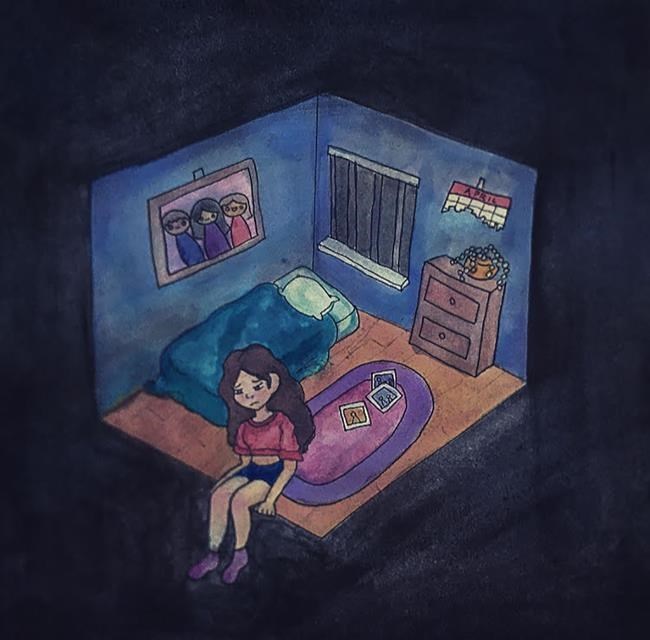
While the study is still underway, Martyn said initial observations suggest that coming of age during the COVID-19 crisis can create an emotional maelstrom during a critical period of adolescent development.
Being a teenager is tough enough at the best of times, she said, but finding your place in the world while stuck at home has left many young people feeling like they have no future to look forward to.
“The saddest part for me … is that kind of loss of not being able to see through to the other side,” she said.
“There’s so much pain and so much struggle right now that I think needs to be shared and seen, so that we can support our youth and make sure they become healthy adults.”
Since September, Martyn’s team has received more than 120 pieces from Canadians aged two to 18, submitted anonymously with parental permission, along with some background information and written responses.
Martyn marvelled at the breadth of creative talent the project has attracted, with submissions ranging from doodles, sketches, digital drawings, paintings, pastels, photos and even one musical composition.
Researchers circulated the call for young artists at schools and on social media. While the collection includes a few tot-scribbled masterpieces, Martyn said the majority of contributors are between the ages of 14 and 17.
As the submissions trickled in, she was struck by the potent and sometimes graphic depictions of adolescent anxiety, despair and isolation.
Recurring themes include confined figures, screaming faces, phantasmic presences, gory imagery and infringing darkness.
Some images contain allusions to self-harm, which Martyn sees as a physical representation of the pain afflicting so many of the study’s participants.
Just as unsettling are the words that accompany the images. Some artists transcribed the relentless patter of pandemic-related concerns that pervade daily life, while others expressed sentiments like “I’m broken,” “this is too much” and “what’s the point?”
Martyn said many participants wrote of struggling to keep up in school, while some were dealing with family problems such as job loss, illness and even death.
Many of these feelings and challenges are common across age groups, Martyn noted. However, while adults are more accustomed to the ups and downs that life can bring, young people are less likely to have fostered the coping skills to help them weather a global crisis.
A coalition of Canadian children’s hospitals has warned that the pandemic is fomenting a youth mental-health crisis with potentially “catastrophic” short- and long-term consequences for children’s wellbeing and growth.
This would be consistent with research from previous outbreaks suggesting that young people are more vulnerable to the negative psychological impacts of quarantine, including increased risk of post-traumatic stress, depression, anxiety and behavioural problems, according to an August report by Children’s Mental Health Ontario.
An online survey of 1,300 Ontario children and young adults last spring found that nearly two-thirds of respondents felt that their mental health had deteriorated since COVID-19 hit, with many citing the abrupt end of school, disconnection from friends and uncertainty about the future as significant stressors.
Lydia Muyingo, a PhD student in clinical psychology at Dalhousie University, said when she looks through the images in the childart.ca gallery, she can see how these concerns are confounding the typical turmoil of being a teenager.
Adolescence is a time for young people to figure out who they are through new experiences, interests and social interactions, said Muyingo.
This transition tends to bring about intense emotions, she said, and the pandemic has exacerbated this upheaval by replacing familiar anxieties about fitting in with fears about mortality.
Muyingo said she’s heartened to see that the childart.ca project is giving young people an outlet for these difficult feelings they may not even be able to put words to.
She encouraged adults to keep an eye out for children’s silent struggles, perhaps setting an example by sharing their own vulnerabilities.

“I think parents are sometimes scared of talking about dark themes, but the reality is that kids know a lot more than we think,” she said. “I think art like this can be used as a tool to communicate that it’s OK to feel this way.”
Martyn said the study has given her hope for what a future led by the quarantined generation could look like, because while pain pervades many of the illustrations, there are also symbols of resilience, connection and compassion.
“One of my visions from the very beginning of this was to have this as an art exhibit in a gallery, and to be able to go and be enveloped by it, have it around us and fully experience that lived idea of what children in Canada experienced.”
Muyingo encouraged young people who are struggling to contact Kids Help Phone at 1-800-668-6868 or by texting “TALK” to 686868.
This report by The Canadian Press was first published Jan. 14, 2021.