The Pool has light heart, affection for characters
Advertisement
Read this article for free:
or
Already have an account? Log in here »
To continue reading, please subscribe:

Digital Subscription
One year of digital access for only $205*
- Enjoy unlimited reading on winnipegfreepress.com
- Read the E-Edition, our digital replica newspaper
- Access News Break, our award-winning app
- Play interactive puzzles
*First annual payment billed as $205.00 + GST for one year. This annual subscription will automatically renew at $233.00 + GST every 52 weeks (10% off the regular annual price of $259.35). Offer available to new and qualified returning subscribers only. Cancel any time.
To continue reading, please subscribe:
Add Free Press access to your Brandon Sun subscription for only an additional
$1 for the first 4 weeks*
- Enjoy unlimited reading on winnipegfreepress.com
- Read the E-Edition, our digital replica newspaper
- Access News Break, our award-winning app
- Play interactive puzzles
*Your next Brandon Sun subscription payment will increase by $1.00 and you will be charged $17.95 plus GST for four weeks. After four weeks, your payment will increase to $24.95 plus GST every four weeks.
Read unlimited articles for free today:
or
Already have an account? Log in here »
Hey there, time traveller!
This article was published 22/05/2009 (6318 days ago), so information in it may no longer be current.
CHRIS Smith’s quietly humanistic drama The Pool concerns an illiterate teenager in a dead-end job who aspires to improve himself: he wants to go to school, and he wants the life of which he sees glimpses every day when he climbs out of his shabby, rundown world into the wealthy surrounding suburbs.
There, he climbs a tree and peers into a pristine swimming pool behind a luxurious villa that represents a life of privilege — complete with an eerie silence, so unlike the bustling town — he can barely understand.
Eventually, the boy will make friends with the owner of the villa and with his attractive daughter, and he will be offered a chance to flee to the big city and go to school to make his dreams come true.
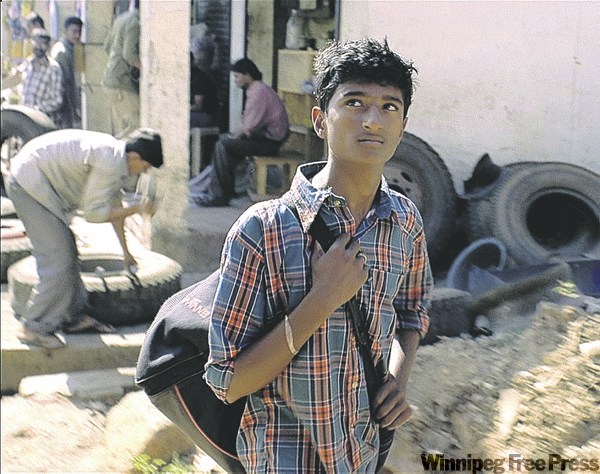
The movie is based on a short story by Randy Russell, which was set in Iowa. Smith has transferred it to Goa, a former Portuguese colony in India: the boy, named Venkatesh, is played by a newcomer named Venkatesh Chavan; his young friend, named Jhangir, is played by Jhangir Badshah, another non-professional actor. The characters are based to some extent, on the actors’ real lives.
In these respects, The Pool may remind you of Slumdog Millionaire, the Oscar-winning phenomenon that shows signs of becoming a model for the new Hollywood fantasy. Although less melodramatic and free of such Bollywood conventions as the closing dance number, The Pool joins Slumdog in expressing something new about 21st-century cinema. Once, in the hardscrabble 1930s, such cinematic dreams — the poor, but honest lad being rescued by good fortune or a rich benefactor — were set in the streets of big-city America. Today, when such ideas have been corrupted by the intervening years of knowingness, irony, entitlement and sophistication, they are set in India, a place where class divisions are still formalized and the magic of achievement can still be unexpected.
The Pool is a measured film that is rich in detail: Smith is a documentary filmmaker (American Movie) who is engaged with the everyday. A man might carve up a coconut while he gives advice to a boy to whom he is becoming a surrogate parent, and the act of carving — the way he chops off the skin, the careful movement of his machete — become as engaging as his words. It’s filmed close to the ground, with few close-ups and little music, so that we can drink in the surroundings and let them tell us a lot of the story.
Venkatesh is a "hotel boy,” who makes beds, cleans rooms (and toilets) and earns some extra cash by buying plastic bags and selling them in the market: a subsequent ban on plastic bags, a bit of environmental revival that cuts across The Pool at an oblique angle, costs him dearly.
Working up his nerve, he approaches the non-nonsense owner of the villa (veteran Indian star Nana Patekar) and becomes his assistant and later, his project. He also is intrigued by Ayesha (Ayesha Mohan), the man’s spoiled daughter, who is always reading a book and who has vulgar, middle-class arguments with her father ("Now where are you going?” "To kill someone.”) Their life is the melodrama of the film — the reason for the empty pool is part of a family secret — but it is presented in passing. One of the strengths of The Pool is that it goes in surprising directions.

No one draws attention to it, but the disputes of the rich stand in interesting contrast to the conviviality of life at the bottom. Even when Venkatesh teases a co-worker, it is with the affection that is vital to people who have nothing but each other. The pool and the life it represents are more than an economic impossibility: they also mean a leap across a moneyed gap that includes a built-in hostility and sullen regret, which are the real luxuries of the rich.
The Pool is not a comedy, but it has a light heart and an affection for its characters. Patekar, the senior actor in the troupe, holds things together with an unforced and naturalistic performance, but the young actors are as charming and persuasive as the cast of Slumdog Millionaire, with whom everyone seems to have fallen in love. Perhaps it is because they remind us of ourselves, before we got spoiled.
— Canwest News Service