Inconvenient truths
Local filmmaker's Zooey and Adam doesn't sugar-coat the facts

Advertisement
Read this article for free:
or
Already have an account? Log in here »
To continue reading, please subscribe:

Digital Subscription
One year of digital access for only $205*
- Enjoy unlimited reading on winnipegfreepress.com
- Read the E-Edition, our digital replica newspaper
- Access News Break, our award-winning app
- Play interactive puzzles
*First annual payment billed as $205.00 + GST for one year. This annual subscription will automatically renew at $233.00 + GST every 52 weeks (10% off the regular annual price of $259.35). Offer available to new and qualified returning subscribers only. Cancel any time.
To continue reading, please subscribe:
Add Free Press access to your Brandon Sun subscription for only an additional
$1 for the first 4 weeks*
- Enjoy unlimited reading on winnipegfreepress.com
- Read the E-Edition, our digital replica newspaper
- Access News Break, our award-winning app
- Play interactive puzzles
*Your next Brandon Sun subscription payment will increase by $1.00 and you will be charged $17.95 plus GST for four weeks. After four weeks, your payment will increase to $24.95 plus GST every four weeks.
Read unlimited articles for free today:
or
Already have an account? Log in here »
Hey there, time traveller!
This article was published 28/01/2010 (6068 days ago), so information in it may no longer be current.
A film is not usually deemed "controversial" before the press have had a chance to chew over a work’s attendant provocations and outrages in the glare of media.
Sean Garrity knew he had a hot potato on his hands before his latest feature film was even shown to press.
Garrity’s strategy for building buzz for his zero-budget film Zooey & Adam was to get it screened at film festivals, beginning with the prestigious Toronto International Film Festival, where his film Inertia won an award for best Canadian first feature in 2001.
But this time, the jury responsible for choosing festival was films was, Garrity says, dramatically divided on its inclusion.
"Half the jury loved the film and were very passionate about programming it," Garrity, 43, recounts over a cup of coffee at the Fyxx on Broadway, a short walk from the downtown apartment he shares with his wife and daughter.
"The other half was like: ‘If you program this film, we quit.’ They’re very passionate about not showing it.
"It’s not a bad reaction to have. I must be doing something right if they love it or they hate it," he says.
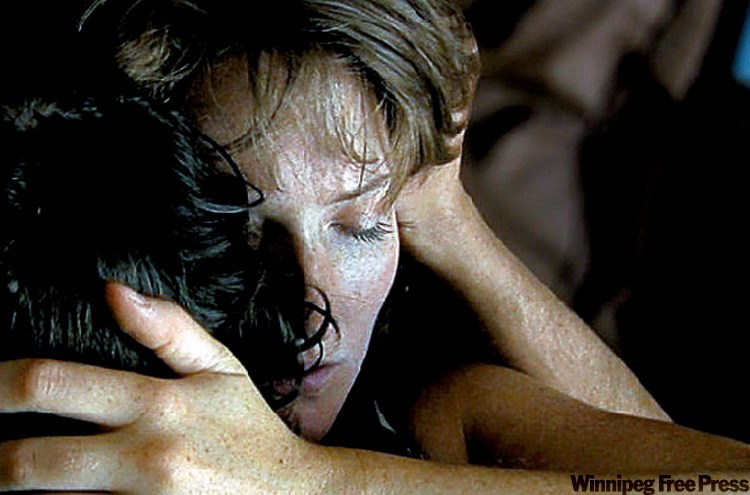
At issue: Many of the jurors could not accept the film’s premise. Zooey and Adam, played by local actors Daria Puttaert and Tom Keenan, are a married couple trying to get pregnant when Zooey is raped during a camping trip. When she subsequently finds herself pregnant, she resolves to keep the baby, regardless of its paternity.
"They didn’t believe that any woman would make the decision that my main character makes," Garrity says.
In retrospect, Garrity regrets that he didn’t follow the lead of a producer buddy who pleaded his case directly to the festival. In fact, Garrity was inspired to write the drama based on the surprising statistic that every year in North America, an estimated 36,000 women become pregnant as a result of rape, and of those, only half terminate their pregnancies. Of the women who bring their babies to term, the vast majority keep their babies.
"They felt that because my main female character makes the ludicrous decision that no woman would make, I was, in effect, demonizing her," Garrity says. "And so that’s where they thought it was inappropriate for them to program the film.
"You can’t expect every jury to research the facts behind every film, obviously," he says. "But it just grates. It’s a non-issue."
Subsequently, Garrity made a point of making a personal pitch to festival juries that might be on the fence, including the Atlantic Film Festival in Halifax, which apparently faced the same controversy with a divided jury.
"It was the exact same thing I had heard in Toronto," Garrity says. "I said, ‘Lemme tell you why you have to put on my movie.’ And they ended up programming it in."
Garrity is philosophical about his TIFF experience now.
"They could have told me they didn’t program the film because it was s -y, and because they didn’t like it or they didn’t think the production values were high enough," he says. "But to have them be offended by one of the ideas of the content, that’s kind of nice," he says. "There are worse reasons to be rejected."
�ñº
Zooey & Adam opens at Cinematheque tomorrow and screens at 7 p.m. every day to Feb. 4.
CREWLESS
Sean Garrity’s guide to
shooting on no budget
11111111But when he read an interview with a filmmaker about the so-called "Mumblecore" movement of low-budget filmmaking and found Inertia cited as one of the influences on the movement, he was inspired to scale down to a next-to-nothing budget for Zooey & Adam.
His budget list includes tapes for his high-def handicam, coffee for his actors, and filling the gas tank of his Toyota to drive his cast to Falcon Lake for a camping scene.
Other ways Garrity cut back?
NO SCRIPT.
Garrity wrote out the story points on three pages.
"It was more of a blueprint than an outline," Garrity says.
"Every scene was basically a paragraph and allowed me to work with story structure, as a writer, spending way more time on the structure of the story before I actually sat down to expand it into a 90-minute piece.
"And so I just worked from the structure and I knew what had to happen in every scene dramatically."
The actors didn’t necessarily know, however. When he had the actors on set, he gave them the arc of the scene, and let them improvise. Sometimes, one actor was not privy to the assignment of his or her acting partner, resulting in spontaneity, surprise and tension.
WHY GET ACTORS TO PLAY COPS WHEN YOU CAN ASK COPS TO PLAY COPS?
When possible, Garrity simply cast real professionals to play professionals, most notably in a scene in which two police officers question Zooey and Adam after she is raped.
"I sort of thought: How am I, for no money, going to get some actors to do enough research on the job that a cop does to pull that scene off convincingly?" Garrity says. "I just didn’t have faith that the zero amount of money I had would buy that kind of backstory from a good actor, and they have other things to do.
"So I found real cops (Adam Kosarych and Mike Peters), and my leads (actors) were convincing enough, which I feel very confident they were, that these guys would just do their jobs and for them, it would just be no-brainer. And so that’s what I did."
SHOOT CHRONOLOGICALLY WHEN POSSIBLE.
Garrity shot the scene with the police officers just two days after shooting the rape scene, and found that an invaluable asset for the actors.
"They were just where they needed to be, emotionally," Garrity says. "Tom actually told me later that the amount of prep he would have to do for that scene would have been monumental, but because we shot it chronologically and it was slightly improvised, it was the most effortless scene he’s ever done. He and Daria were right there."
Our newsroom depends on a growing audience of readers to power our journalism. If you are not a paid reader, please consider becoming a subscriber.
Our newsroom depends on its audience of readers to power our journalism. Thank you for your support.
Our newsroom depends on a growing audience of readers to power our journalism. If you are not a paid reader, please consider becoming a subscriber.
Our newsroom depends on its audience of readers to power our journalism. Thank you for your support.
Advertisement Advertise With Us
Advertisement Advertise With Us