Animated film a charming, tender throwback

Advertisement
Read this article for free:
or
Already have an account? Log in here »
To continue reading, please subscribe:

Digital Subscription
One year of digital access for only $205*
- Enjoy unlimited reading on winnipegfreepress.com
- Read the E-Edition, our digital replica newspaper
- Access News Break, our award-winning app
- Play interactive puzzles
*First annual payment billed as $205.00 + GST for one year. This annual subscription will automatically renew at $233.00 + GST every 52 weeks (10% off the regular annual price of $259.35). Offer available to new and qualified returning subscribers only. Cancel any time.
To continue reading, please subscribe:
Add Free Press access to your Brandon Sun subscription for only an additional
$1 for the first 4 weeks*
- Enjoy unlimited reading on winnipegfreepress.com
- Read the E-Edition, our digital replica newspaper
- Access News Break, our award-winning app
- Play interactive puzzles
*Your next Brandon Sun subscription payment will increase by $1.00 and you will be charged $17.95 plus GST for four weeks. After four weeks, your payment will increase to $24.95 plus GST every four weeks.
Read unlimited articles for free today:
or
Already have an account? Log in here »
Hey there, time traveller!
This article was published 18/03/2011 (5684 days ago), so information in it may no longer be current.
Any movie deserves to be judged on its own merits. But the back story behind The Illusionist offers up such a surprising perspective, it merits consideration.
Of the movie itself, it’s a gorgeous animated work from the masterful Sylvain Chomet, who last made the sublime feature The Triplets of Belleville.
Here, Chomet essentially collaborates with the legendary French screen comic Jacques Tati, who has been dead for nearly 30 years.
Tati has been celebrated for his mastery of the medium in his classic comedies such as Play Time, films that revived the pleasures of silent comedy in an era of colour and sound.
The Illusionist is a hitherto unproduced Tati screenplay about a magician struggling in an era when rock ‘n’ roll is hammering the last coffin nail into the traditional European music hall.
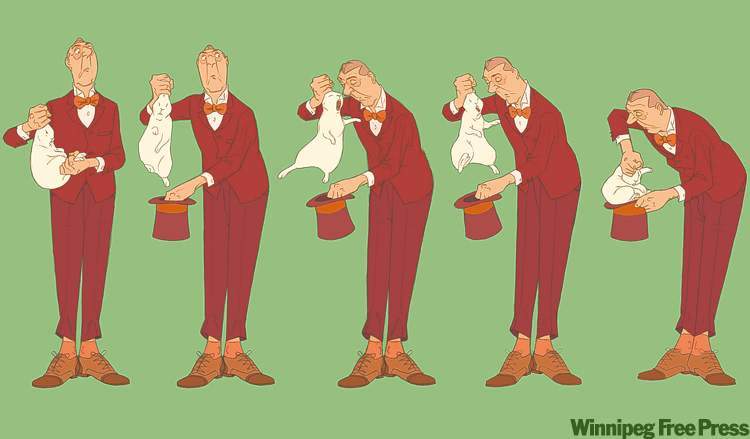
Resigned to playing nearly empty theatres, Monsieur Tatischeff (Tati’s original family name) barely scrapes by doing the kind of old-fashioned magic act that involves pulling a rabbit out of a hat. (It is a Tati-esque detail that the rabbit is decidedly unhappy about its lot in life. It bites.)
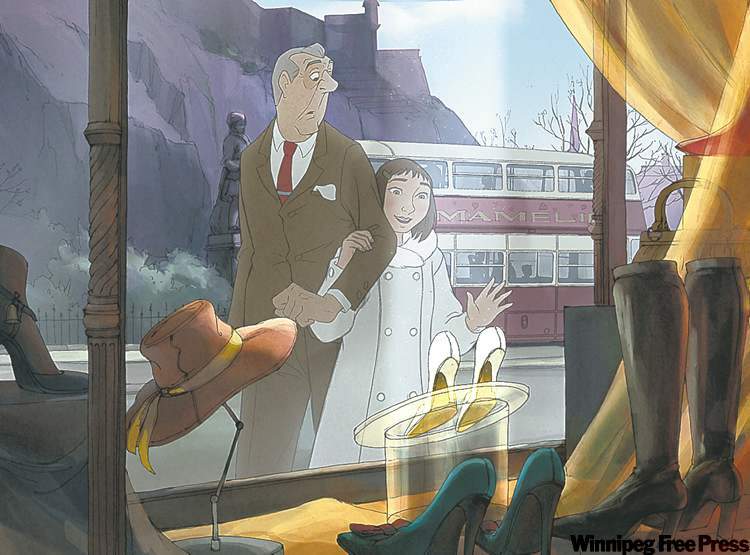
With his options diminishing, Tatischeff takes a gig in a pub on a remote Scottish island where he is still appreciated. (Even there, we can surmise his days are numbered with the ominous appearance of a jukebox on the pub premises.) It is here he meets a naive Scottish girl who believes Tatischeff’s sleight-of-hand really is magic. She is especially impressed when he charitably conjures a new pair of shoes for her (surreptitiously purchased earlier). Hence, when the engagement has run its course, he journeys back to London and she follows, moving in with him into the shabby hotel populated by the kind of entertainers — acrobats, ventriloquists, clowns — whose careers are likewise in shared twilight.
The reason for Tatischeff’s charitable adoption of the girl is never spelled out, but we surmise it has to do with the photo he keeps by his mirror of a figure now absent from his life.

The occasion allows Chomet the opportunity to resurrect Tati physically, a tall, ponderous figure possessed of a unique, self-contradictory quality one could only describe as clumsy grace.
Tati would likely approve of Chomet’s glorious mise-en-scène. Every frame of film could be a painting, and within that frame, a multitude of comic details. (After a steady diet of computer-generated animation, Chomet’s work is a visual treat akin to leafing through a photo album and coming upon an impressionist masterpiece.)
The back story: Tati essentially abandoned his first daughter, born in 1942, the result of an affair with a dancer. A controversy currently rages as to whether this screenplay is intended as a conciliation with his legitimate daughter (of whom it is said Tati felt he neglected), or a poignant acknowledgement of the daughter he left behind so many years earlier.
We may never know the truth, but the issue only enhances one’s appreciation of Chomet’s film. On top of its lavish animation and its gentle comedy, it has mystery, too.
randall.king@freepress.mb.ca
Our newsroom depends on a growing audience of readers to power our journalism. If you are not a paid reader, please consider becoming a subscriber.
Our newsroom depends on its audience of readers to power our journalism. Thank you for your support.
MovieReview
The Illusionist
Directed by Sylvain Chomet
Globe
80 minutes
PG
Four stars out of five
Other voices
Selected excerpts from reviews of The Illusionist.
The Illusionist is magical in more ways than one.
— Chris Vognar, Dallas Morning News
The story has enough sentimental shmaltz to grease a locomotive.
— Colin Covert, Minneapolis Star Tribune
A lovely appreciation of Tati and a loving, bittersweet look at the end of the 1950s, before entertainers like the magician of the title were displaced by rock bands and other more visceral acts.
— Bill Goodykoontz, Arizona Republic
It’s not much of a story, but the delights of The Illusionist have little to do with plot.
— Chris Hewitt, St. Paul Pioneer Press
The film ends on a note of graceful, heartbreaking beauty that Tati would have admired for its lack of sentimentality. A lot of what precedes that ending, though, is precious and slight and a little too fanciful.
— Rene Rodriguez, Miami Herald
Watching The Illusionist is like peering through a rippled windowpane onto a past that knows it’s disappearing.
— Ty Burr, Boston Globe
The Illusionist is almost a silent movie, save for amusing sound affects, snatches of garbled dialogue and a beguiling piano score that inspires deep reflection.
— Peter Howell, Toronto Star
The Illusionist represents the magically melancholy final act of Jacques Tati’s career.
— Roger Ebert, Chicago Sun Times
The hand-drawn cell-animation — no 3D, thank you — is watercolor soft and charming. As is the film itself.
— Roger Moore, Orlando Sentinel
A cliché-riddled nostalgia trip.
— Richard Brody, New Yorker
A true masterpiece of visual enchantment.
— Rex Reed, New York Observer
— Compiled by Shane Minkin
Our newsroom depends on a growing audience of readers to power our journalism. If you are not a paid reader, please consider becoming a subscriber.
Our newsroom depends on its audience of readers to power our journalism. Thank you for your support.
Advertisement Advertise With Us
Advertisement Advertise With Us