Nintendo adds new dimension with glasses-free 3-D
Advertisement
Read this article for free:
or
Already have an account? Log in here »
To continue reading, please subscribe:

Digital Subscription
One year of digital access for only $205*
- Enjoy unlimited reading on winnipegfreepress.com
- Read the E-Edition, our digital replica newspaper
- Access News Break, our award-winning app
- Play interactive puzzles
*First annual payment billed as $205.00 + GST for one year. This annual subscription will automatically renew at $233.00 + GST every 52 weeks (10% off the regular annual price of $259.35). Offer available to new and qualified returning subscribers only. Cancel any time.
To continue reading, please subscribe:
Add Free Press access to your Brandon Sun subscription for only an additional
$1 for the first 4 weeks*
- Enjoy unlimited reading on winnipegfreepress.com
- Read the E-Edition, our digital replica newspaper
- Access News Break, our award-winning app
- Play interactive puzzles
*Your next Brandon Sun subscription payment will increase by $1.00 and you will be charged $17.95 plus GST for four weeks. After four weeks, your payment will increase to $24.95 plus GST every four weeks.
Read unlimited articles for free today:
or
Already have an account? Log in here »
Hey there, time traveller!
This article was published 07/04/2011 (5670 days ago), so information in it may no longer be current.
The Nintendo DS in its various versions has sold so many units (more than 130 million worldwide) that it can be hard to remember that when it was first released in 2004, it was met with bafflement and skepticism.
But Nintendo knew what it was doing, and while it took a while for game developers to realize the potential for the dual displays, touch screen and stylus, now it’s hard to imagine the device without them.
The DS Lite in 2006 slimmed the system down and upgraded the picture quality, and the DSi in 2009 dropped support for older Game Boy Advance games, added support for downloadable games and included front and rear cameras.
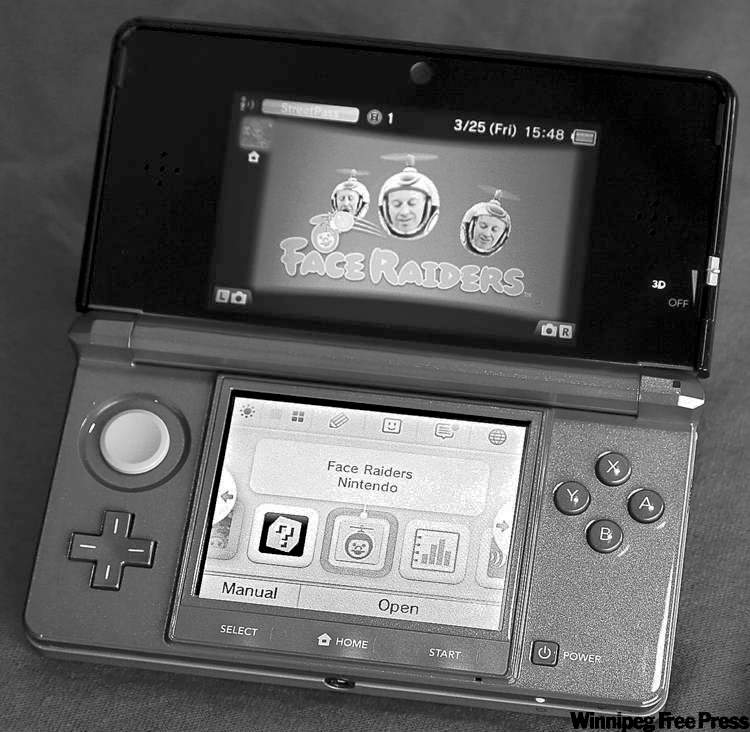
Like its predecessors, the Nintendo 3DS features two screens, but they’re a major upgrade over the DS and DSI.
The lower is a 3.02-inch, touch-sensitive display with a resolution of 320 by 240 pixels. The wide upper screen is 3.53 inches and is the centerpiece of the 3DS’s namesake feature: stereoscopic visuals, no glasses required. The resolution is 800 by 240 pixels (400 pixels for each eye).
By moving a sliding switch, players can adjust the depth of the system’s 3-D effects, which can present a diorama-like view of what’s onscreen or generate images of even greater simulated depth.
The effect can get a bit eye-bending, especially at the higher end, and Nintendo recommends players younger than six not activate the effect at all. (Parents can restrict it in the system’s parental controls.) In some games, the 3-D adds little, but for others it looks fantastic.
The device includes a gyroscope and accelerometer for motion sensitivity, and the control layout features an analog pad in addition to the digital cross pad. The system has three cameras — one in front and two in the back for taking stereoscopic images.
Among the 3DS’s pre-installed applications are a couple of games that take advantage of the cameras. AR Games scans a set of cards to generate 3-D models on top of whatever flat surface the device is pointed at, while Face Raiders scans and maps a human face onto flying foes for players to follow around the room and shoot down.
Some of the system’s features, such as the Nintendo eShop for downloadable items, have yet to be activated.
More than a dozen games are already available for the system, released March 27. Read on for a closer look at several of them.
Bust-A-Move Universe by Square Enix, rated Everyone — The bubble-popping puzzle game returns with a touch of 3-D flair in this edition. There are a few modes, but all of them boil down to firing coloured bubbles at like-coloured clusters, trying to clear them all in groups of three or more before they reach the bottom of the screen.
Lego Star Wars III: The Clone Wars by Lucasarts, rated 10 and older — This cutesy take on the Clone Wars animated series features some very nice visuals and kid-friendly action. This version lacks some elements of the console versions of the game, and older players won’t find much different from other Lego Star Wars titles, but that basic formula remains a solid one.
Ridge Racer 3D by Namco Bandai, rated Everyone — The Ridge Racer series scales down well for the 3DS, and its drift-oriented racing is intact. The game looks good and plays well — even if there’s really nothing new here for the Ridge Racer veteran, the game makes a good showcase for the 3DS’ visuals.

The Sims 3 by Electronic Arts, rated Teen — Similar to last year’s console and DS versions of the PC hit, The Sims 3 can take pictures of players’ faces to generate its Sims, and the 3-D effects really stand out in the game’s isometric view.
Steel Diver by Nintendo, rated 10 and older — A slow-paced submarine action game, Steel Diver puts players in control of several kinds of submersibles, each with different armament, speed and handling capabilities. Players control the subs with a set of touch-sensitive icons on the lower screen.
Super Street Fighter IV: 3D Edition by Capcom, rated Teen — Among the best-looking of the 3DS’ launch lineup, Super Street Fighter IV: 3D Edition features the full roster of fighters from the console versions and looks nearly as good scaled down. Features a behind-the-shoulder view in one mode, showcasing the 3DS’ depth effects. The touch screen features four “buttons” that can be set to combinations of standard attacks, special attacks and other uses.
— McClatchy Newspapers