Citizen gangster not such a bad guy in end

Advertisement
Read this article for free:
or
Already have an account? Log in here »
To continue reading, please subscribe:
Digital Subscription
One year of digital access for only $1.44 a week*
- Enjoy unlimited reading on winnipegfreepress.com
- Read the E-Edition, our digital replica newspaper
- Access News Break, our award-winning app
- Play interactive puzzles
*Billed as $5.77 plus GST every four weeks. After 52 weeks, price increases to the regular rate of $19.95 plus GST every four weeks. Offer available to new and qualified returning subscribers only. Cancel any time.
To continue reading, please subscribe:
Add Free Press access to your Brandon Sun subscription for only an additional
$1 for the first 4 weeks*
- Enjoy unlimited reading on winnipegfreepress.com
- Read the E-Edition, our digital replica newspaper
- Access News Break, our award-winning app
- Play interactive puzzles
*Your next Brandon Sun subscription payment will increase by $1.00 and you will be charged $17.95 plus GST for four weeks. After four weeks, your payment will increase to $24.95 plus GST every four weeks.
Read unlimited articles for free today:
or
Already have an account? Log in here »
Hey there, time traveller!
This article was published 25/05/2012 (5260 days ago), so information in it may no longer be current.
Michael Mann’s misfired gangster movie Public Enemies has a kind of Canadian counterpart with this biopic of Edwin Boyd, a bank robber who lived up to the national identity by being polite, if not apologetic.
If Johnny Depp was too exquisitely handsome as the raw-boned John Dillinger, Scott Speedman’s movie-star good looks are actually appropriate for the role of Boyd, a would-be actor who comes out of service in the Second World War looking for a more glamourous career.
What he does to provide for his British wife (Kelly Reilly, Jude Law’s missus in Guy Ritchie’s Sherlock Holmes movies) is drive a bus on a wintry route through Toronto the Good, circa 1950. One of his stops is in front of the Lorne Greene Acting Studio, a maddening reminder of a future denied him.
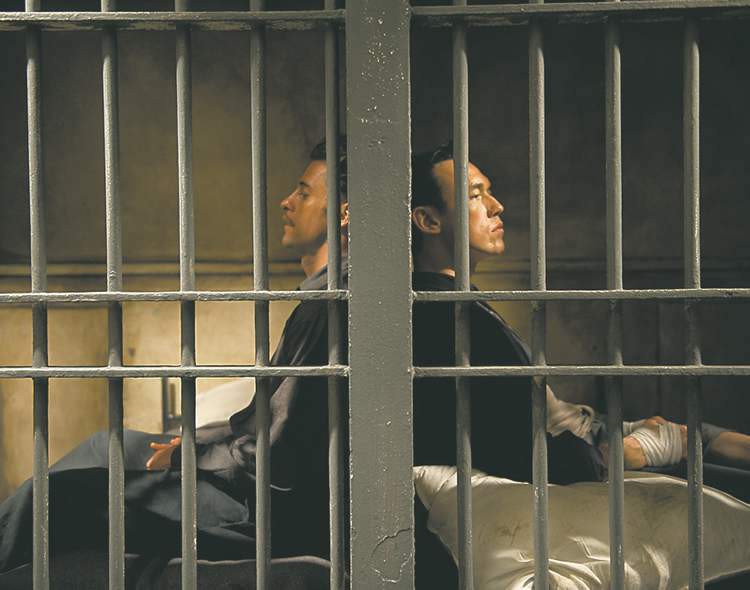
Edwin quits his job and dips his toes in the field of bank robbery. The money is good, but the risk is high, as he discovers when he is caught and sent to do time in Toronto’s Don Jail. It is here where Edwin meets fellow war vet Lenny Jackson (the imposing Kevin Durand), a guy with some saw blades stashed in his wooden foot and admiration for Boyd’s chutzpah. Before long, Edwin and company are on the loose, a band of bank-robbing brothers, a development that sours the relationship between Eddie and his wife, a woman whose patience is of biblical proportions.
Writer-director Nathan Morlando fashions a movie that achieves the same realistic dynamic of gangster life as Public Enemies did, but on a small fraction of the budget. Much time is spent watching the gang enjoy some hard partying among women of sometimes questionable character. And, like Dillinger, when Boyd staged a robbery, he turned it into a kind of performance art, a practice that inevitably endeared him to a small segment of society that chose to interpret his thieving as the work of a glamourous outlaw.
Morlando is more attuned to the subtleties of Boyd’s larceny, strongly suggesting that Boyd was at heart a decent man in the grips of traumatic stress suffered during the war.
The movie’s most obvious flaw, with respect to its low budget, is its entirely wintry atmosphere. Presumably, Boyd’s story took place over some years, but a short shooting schedule translates to a Toronto where the snow never melts, a detail likely to be misinterpreted by American audiences who believe the entire country is snowbound year-round.
Morlando need not apologize. His first film is an interesting slice of Canadian criminality with a surprising conclusion that suggests our most pre-eminent post-war bad guy wasn’t really such a bad guy after all.
randall.king@freepress.mb.ca
Other voices
Selected excerpts from reviews of Edwin Boyd: Citizen Gangster.
The film is a departure for a country that is more likely to celebrate the people who built the railways or settled the North: Boyd is a little too much of a show-off to fit comfortably into our mythology, and he’s played by Scott Speedman with a sort of shy hunkiness, as a frustrated veteran just trying to do the best for his family.
— Jay Stone, Ottawa Citizen
We’ve seen our share of period gangster flicks–bank jobs, shootouts, tense arguments, rinse and repeat–and first-time feature writer-director Nathan Morlando has too. But Scott Speedman, like Edward Norton lite, carries a sweet, convincing mix of mania and sadness as the pretty-boy bandit flirting with bank tellers.
— Patty Jones, Georgia Straight
Winner of the prize for Best Canadian First Feature Film at TIFF, Nathan Morlando is establishing his skills early with Edwin Boyd: Citizen Gangster. But whoever came up with this clumsy and criminally silly title should be doing time.
— Linda Barnard, Toronto Star
Inspired by Boyd’s story, rather than literally retelling it, the movie is less a gangster film than an existential allegory of choices and limitations.
— Liam Lacey, Globe and Mail
The film captures the innocent spirit behind Boyd’s crime spree without shying away from the damage his exploits inflicted on his family. Canadian movies are rarely this slick and entertaining. Come to think of it, period crime movies rarely play so well.
— Phil Brown, Now magazine
Nathan Morlando’s minimalistic and nuanced storytelling delivers a first-rate biopic that both chills and invigorates the whole way through.
— Christopher Sykes, Montreal Mirror
— Compiled by Shane Minkin
Edwin Boyd: Citizen Gangster
Starring Scott Speedman
Globe
14A
105 minutes
3 stars out of five
Our newsroom depends on a growing audience of readers to power our journalism. If you are not a paid reader, please consider becoming a subscriber.
Our newsroom depends on its audience of readers to power our journalism. Thank you for your support.
Our newsroom depends on a growing audience of readers to power our journalism. If you are not a paid reader, please consider becoming a subscriber.
Our newsroom depends on its audience of readers to power our journalism. Thank you for your support.
Advertisement Advertise With Us
Advertisement Advertise With Us