Effort to make Mad Ship film needed singular determination

Advertisement
Read this article for free:
or
Already have an account? Log in here »
To continue reading, please subscribe:

Digital Subscription
One year of digital access for only $205*
- Enjoy unlimited reading on winnipegfreepress.com
- Read the E-Edition, our digital replica newspaper
- Access News Break, our award-winning app
- Play interactive puzzles
*First annual payment billed as $205.00 + GST for one year. This annual subscription will automatically renew at $233.00 + GST every 52 weeks (10% off the regular annual price of $259.35). Offer available to new and qualified returning subscribers only. Cancel any time.
To continue reading, please subscribe:
Add Free Press access to your Brandon Sun subscription for only an additional
$1 for the first 4 weeks*
- Enjoy unlimited reading on winnipegfreepress.com
- Read the E-Edition, our digital replica newspaper
- Access News Break, our award-winning app
- Play interactive puzzles
*Your next Brandon Sun subscription payment will increase by $1.00 and you will be charged $17.95 plus GST for four weeks. After four weeks, your payment will increase to $24.95 plus GST every four weeks.
Read unlimited articles for free today:
or
Already have an account? Log in here »
Hey there, time traveller!
This article was published 08/12/2012 (5051 days ago), so information in it may no longer be current.
The film Mad Ship depicts one man’s quixotic effort to build a boat and drag it over the prairie in a crazed, delusional effort to transport his family back to Norway from the barren despair of the Prairies during the Dust Bowl years.
If the events depicted in the film seem strange and obsessive, the effort to make the film required an equal amount of singular determination from Ontario-based co-writer-director David Mortin.
Partnered with his wife Patricia Fogliato of their company Enigmatico Films, Mortin says he was inspired by the true story of Tom Sukanen, a Finnish immigrant who, in the depths of his own personal despair, constructed a ship that would sail back to Finland from the crushing despair of the Dust Bowl in the Macrorie district of Saskatchewan.
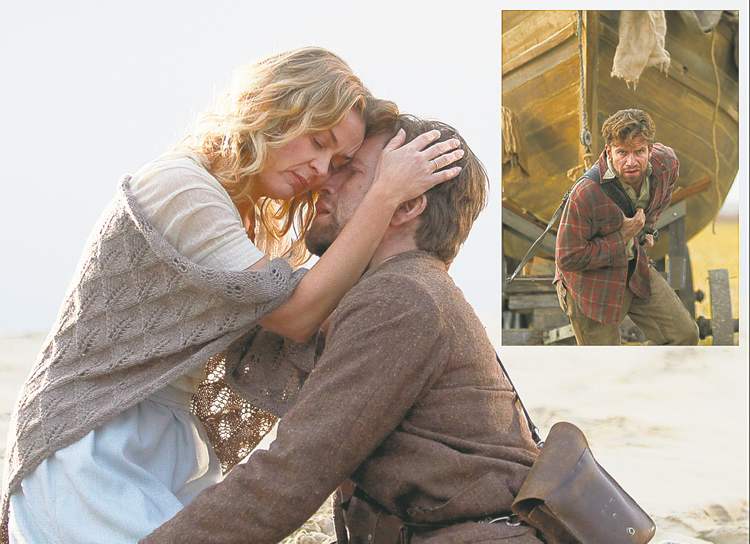
“He was inspired to try build a ship and drag it to the Saskatchewan River thinking he would follow that route out to Hudson Bay and sail it back to Finland,” Mortin says in a phone interview from his home outside Toronto.
“So he built his boat in three sections and he actually built an iron hull and he started dragging them over years 27 kilometres from his farm to the river,” Mortin says. “He ended up working himself almost to the point of fatal exhaustion and his neighbours came and found him out there in the middle of the prairie by one of the pieces of his boat and they collected him and took him to the asylum where he was committed. He died in the asylum about 18 months after that. But his story has gone on and he’s become something of a folk hero throughout the Prairies.”
Mortin’s take on the story, though likewise gloomy, is not as hopeless.
“We asked ourselves: What would cause a man to be in that situation?” he says. “We worked backwards from there and created a story that had to do more with heart. He’s there for love and to try to make amends for a mistake he made, or a promise he had broken, to atone and try to rectify something.
“All those things, we found, were a lot more emotionally accessible and universally accessible than the real story of this man from Finland who was truly doing it out of madness.”
The effort to get the film made might have resulted in an equally doomed effort. It began that way when Mortin tried to get the film made in Saskatchewan. But after shifting to Manitoba and partnering with local production company Buffalo Gal Pictures, the film became a reality, although it was a challenge finding a location that could suggest a Dust Bowl farm of the Dirty ’30s.
“Patricia and I came out west thinking it would be really easy to find what we needed, and we had in mind a very specific idea of a clean horizon line and a very pure prairie without any sort of visible structures or tree shelters or that sort of thing,” he says.
“It took us a long time to find that. But we went out to the Roseisle area (100 km southwest of Winnipeg) and we knew we had found something special,” he says. “That location gave us a 270-degree view and that gave us a lot of the opportunities we were looking for.”
The film stars Danish actor Nikolaj Lie Kaas as the crazed patriarch and Norwegian actress Line Verndal as his wife. If the film’s story was bleak, the mood on the set was precisely the opposite, Mortin says.
“They’re both really open and fun-loving people and though this is a dark and sad film, they kept it very light on set,” Mortin says. And all the Manitoba crew were also incredibly warm and friendly with them.”
Mad Ship is currently playing at the Globe cinema.
randall.king@freepress.mb.ca
Our newsroom depends on a growing audience of readers to power our journalism. If you are not a paid reader, please consider becoming a subscriber.
Our newsroom depends on its audience of readers to power our journalism. Thank you for your support.
Our newsroom depends on a growing audience of readers to power our journalism. If you are not a paid reader, please consider becoming a subscriber.
Our newsroom depends on its audience of readers to power our journalism. Thank you for your support.
Advertisement Advertise With Us
Advertisement Advertise With Us