Django Unchained a western with southern discomfort only Tarantino could conjure up

Advertisement
Read this article for free:
or
Already have an account? Log in here »
To continue reading, please subscribe:

Digital Subscription
One year of digital access for only $205*
- Enjoy unlimited reading on winnipegfreepress.com
- Read the E-Edition, our digital replica newspaper
- Access News Break, our award-winning app
- Play interactive puzzles
*First annual payment billed as $205.00 + GST for one year. This annual subscription will automatically renew at $233.00 + GST every 52 weeks (10% off the regular annual price of $259.35). Offer available to new and qualified returning subscribers only. Cancel any time.
To continue reading, please subscribe:
Add Free Press access to your Brandon Sun subscription for only an additional
$1 for the first 4 weeks*
- Enjoy unlimited reading on winnipegfreepress.com
- Read the E-Edition, our digital replica newspaper
- Access News Break, our award-winning app
- Play interactive puzzles
*Your next Brandon Sun subscription payment will increase by $1.00 and you will be charged $17.95 plus GST for four weeks. After four weeks, your payment will increase to $24.95 plus GST every four weeks.
Read unlimited articles for free today:
or
Already have an account? Log in here »
Hey there, time traveller!
This article was published 22/12/2012 (4972 days ago), so information in it may no longer be current.
Here’s a great drinking game. Sit through a Quentin Tarantino movie and every time you catch a reference to another movie, specific or oblique, identify the allusion and take a shot.
Of course, the trouble with the game is that, if you’re at all familiar with the history of cinema, you’ll be blotto after 20 minutes.
That would be a particular shame in the case of Django Unchained, a movie that sees Tarantino finally tackle the western genre. It’s a runaway stagecoach of a movie, suspenseful, shocking and grimly funny.
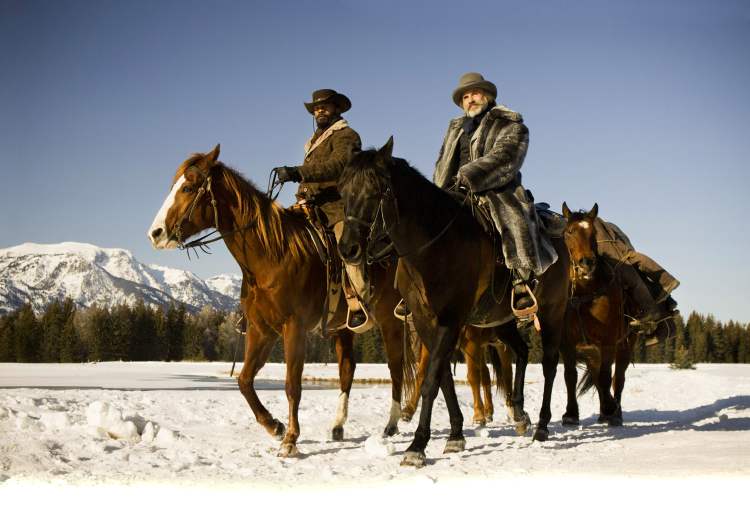
As always with Tarantino, it is wildly referential. (Hey, that zoom shot is right out of The Wild Bunch! Hey, I recognize that music from Two Mules for Sister Sarah!) But as usual, the disparate references add up to something entirely unique.
Tarantino has toyed with the genre before. The whole opening scene of Inglourious Basterds, in which Christoph Waltz’s Nazi “Jew-hunter” terrorizes a farm family, is a homage to spaghetti western director Sergio Leone, and his suspenseful staging of similar scenes in films such as The Good, the Bad and the Ugly and Once Upon a Time in the West.
The amoral universe of the spaghetti western should nicely dovetail with Tarantino’s own portrayals of the criminal milieu (Reservoir Dogs, Kill Bill, and just about everything he’s done, really).
Yet Tarantino, bless his perverse soul, eschews the usual violence for revenge, profit and fun. There is lots of that, to be sure. But his hero is on an entirely righteous mission.
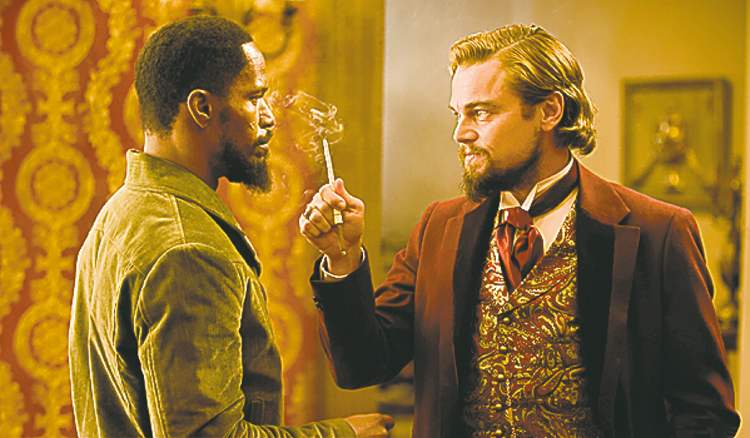
Django (Jamie Foxx) is a slave who finds himself suddenly free when he is rescued from a couple of slave traders by an unlikely saviour, Dr. King Shultz (Christoph Waltz again), a dentist-turned-bounty hunter. Shultz is tracking a trio of fraternal killers, the Brittle brothers, and he partners with Django, who can identify them. That goes well, and the two men form a formal partnership with the stipulation that Django will be free to pursue his own mission, to rescue his wife from the plantation of debauched southern aristocrat Calvin Candie (Leonardo DiCaprio).
As it happens, Django’s German-speaking wife (Kerry Washington) is named Broomhilda. The good Dr. Shultz cannot resist joining Django on his mission as it echoes the Teutonic mythology of Siegfried enduring dragons and hellfire to rescue his Brunhilde.
Tarantino loves to reward actors with their own wonderful scenes: DiCaprio offers an indelible portrait of villainy with a lecture on the bogus science of phrenology. As an elderly house slave who aids and abets Candie’s genteel depravity, Samuel L. Jackson glowers over our hero with a discussion of the worst possible punishments. Waltz gets to exercise his considerable charm in a less unnerving context than his Nazi villain in Basterds. Even Don Johnson gets in on the act as a southern plantation owner caught in an outrageously comic debate on the design flaws of a Ku Klux Klan hood.
The only actor who doesn’t really benefit from Tarantino’s largesse with actors is its star. Jamie Foxx demonstrates some expert pistol play and guts when it comes to taking on some of the story’s more outré moments. (One can see how Will Smith would not have been able to take on this role as written.) But Foxx does not quite make Django the cool hero this movie deserves.
Like the “D” in Django, Foxx’s star quality is silent.
randall.king@freepress.mb.ca
OTHER VOICES
Excerpts of select reviews of Django Unchained:
“Tarantino lives to cross the line. Is Django Unchained too much?… It wouldn’t be Tarantino otherwise.”
– Peter Travers, Rolling Stone
“I’ve always wondered whether Tarantino would finally grow up. But after seeing his latest spectacular, bloody mess of a movie, frankly, I don’t give a damn.”
– Cameron Meier, Orlando Weekly
“Tarantino, with lip-smacking down-and-dirty subversive gusto, rubs our noses in the forbidden spectacle of America’s racist ugliness.”
– Owen Gleiberman, Entertainment Weekly
“An immensely satisfying taste of antebellum empowerment packaged as spaghetti-western homage.”

– Peter Debruge, Variety
“A pastiche that’s nearly as funny as it is long, and quite as politically troubling as it may be liberating, Django Unchained is pure, if not great, Tarantino.”
– Richard Corliss, Time
“Bold, original, mesmerizing, stylish and one hell of a piece of entertainment.”
– Rex Reed, New York Observer
Our newsroom depends on a growing audience of readers to power our journalism. If you are not a paid reader, please consider becoming a subscriber.
Our newsroom depends on its audience of readers to power our journalism. Thank you for your support.
Movie review
Django Unchained
- Starring Jamie Foxx, Christoph Waltz and Leonardo DiCaprio
- Opens Christmas Day at Globe, Kildonan Place, McGillivray, McGillivray VIP, Polo Park, St. Vital
- 18A
- 166 minutes
- 4 stars out of five
Our newsroom depends on a growing audience of readers to power our journalism. If you are not a paid reader, please consider becoming a subscriber.
Our newsroom depends on its audience of readers to power our journalism. Thank you for your support.
Advertisement Advertise With Us
Advertisement Advertise With Us