Manitoba’s moving pictures
Motion pictures, now mostly forgotten, offer black-and-white view of early Manitoba
Advertisement
Read this article for free:
or
Already have an account? Log in here »
To continue reading, please subscribe:

Digital Subscription
One year of digital access for only $205*
- Enjoy unlimited reading on winnipegfreepress.com
- Read the E-Edition, our digital replica newspaper
- Access News Break, our award-winning app
- Play interactive puzzles
*First annual payment billed as $205.00 + GST for one year. This annual subscription will automatically renew at $233.00 + GST every 52 weeks (10% off the regular annual price of $259.35). Offer available to new and qualified returning subscribers only. Cancel any time.
To continue reading, please subscribe:
Add Free Press access to your Brandon Sun subscription for only an additional
$1 for the first 4 weeks*
- Enjoy unlimited reading on winnipegfreepress.com
- Read the E-Edition, our digital replica newspaper
- Access News Break, our award-winning app
- Play interactive puzzles
*Your next Brandon Sun subscription payment will increase by $1.00 and you will be charged $17.95 plus GST for four weeks. After four weeks, your payment will increase to $24.95 plus GST every four weeks.
Read unlimited articles for free today:
or
Already have an account? Log in here »
Hey there, time traveller!
This article was published 17/08/2013 (4808 days ago), so information in it may no longer be current.
The oldest known motion picture in the province features horse-drawn fire engines racing down a crowded Winnipeg downtown street and some guys jigging to a couple of banjo pickers.
What the two segments have to do with one another is anyone’s guess.
It’s called Brigade on the Run and was shot by a French filmmaker under circumstances that were as cloudy then as they are 107 years later.
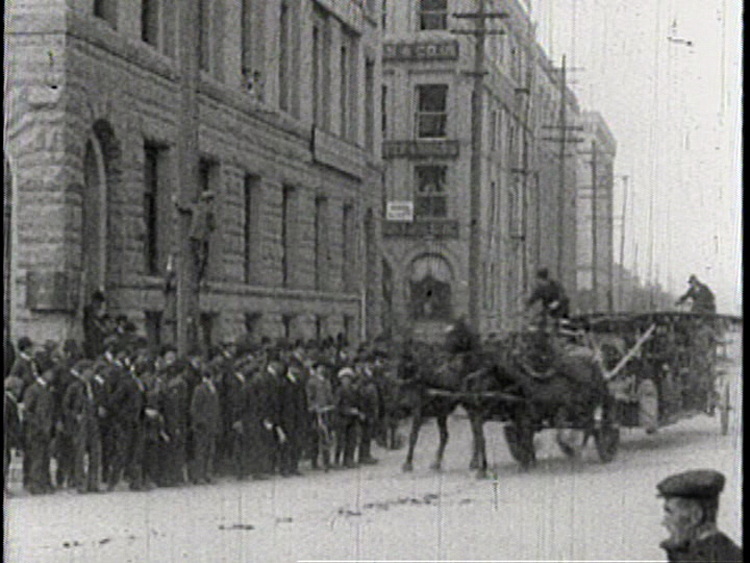
How Parisian movie-maker Leo Lefebvre convinced the then Winnipeg Fire Department to get all their men, horses and wagons out in the middle of the day and gallop down Bannatyne Avenue to Albert Street is unknown.
The Manitoba Archives is the keeper of Brigade on the Run and about a dozen other old moving pictures that depict in black and white a province and city trying to find its place in the world. They can be searched online on the Archives of Manitoba website using the format “moving images.”
Most are from the 1920s, 30s and 40s. At the time of their releases, they were watched by hundreds if not thousands. But now, with the passage of time, they sit on shelves mostly forgotten.
“They give us insight into what human nature was like at the time, what architecture was like, what the world was like,” said Gene Walz, recently retired as a professor of film studies at the University of Manitoba. “They recall an era when things were simpler, but decidedly different.”
The Free Press has selected several archival films, including Brigade on the Run, from the Manitoba Archives so that you can watch them on the comfort of your home computer or phone — and see a part of our province’s history up close.
Or as Walz said, to watch something as important as reading any historical document.
Walz said Brigade on the Run is not the oldest film in Manitoba — it’s just the oldest that’s survived.
He said the oldest films were home movies made by bartender Richard Hardie and the work of James Freer, who lived near Brandon and is credited with being one of Canada’s earliest filmmakers. Freer recorded farms and trains in the late 1890s. His work, known as Ten Years in Manitoba, was shown in the British Isles in 1898 to promote immigration to Canada. A second tour occurred in 1902 — sponsored by Sir Clifford Sifton, Canadian Minister of the Interior — to open up the prairies to new immigrants.
“None of those films exist,” Walz said. “At the time film was not thought as a permanent record.”
We’ve selected several others for your viewing pleasure — read and watch below!
Brigade on the Run (1906)
Why was it made: There are a few stories. They all sound plausible enough that they could both be true. The Manitoba Archives and accounts at the time in the Manitoba Free Press and Montreal Gazette say French film maker Leo Lefebvre came to Canada and Winnipeg on behalf of the French government and the French Geographical Society to document everyday life.
One story is that his work was to be viewed by King Edward VII so that he could see what life was like in the provinces without leaving England. The second is that Lefebvre’s work could be viewed by the public in France so that they could see Canada as a good place to emigrate because there was actually civilianization here. It wasn’t just untamed wilderness and blood-sucking bugs.
Walz said the film was also made to show that Winnipeg, which had a reputation for having catastrophic fires — a large part of downtown almost burned down in 1904 — had the latest in fire-fighting protection.
“One picture was taken immediately after an alarm had been sounded at the central fire station,” the Manitoba Free Press reported Oct. 6, 1906. “For the second picture hose wagons, engines, ladder trucks and other apparatus, headed by the chief’s rig, swing around the corner from Bannatyne Avenue to Albert Street in full gallop.
“There were several narrow escapes from collisions, teamsters insisting in stopping their horses to see the sights.”
Lefebvre told the newspaper afterwards said that “undoubtedly fine pictures had been secured.”
The fire department was the only one in North America to be photographed by Lefebvre during his visit to the continent.
“It is understood that the fireman are to be supplied with the pictures for their annual benefit, to take place at a city theatre in November,” the Free Press said.
Lefebvre lived up to his word. A copy of the two-minute film was presented to the fire department. At some point it was stuck in a box or put on a shelf and mostly forgotten until it was found in a city fire hall in 1965. It later made its way into the archives.
Walz said the film was shot when visiting firefighters from North Dakota came to see Winnipeg’s new fire-fighting equipment, including high-pressure hoses.
He said what’s historically unique about Brigade on the Run is that it depicts a city in which men made up almost three-quarters of the population and most if not all wore jackets and ties every day, even when they were digging ditches.
Winnipeg Fire Department platoon chief Ted Kuryluk, also president emeritus of the firefighter’s museum, said Brigade on the Run is significant because it shows in detail the equipment firefighters used at the time, from their long horse-drawn ladder wagons to steam-powered fire engines used to pump water.
“It does set the tone for what firefighting was like back in that day,” Kuryluk said. “The ladder truck that you see, it actually had two drivers. There was a driver for the front for the horses and there was a driver at the back. That was called the tiller. The tillerman steered it from the back. Getting around a corner with just the horse driver would be quite difficult, because it had a hugely long wheel base. That tillerman was able to steer the back so that they would be able to make tight corners and get into tight spots.”
The archives, citing a 1906 article in Optical Lantern and Kinematograph Journal, says Lefebvre was actually commissioned by the Canadian government. The article stated that, “The views will be shown all over France with the idea of stimulating emigration, and removing the common conception existing in France, of Canada, as a place with an Arctic climate.”
Lefebvre filmed in other parts of North America, including New York, Ontario, Quebec, Ottawa and possibly Alberta and British Columbia. The footage was meant to be edited by French company Pathé Brothers and shown in France, as well as other parts of the world, in part to also attract farmers to Canada.
The Montreal Gazette reported Sept. 16, 1906 that Lefebvre was at the CPR office making plans for a cross-country trip to, “take a large moving pictures as well as ordinary photographs.
“Mr. Lefebvre will leave today on the CPR train and will have his moving picture machine fastened on the rear platform, whence he will secure a large series of views.”
Lefebvre told the newspaper that by special arrangement with the French Geographical Society, that next Christmas he had to exhibit moving pictures before King Edward at Buckingham Palace as he could not make the trip himself.
Who’s in it: Members of the Winnipeg Fire Department, its horses, a group of smiling men clapping and dancing on the street, one assumes to the music of two other men playing banjos. There are also street scenes of Winnipeg.
Best line: None: It’s a silent movie. The are several title cards, or intertitles, to explain to the audience what they’re watching.
Running time: 2:37
brightcove.createExperiences();
Seaport of the Prairies (1925)
Why was it made: This is probably one the more ambitious movies about Manitoba history if not Canadian. It depicts a train trip by Saskatchewan and Manitoba politicians and businessmen (and Manitoba Free Press reporter H.B. Guest) from The Pas north along the Hudson Bay rail line that hugged the Nelson River. The line was built in 1910-11, but not finished. The intent was to go all the way to what was called the Port Nelson at the mouth of the Nelson at Hudson Bay.
University of Winnipeg Filmmaking and History of Film professor Howard Curle said Seaport was made as an promotional film as were many films of the era. They were not so much as to entertain, but to explain to an audience a new idea or technology.
He said it also uses a technique of placing a camera on the front of the train, creating images known as a phantom ride.
“The technique was already well-established,” Curle said. “It was very popular.”
Where the rail line ended at Kettle Rapids near Gillam the party of almost two dozen men got into canoes paddled by “hardy” Cree Indians to a few kilometres short of their destination at the mouth of the Nelson River at Hudson Bay. Government boats took them the rest of the way.
The expedition and film were put together to restart efforts to develop Port Nelson, described in the film as “the hope of Western Canada.” Port Nelson was later called one of the most colossal mistakes of government. Ever.
At the time, the development of the port was one of the most ambitious public projects ever undertaken in Canada. The dream was to allow prairie farmers and big grain companies a direct route to ship their wheat around the world. Plus develop the north.
That was the plan, anyway.
A couple of things got in the way. The First World War broke out in 1914 and resources such as steel, coal, ships and men had to go towards the war effort. Port Nelson also proved difficult to tame. The river’s currents and the bay’s tides were behind several ship wrecks during construction. One wreck involved a specially-made 1,155-ton ocean-going dredger washed ashore during a storm in 1924. It’s still there.
Governments also changed. And what was considered an Herculean engineering feat a decade earlier saw Port Nelson abandoned in 1918 in favour of Churchill, which opened in 1931.
The full story of Port Nelson and the Hudson Bay Railway is on the Manitoba Historical Society’s website.
Seaport of the Prairies was produced by a group called the North Country Tourist Association, ostensibly to promote Manitoba’s north as a place of tourism and commerce — well before the Nelson was harnessed for hydro development.
However, it appears more so Seaport of the Prairies was simply made to lobby for work on Port Nelson to continue over going further north to Churchill.
Once Seaport was released, not much was heard from the North Country Tourist Association again. In following months, questions were raised in the legislature on who paid for the trip. Filmmaker Frank Holmes, who went on to become one of the province’s most prolific filmmakers, also had to go to court to get paid.
In the end, the participants on the excursion to Port Nelson had an adventurous trip, but Seaport of the Prairie had little if any political value.
Who’s in it: MLA William Ivens, a leader in the 1919 Winnipeg General Strike, MLA Nicolas Bachynsky, MLA George Compton, MLA James Breakey, Moose Jaw Mayor W.W. Davidson and former Winnipeg mayor Charles Gray.
Best line: None. It’s a silent movie. Intertitles provide narration.
Running time: One hour, four minutes.
brightcove.createExperiences();
Winnipeg Free Press Champions of Safety (1939)
Why it was made: While the Winnipeg Free Press was training young men to be school patrols, saving young children from automobiles and streetcars, Adolf Hitler was training young men in Germany to kill them.
In the current technological and social media age, the Free Press routinely produces six to 10 videos a week.
But Champions of Safety is the paper’s first, produced eight decades earlier.
It’s not known who produced it, but it depicts several events hosted by the newspaper to reward the patrols for their efforts. The safety patrol program started in 1936 and been sponsored by the Free Press since. The film was also used by the Winnipeg Police Department to promote the safety program.
Walz, who’s writing a book about the history of filmmaking in Manitoba, said it was filmed by Ken Davey, another prolific local filmmaker who was known for prodigiously recording the early Winnipeg Blue Bombers.
The film shows the patrols at work at Selkirk and Arlington, marching down Portage Avenue past The Hudson’s Bay Company department store, watching a Blue Bomber game at Osborne Stadium, now the site of Great-West of Life, and a picnic event at Assiniboine Park.
Who’s in it: Winnipeg Mayor John Queen, Winnipeg Police Chief George Smith
Best line: “Unlike the youth of Europe, this line of marching feet is intent upon saving lives rather than taking them.”
Running time: About five minutes
brightcove.createExperiences();
49th Parallel (1941)
Why it was made: This Second Wolrd War drama shows the sinking of a U-boat in Hudson Bay and how the surviving Nazi crew try to get back to Germany. Along the way they meet a whole bunch of Canadians, including Trapper Johnny, a devote Québécois played by young, over-the-top Laurence Olivier.
There are numerous Winnipeg and Manitoba references throughout and despite it’s age, it’s not that bad of a film.
It was produced by British writer-director team of Michael Powell and Emeric Pressburger in an effort to stir up American support for the war on Germany. At that time, the United States was not involved in the war in Europe or in the Far East. That changed two months after 49th Parallel was released — Pearl Harbor was attacked and the U.S. declared war on both Japan and Germany.
The film’s story follows the surviving U-boat crewmen as they kill their way south from a northern Hudson’s Bay Company outpost to Winnipeg. Along the way they stop at a Hutterite colony outside of Winnipeg.
Through it all, the film preaches that Canadians, be they French Canadian, Inuit, Hutterite, aboriginal, rich eccentrics, whatever, are a pretty decent bunch who have one thing in common — they don’t like Hitler’s Nazis one bit.
Walz said while somewhat of a “hokey” portrayal of the province and Canada, 49th Parallel is more appreciated now by film buffs as it was when it was first released.
Best line: “Because I’m not asking for those pants; I’m just taking them.”
Running time: Two hours, three minutes
You can also watch it on YouTube.
To watch other old films, The University of Manitoba has moved its archived “moving pictures” to YouTube.
For example, check out public health nursing as it was in 1921:
Or review 1948’s Santa Claus parade:
bruce.owen@freepress.mb.ca
History
Updated on Tuesday, August 20, 2013 10:48 AM CDT: Removes erroneous reference to being able to download film clips.