Was Dutch master Vermeer a painter or an illusionist?

Advertisement
Read this article for free:
or
Already have an account? Log in here »
To continue reading, please subscribe:

Digital Subscription
One year of digital access for only $205*
- Enjoy unlimited reading on winnipegfreepress.com
- Read the E-Edition, our digital replica newspaper
- Access News Break, our award-winning app
- Play interactive puzzles
*First annual payment billed as $205.00 + GST for one year. This annual subscription will automatically renew at $233.00 + GST every 52 weeks (10% off the regular annual price of $259.35). Offer available to new and qualified returning subscribers only. Cancel any time.
To continue reading, please subscribe:
Add Free Press access to your Brandon Sun subscription for only an additional
$1 for the first 4 weeks*
- Enjoy unlimited reading on winnipegfreepress.com
- Read the E-Edition, our digital replica newspaper
- Access News Break, our award-winning app
- Play interactive puzzles
*Your next Brandon Sun subscription payment will increase by $1.00 and you will be charged $17.95 plus GST for four weeks. After four weeks, your payment will increase to $24.95 plus GST every four weeks.
Read unlimited articles for free today:
or
Already have an account? Log in here »
Hey there, time traveller!
This article was published 09/05/2014 (4537 days ago), so information in it may no longer be current.
Two questions arise from the documentary Tim’s Vermeer.
One: How did Dutch master Johannes Vermeer paint pictures with almost photo-realistic detail in the 17th century?
Two: Why is the film on the subject produced and directed by the magician duo Penn and Teller?
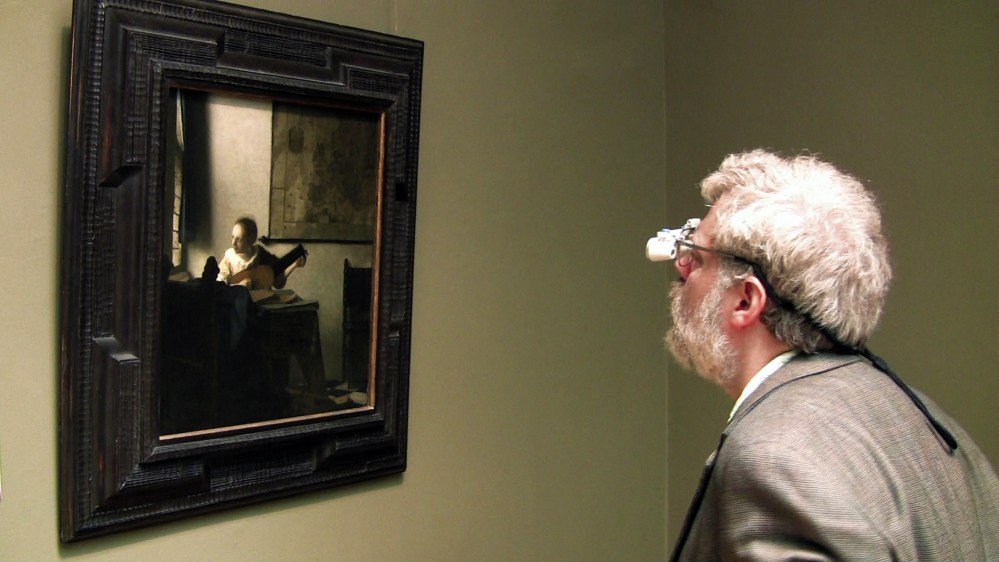
To answer the second one first, Penn and Teller are illusionists, yes, but they have also been in the business of revealing the mechanics behind illusions.
And the first question? Instead of buying into the accepted notion that Vermeer was simply gifted with a dazzling visual genius, the magicians suggest that technology was available in the 17th century that would have given Vermeer the ability to create his paintings with a proto-photographic technique.
As luck would have it, producer Penn Jillette’s friend, inventor Tim Jenison, came up with a precise model of how Vermeer might have done it, incorporating a huge glass lens, a camera obscura projection system and a mirror.
Better: Jenison, a self-made success owing to his invention of digital video breakthroughs, could fund his own project to recreate the Vermeer painting The Music Lesson, in spite of his claim he has no artistic talent.
The effort required Jenison to reconstruct a 400-year-old Dutch drawing room in a Texas facility, right down to the tapestry, rugs, plastered walls and the intricately designed virginal (harpsichord). Once completed, Jenison proceeded to reproduce the painting itself, brush stroke by brush stroke, over the better part of a year.

Supportive of Jenison’s project is artist David Hockney, who has long theorized about Vermeer’s use of technology.
Jenison’s project has been deemed controversial, with some critics horrified at the suggestion that Vermeer was more of a technician than a real artist. On that score, Penn and Teller are remiss in digging up any stuffy art academics to repudiate Jenison’s theory.
The film could make a stronger case that Vermeer’s genius was revealed not in how he painted, but in what he chose to paint. Even a photographer gets credits for his or her use of light, colour and composition.
Nevertheless, the film is a fascinating piece of work that accomplishes its primary goal: it prompts a provocative reconsideration of art history as we know it, and it does so with a touch of wit and a healthy helping of awe.
randall.king@frepress.mb.ca
Our newsroom depends on a growing audience of readers to power our journalism. If you are not a paid reader, please consider becoming a subscriber.
Our newsroom depends on its audience of readers to power our journalism. Thank you for your support.
Tim’s Vermeer
Directed by Teller
Globe
G
80 minutes
3 1/2 stars out of five
Other voices:
You might think that following this insanely ambitious DIY project would be like watching paint dry. Wrong.
— Colin Covert, Minneapolis Star Tribune
Tim’s Vermeer is about many things — art history, technology, painting technique, beauty — but ultimately it’s a beguiling study of fascination.
— Moira MacDonald, Seattle Times
Tim’s Vermeer is a movie for people who like to think, who like to ponder the big questions surrounding art and the act of creation.
— Bill Goodykoontz, Arizona Republic
Shooting in unattractive, hard-edge digital, Teller condenses Mr. Jenison’s years-long pursuit into 80 glib, alternately diverting, exasperating and tedious minutes.
— Manohla Dargis, New York Times
Our newsroom depends on a growing audience of readers to power our journalism. If you are not a paid reader, please consider becoming a subscriber.
Our newsroom depends on its audience of readers to power our journalism. Thank you for your support.
Advertisement Advertise With Us
Advertisement Advertise With Us