Jingle Bells …his butt!
Canadian filmmaker wants you to have a very alt Christmas

Advertisement
Read this article for free:
or
Already have an account? Log in here »
To continue reading, please subscribe:

Digital Subscription
One year of digital access for only $205*
- Enjoy unlimited reading on winnipegfreepress.com
- Read the E-Edition, our digital replica newspaper
- Access News Break, our award-winning app
- Play interactive puzzles
*First annual payment billed as $205.00 + GST for one year. This annual subscription will automatically renew at $233.00 + GST every 52 weeks (10% off the regular annual price of $259.35). Offer available to new and qualified returning subscribers only. Cancel any time.
To continue reading, please subscribe:
Add Free Press access to your Brandon Sun subscription for only an additional
$1 for the first 4 weeks*
- Enjoy unlimited reading on winnipegfreepress.com
- Read the E-Edition, our digital replica newspaper
- Access News Break, our award-winning app
- Play interactive puzzles
*Your next Brandon Sun subscription payment will increase by $1.00 and you will be charged $17.95 plus GST for four weeks. After four weeks, your payment will increase to $24.95 plus GST every four weeks.
Read unlimited articles for free today:
or
Already have an account? Log in here »
Hey there, time traveller!
This article was published 11/12/2014 (4313 days ago), so information in it may no longer be current.
Canadian filmmaker Mitchell Kezin takes a page from his fellow Canuck documentarian Alan Zweig in his modus operandi.
1. Find a funny, multifaceted subject with a guaranteed supply of entertaining interview subjects.
2. Find a way to make said subject illuminate your own neuroses.

As Zweig found his voice on the subject of record-collecting with his film Vinyl, Kezin debuts with a movie about his own obsession, one that sees him in the opening scene scuttering around on the floor of the great Amoeba music store in L.A., frantically gathering CDs and vinyl records as closing time ticks ever nearer.
Kezin’s fetish is alternative Christmas music. At a time of year when the airwaves are filled with a million interpretations of done-to-death standards such as White Christmas and Rudolph the Red-Nosed Reindeer (the two bestselling singles of all time, by the way), it’s a relief that Kezin’s tastes run more towards Run DMC’s Christmas in Hollis, Bob Dorough’s dyspeptic Blue Xmas, or Free Design’s sanctimonious hippie carol Close Your Mouth (It’s Christmas).
Kezin’s search for other cultists brings him into the company of music producer Bill Adler, who has celebrated the season every year with his personalized compilations of alternative seasonal music he sends to friends. (“I’m not opposed to songs about Jesus, but as a Jew, I tend to favour Santa Claus,” he says.)
Kezin not only uncovers like-minded enthusiasts, but the artists themselves, including Dorough (best known as the songwriter behind Schoolhouse Rock), who describes his unexpected collaboration with Miles Davis on the decidedly downbeat Blue Xmas, decrying the commercialism and bad taste of contemporary Christmas, circa 1962.
Bluesman Clarence Carter is still around to discuss and perform his naughty but nice Christmas song Back Door Santa (“I ain’t like old St. Nick/ He don’t come but once a year”).
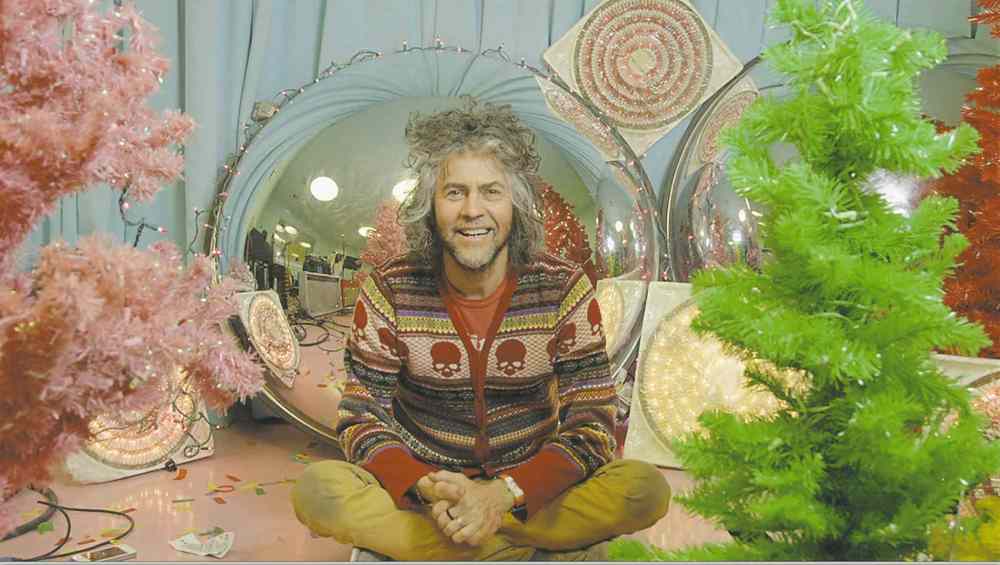
The Flaming Lips’s frontman Wayne Coyne shines his own psychedelic gels on the topic, describing, among other things, his mom’s description of a weird Christmas movie she watched while half-asleep on the couch. (After failing to find it, he concluded the plot as described was a mishmash of different movies she saw while drifting in and out of consciousness. It didn’t stop Coyne and the Lips from releasing their own version of the movie, Christmas on Mars, in 2008.)
Filmmaker and novelty-song zealot John Waters is another dependably droll subject on the strength of his own 2004 compilation A John Waters Christmas. That collection, in turn takes us to the one-off holiday song Santa Claus Is a Black Man, recorded in 1973 by a little girl named Akim, who, as an adult, affectionately describes the making of the record.
Some childhoods were not as happy. Case in point: director Kezin, who eventually traces his own seasonal music obsession to a Nat King Cole recording of The Little Boy That Santa Claus Forgot, a sublimely lugubrious tune about a kid who, through no fault of his own, was stiffed for presents at Christmas time.

Kezin describes himself at the age of six, unclear on the concept of records, listening and re-listening to the song in the hopes that the story would end more happily. (It didn’t.) For Kezin, the emotions of that time are wrapped up in his own father’s departure from the family. To give himself some closure (and to give his movie an ending), Kezin and Adler convince a Brooklyn record producer to record a Calypso-flavoured version of The Little Boy That Santa Claus Forgot, sung by Mighty Sparrow.
The producer and artists look bemused by the whole experience, but Kezin is clearly ecstatic. That dynamic is reminiscent of the Zweig doc When Jews Were Funny, when some of Zweig’s interview subjects got wise to the fact that the doc was less an analysis of Jewish comedy and more about Zweig’s nostalgia for an era gone by.
But as in Zweig’s film, Kezin’s doc manages to rise above his own personal issues with its embrace of the unconventional in a musical sub-genre where convention is prized above all.
CKUW DJ Stu Reid, a legendary local Christmas music aficionado, will introduce the Dec. 11 and 12 screenings of Jingle Bell Rocks.
randall.king@freepress.mb.ca
Our newsroom depends on a growing audience of readers to power our journalism. If you are not a paid reader, please consider becoming a subscriber.
Our newsroom depends on its audience of readers to power our journalism. Thank you for your support.
Movie review
Jingle Bell Rocks!
- Directed by Mitchell Kezin
- Cinematheque
- PG
- 94 minutes
- 3 1/2 stars out of five
Our newsroom depends on a growing audience of readers to power our journalism. If you are not a paid reader, please consider becoming a subscriber.
Our newsroom depends on its audience of readers to power our journalism. Thank you for your support.
Related Articles
Rhythm & blues
Advertisement Advertise With Us
Advertisement Advertise With Us