Fighting a post-fact narcissist
What ought to be a topical story is too distant to satisfy

Advertisement
Read this article for free:
or
Already have an account? Log in here »
To continue reading, please subscribe:

Digital Subscription
One year of digital access for only $205*
- Enjoy unlimited reading on winnipegfreepress.com
- Read the E-Edition, our digital replica newspaper
- Access News Break, our award-winning app
- Play interactive puzzles
*First annual payment billed as $205.00 + GST for one year. This annual subscription will automatically renew at $233.00 + GST every 52 weeks (10% off the regular annual price of $259.35). Offer available to new and qualified returning subscribers only. Cancel any time.
To continue reading, please subscribe:
Add Free Press access to your Brandon Sun subscription for only an additional
$1 for the first 4 weeks*
- Enjoy unlimited reading on winnipegfreepress.com
- Read the E-Edition, our digital replica newspaper
- Access News Break, our award-winning app
- Play interactive puzzles
*Your next Brandon Sun subscription payment will increase by $1.00 and you will be charged $17.95 plus GST for four weeks. After four weeks, your payment will increase to $24.95 plus GST every four weeks.
Read unlimited articles for free today:
or
Already have an account? Log in here »
Hey there, time traveller!
This article was published 22/10/2016 (3624 days ago), so information in it may no longer be current.
American historian Deborah Lipstadt refuses to debate Holocaust deniers. She believes engaging with them can suggest the terrible, fundamental fact of the Holocaust is somehow up for dispute.
But when Lipstadt was sued for defamation in 1996 by English Holocaust denier and professional provocateur David Irving, she ended up being dragged into a long, expensive and emotionally draining ordeal that effectively put history on trial.
These events have been turned into a sometimes intriguing but ultimately unsatisfying drama, directed by Mick Jackson (Temple Grandin) and scripted by David Hare (The Reader), the English playwright and screenwriter.
Hare has spoken about his horror of “sentimentalizing” the Holocaust, and he keeps things crisp, cool and rather distant. This strategy might have paid off if he had created a taut legal procedural or a sparky exchange of ideas, but the script struggles to connect its potent parts into a compelling whole.
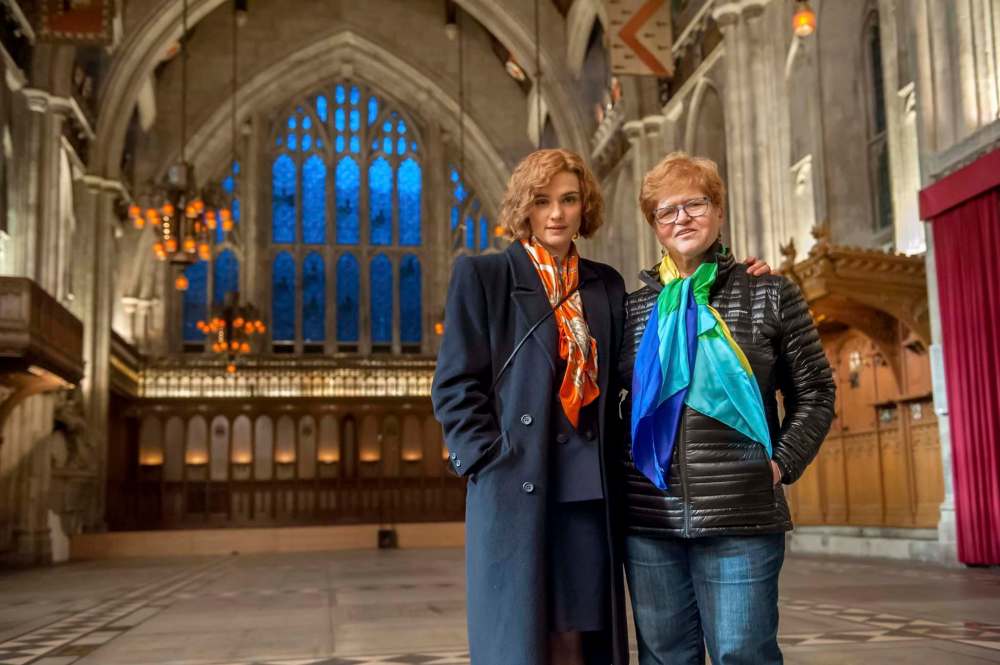
Rachel Weisz plays Lipstadt. A busy academic at Emory University in Atlanta, she has recently launched her book Denying the Holocaust: The Growing Assault on Truth and Memory, which includes references to Irving as a Holocaust denier. (Among other things, Irving has characterized Auschwitz as a labour camp with an unusually high death rate.)
Irving brings a libel suit against Lipstadt, claiming she has threatened his reputation. Because of the oddities of the British legal system, the burden of proof is on the defendant in libel actions. Lipstadt hires a legal team, headed by Anthony Julius (Andrew Scott, Sherlock’s Moriarty), who just happens to be the author of a book on T.S. Eliot and anti-Semitism — as well as a top solicitor, having represented Diana, the Princess of Wales, in her divorce.
Tom Wilkinson turns in a characteristically thoughtful performance as Richard Rampton, Lipstadt’s courtroom barrister, who expertly boxes in Irving using his own words.
The dark hole at the centre of the story, though, is Irving. Timothy Spall (Mr. Turner) gives a morbidly fascinating portrayal of a pompous, attention-hungry narcissist. Publicly, Irving projects a queasy veneer of respectability and joviality, but he’s haunted by secret insecurity.
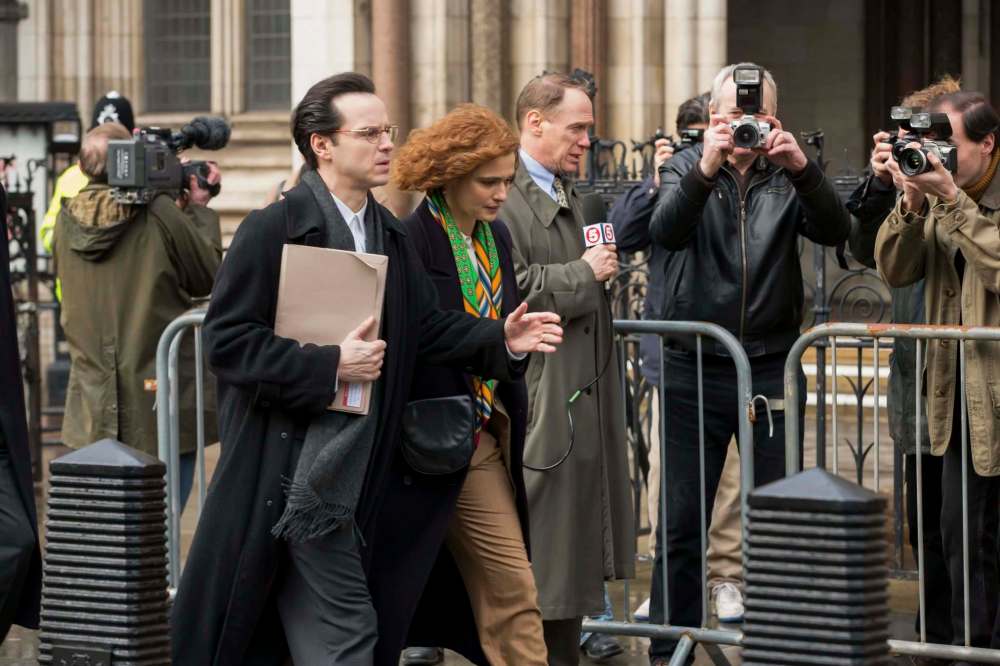
Irving’s dilemma, according to Julius, is that he wants to be both a maverick outsider and a member of the club. “England is a club, Deborah,” Julius tells his client, hinting at the boundaries of privilege and class.
Lipstadt, of course, is another kind of outsider. With a broad Queens accent and a rather obvious wig, Weisz gives a passionate and earnest performance, but too many scenes involve her fired-up Americanness running smack into British reserve. In one supremely awkward sequence, her matter-of-fact New York ways reduce an entire dining table of English people to appalled silence.
The story doesn’t work as personal or emotional drama and it falls short as a drama of ideas. Denial ought to feel topical and timely, since we are witnessing the implications of an increasingly “post-factual” public discourse, where pseudo-science, conspiracy theories, galloping distrust of evidence-based knowledge and outright lies have gained increasing traction, allowing extremist ideas to enter mainstream discussion.
Lipstadt, along with the filmmakers, argues that while historical interpretations of events often vary, there are facts that possess indisputable objective truth. Unfortunately, this important argument doesn’t translate into any sense of cinematic urgency.
At one point during Denial, Lipstadt laments that the courtroom is not the best place to assess history. The movie theatre doesn’t always work that well, either.
alison.gillmor@freepress.mb.ca
Studying at the University of Winnipeg and later Toronto’s York University, Alison Gillmor planned to become an art historian. She ended up catching the journalism bug when she started as visual arts reviewer at the Winnipeg Free Press in 1992.
Our newsroom depends on a growing audience of readers to power our journalism. If you are not a paid reader, please consider becoming a subscriber.
Our newsroom depends on its audience of readers to power our journalism. Thank you for your support.
Movie review
Denial
Starring Rachel Weisz and Timothy Spall
Grant Park
PG
110 minutes
★★★ out of five
Other voices
The picture is methodically constructed, to the point that it’s sometimes dull. But here and there it sets off a mini charge, building up to a subtly satisfying conclusion.
— Stephanie Zacharek, Time
Awaiting the verdict makes for a real nail-biter, even knowing the outcome. Denial does a stellar job demonstrating the truth is worth fighting for.
— Peter Howell, Toronto Star
A British courtroom drama that’s an election year reminder that America doesn’t have the market cornered on “deplorables.”
— Roger Moore, Movie Nation
You wonder if the material would have been more effective as a courtroom procedural adapted for the stage.
— Stephen Holden, New York Times
The film is talky and well-mannered, which are not usually the highest of compliments. But it works.
— Claudia Puig, TheWrap
Studying at the University of Winnipeg and later Toronto’s York University, Alison Gillmor planned to become an art historian. She ended up catching the journalism bug when she started as visual arts reviewer at the Winnipeg Free Press in 1992.
Our newsroom depends on a growing audience of readers to power our journalism. If you are not a paid reader, please consider becoming a subscriber.
Our newsroom depends on its audience of readers to power our journalism. Thank you for your support.
Related Articles
Denial's real-life scholar is a born leader
Advertisement Advertise With Us
Advertisement Advertise With Us