Observing alienation in modern America
Meditation on violence shows its hand
Advertisement
Read this article for free:
or
Already have an account? Log in here »
To continue reading, please subscribe:

Digital Subscription
One year of digital access for only $205*
- Enjoy unlimited reading on winnipegfreepress.com
- Read the E-Edition, our digital replica newspaper
- Access News Break, our award-winning app
- Play interactive puzzles
*First annual payment billed as $205.00 + GST for one year. This annual subscription will automatically renew at $233.00 + GST every 52 weeks (10% off the regular annual price of $259.35). Offer available to new and qualified returning subscribers only. Cancel any time.
To continue reading, please subscribe:
Add Free Press access to your Brandon Sun subscription for only an additional
$1 for the first 4 weeks*
- Enjoy unlimited reading on winnipegfreepress.com
- Read the E-Edition, our digital replica newspaper
- Access News Break, our award-winning app
- Play interactive puzzles
*Your next Brandon Sun subscription payment will increase by $1.00 and you will be charged $17.95 plus GST for four weeks. After four weeks, your payment will increase to $24.95 plus GST every four weeks.
Read unlimited articles for free today:
or
Already have an account? Log in here »
Hey there, time traveller!
This article was published 22/04/2017 (3448 days ago), so information in it may no longer be current.
Everyone in Dark Night seems terribly alone — even the people who aren’t.
In the opening moments, a teenager stares blankly out at a mall parking lot, her eyes reflecting, but barely registering, the flashing red-and-blue lights of a police car.
In another scene, two skateboarding kids keep slipping past each other, back and forth, never quite managing to inhabit the same frame.
In writer-director Tim Sutton’s hypnotically eerie new movie, togetherness is just another form of isolation.
Set over the course of one hot Florida day, Dark Night is a suburban symphony, at once menacing and dreamlike, on the theme of alienation.
Disconnection informs the film’s very structure: the movie is a loosely woven patchwork of unrelated characters — a mother and her video-game-addicted son, a beauty-obsessed teen, a young man driving around town, two girls playing the guitar — glimpsed in their mostly private moments.
Sutton, who brought a similar sense of documentary-inflected experimentation to his 2014 feature, Memphis, here interrogates the gap between the real world and the one that stares back at us from our personalized screens — a cellphone selfie, a first-person shooter video game or a stream of interlinked Google Street View images. But he is also interested in the terrifying break with reality that eventually pushes one individual to take up arms and open fire inside a crowded movie theater.
The crime itself is left to our imagination; violence is largely critiqued through its very absence. But an undercurrent of menace runs almost imperceptibly throughout. Sutton spends about 80 minutes setting the stage for a copycat version of the shooting that took place in Aurora, Colo., in 2012, during a showing of the Batman movie The Dark Knight Rises. The title of Dark Night offers a blunt echo of that tragedy, even if our bloodthirsty, bullet-riddled Hollywood cinema is but one of several possible targets being entertained here.
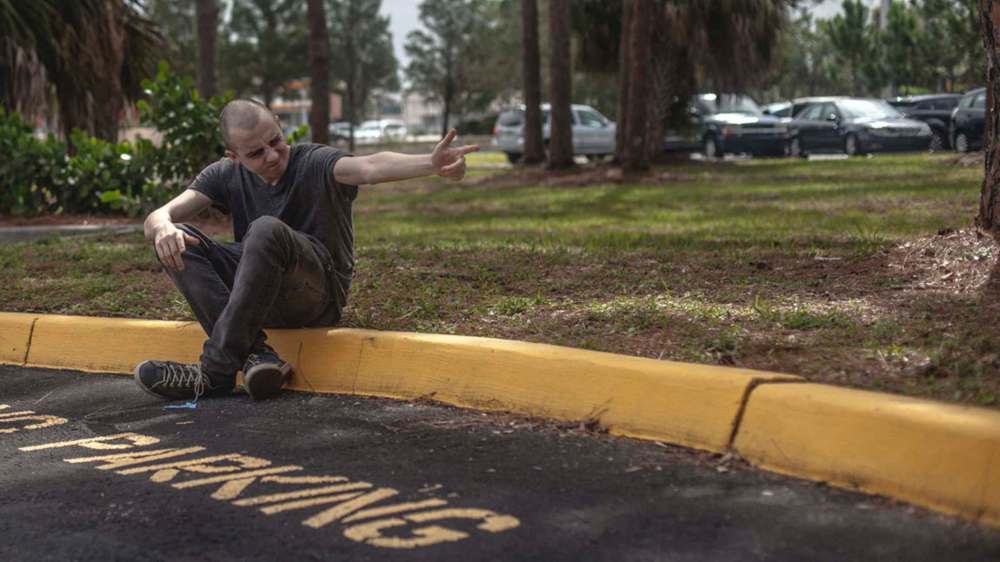
The question of whodunit (or who-will-do-it), compelling though it may be, is one of the film’s queasier gambits. Sutton can’t resist showing us a young man dyeing his hair bright orange, or an Iraq War veteran cleaning his guns, and daring us to guess which of them (or someone else?) will snap in the end. A couple of dramatic fake-outs — one tense, the other startling — achieve the desired aim of rattling the viewer’s nerves, but Dark Night is strongest when it sets suspense and motivation aside and simply drifts alongside its characters in what will be, for many of them, their final moments.
The influence of Elephant, Gus Van Sant’s coolly estheticized 2003 drama inspired by the Columbine shootings, is unmistakable. It’s there in the gentle, gliding movements of the camera (wielded by the superb French cinematographer Hélène Louvart), and also in the presence of an invisible narrative hand that, for all its ostensible detachment, can’t help but betray its own ideas and assumptions about what it shows us.
Sutton’s vision is unsettling and immersive, his technical precision immaculate. The sound design alone — long, ambient silences disrupted by a flashbulb-popping hallucination or a sudden scream — is reason enough to see the movie in a theatre, whatever unpleasant associations the ending may conjure.
But the virtues of a mood piece are not always those of a sociological document, and even if there weren’t a horrific tragedy waiting in the wings, Dark Night would make for troubling viewing, and not always for the reasons it would like.
Nearly every moment of the movie — much of it accompanied by the dolorous crooning of Maica Armata, who composed the score — speaks to the hollowness, the imaginative poverty and emotional constriction of these young people’s lives.
That assessment might well be correct, but it feels less like a discovery than something that was concluded at the outset.
— Los Angeles Times
Movie review

Dark Night
Directed by Tim Sutton
Cinematheque
PG
80 minutes
3 1/2 stars out of five
Advertisement Advertise With Us
Advertisement Advertise With Us